Practice Essentials
The fire ant is a wingless member of the order Hymenoptera, which includes wasps and bees. It is a potentially lethal environmental hazard in the United States, infesting more than 310 million acres of land. Fire ants are resistant to control efforts and can overwhelm an environment. They damage farm equipment, electrical systems, irrigation systems, and land. They build mounds in sunny, open areas (eg, lawns, playgrounds, parks, golf courses) and aggressively attack anyone who disrupts their mound. See the images below.
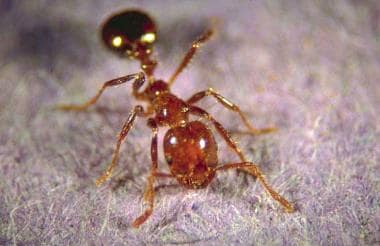 Red imported fire ant worker. From http://fireant.tamu.edu. Reproduced with permission from B.M. Drees, Texas Imported Fire Ant Project Coordinator, Texas A&M University, College Station, Texas.
 Fire ant mound in lawn. From http://fireant.tamu.edu. Reproduced with permission from B.M. Drees, Texas Imported Fire Ant Project Coordinator, Texas A&M University, College Station, Texas.
Fire ants are thought to have arrived in the United States between 1918 and the 1930s from South America by ships that docked in Mobile, Alabama. [1] They are now found throughout the Southeast and are migrating rapidly. One contributing factor to this expansion is progressive urbanization in the United States, which creates the type of disturbed habitat that the fire ants prefer. [2] Their mobility and ability to establish colonies in diverse habitats makes the detection of new infestations difficult. Sometimes, colonies exist several years before detection.
Each year, fire ants sting more than one half of the population in endemic areas of the Southeast. They cause a variety of medical problems, including increasing numbers of hypersensitivity reactions, secondary infections, neurologic complications, and even death. [3, 4, 5]
Prognosis
Minor reactions have an excellent prognosis. Severe reactions have an excellent prognosis with early and appropriate treatment. However, fire ants are becoming an increasingly important public health concern in the United States. More than 80 fatalities have been reported from fire ant-induced anaphylaxis.
Diagnostics
See Workup.
Treatment
See Treatment.

Background
Pathophysiology
The fire ant uses its mandibles to grasp its victim. It arches its body and drives an abdominal stinger into the skin to release venom. If not quickly removed, it then pivots around its mandibles and inflicts further stings in a circular pattern.
The stinger is a modified ovipositor that consists of a dorsal stylet and two ventrolateral lancets. These structures surround the venom canal, which connects to the venom sac. A pair of coiled glands produces the venom that discharges into the venom sac. See the image below.
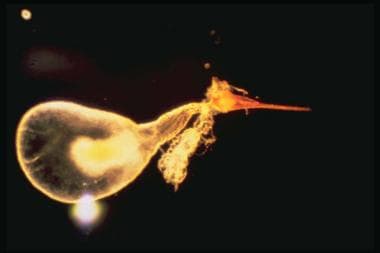 Venom sac and stinger of a fire ant. From http://fireant.tamu.edu. Reproduced with permission from B.M. Drees, Texas Imported Fire Ant Project Coordinator, Texas A&M University, College Station, Texas.
Fire ant venom differs from bee and wasp venom, which are mostly proteinaceous solutions. About 95% of fire ant venom is water-insoluble, is nonproteinaceous, and contains dialkylpiperidine hemolytic factors. These hemolytic factors induce the release of histamine and other vasoactive amines from mast cells, resulting in a sterile pustule at the sting site. These alkaloids are not immunogenic, but their toxicity to the skin is believed to cause the pustules to form.
The venom also contains several allergenic proteins, measuring about 1.5% by dry weight. [6] Four major allergenic proteins exist; Soli 1-4 induce immunoglobulin E (IgE) responses, including anaphylaxis, in patients who are allergic. [7] Antigenic similarity exists between these proteins and bee and wasp venoms.
Many patients have venom-specific IgE-mediated wheal and flare reactions that develop over hours into pruritic edematous, indurated, and erythematous lesions that persist for up to 72 hours. These lesions may involve an entire extremity. They histologically resemble late-phase mast cell–dependent reactions and show an infiltrate of eosinophils, neutrophils, and fibrin deposition. Large, local reactions rarely can cause edematous tissue compression, leading to vascular compromise of an extremity.
Etiology
The fire ant prefers open, sunny areas, such as pastures, parks, lawns, playgrounds, golf courses, and fields. Colonies also occur in or around buildings. Mound building increases considerably during warm months of the year when soil is moist. Concentrations in some areas exceed 200 mounds per acre. Several risk factors have been identified.
Immobility
Infants and elderly persons have an increased risk of fire ant stings, as do others with decreased mobility or an inability to defend themselves, such as persons who are inebriated and fall asleep on or near a mound. Massive sting attacks by fire ants have occurred in nursing home residents. Infants are unable to defend themselves from attacks. [8]
Immobilized people are likely to have numerous stings when exposed to fire ants. In these situations, determining the source of the fire ants and exterminating them are essential.
Diabetes mellitus
Persons with diabetes are at an increased risk of secondary infection of a sting site because of potential circulatory or neurosensory compromise of the extremities.
Secondary infection of a sting site may lead to pyoderma or sepsis.
Alcoholism [9]
Several cases of severe fire ant stings have been reported in people who are alcoholics, often secondary to alcohol-induced unconsciousness.
One case involved a person with alcoholism who fell asleep in a ditch and apparently used a fire ant mound as a pillow. He was hospitalized hours later with about 5000 pustules from fire ant stings on his face, trunk, and extremities that eventually healed with scarring.
Previous sensitization
Systemic reactions typically occur in patients previously sensitized to fire ant stings.
Individuals with no previous exposure can have anaphylactic reactions after their first sting. Most of these patients are previously sensitized to yellow jacket venom.
Epidemiology
US frequency
Because most fire ant stings are not severe enough to cause the victim to seek medical attention, estimating the frequency of stings is difficult; however, annually, more than one half of the population in endemic areas is stung, and the incidence appears to be increasing. Approximately 367,000,000 acres are infected, and the areas include Alabama, Arkansas, California, Florida, Georgia, Louisiana, Mississippi, New Mexico, North Carolina, Oklahoma, South Carolina, Tennessee, Texas, Virginia, and Puerto Rico. [10]
See the image below.
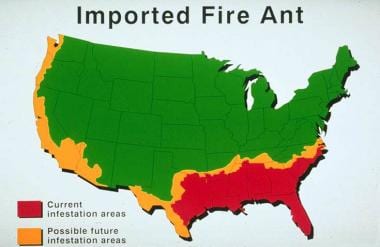 Imported fire ant national distribution map. From http://fireant.tamu.edu. Reproduced with permission from B.M. Drees, Texas Imported Fire Ant Project Coordinator, Texas A&M University, College Station, Texas.
Race
Fire ant stings may occur in people of any race. No race has been shown to have an increased risk of being stung or to have a higher predisposition to complications.
Sex
Fire ants sting both males and females without discrimination.
Age
Fire ants sting people of all ages, but children are overrepresented, probably because of greater environmental exposure.
Patient Education
Patient education is essential in preventing possible life-threatening reactions in patients who are allergic and in providing appropriate treatment of such reactions if they occur. This should include the following:
-
Identification of stinging insects
-
Knowledge of how to avoid being stung
-
Knowledge of how and when to self-administer epinephrine, if indicated
-
Carrying proper identification of stinging insect hypersensitivity (eg, Medic Alert bracelet)
-
Imported fire ant national distribution map. From http://fireant.tamu.edu. Reproduced with permission from B.M. Drees, Texas Imported Fire Ant Project Coordinator, Texas A&M University, College Station, Texas.
-
Red imported fire ant worker. From http://fireant.tamu.edu. Reproduced with permission from B.M. Drees, Texas Imported Fire Ant Project Coordinator, Texas A&M University, College Station, Texas.
-
Fire ant mound in lawn. From http://fireant.tamu.edu. Reproduced with permission from B.M. Drees, Texas Imported Fire Ant Project Coordinator, Texas A&M University, College Station, Texas.
-
Venom sac and stinger of a fire ant. From http://fireant.tamu.edu. Reproduced with permission from B.M. Drees, Texas Imported Fire Ant Project Coordinator, Texas A&M University, College Station, Texas.
-
Fire ant worker biting and stinging. From http://fireant.tamu.edu. Reproduced with permission from B.M. Drees, Texas Imported Fire Ant Project Coordinator, Texas A&M University, College Station, Texas.
-
Pustules and blisters formed following fire ant stings on the arm. From http://fireant.tamu.edu. Reproduced with permission from B.M. Drees, Texas Imported Fire Ant Project Coordinator, Texas A&M University, College Station, Texas.
-
Pustules and blisters formed following fire ant stings on the hand. From http://fireant.tamu.edu. Reproduced with permission from B.M. Drees, Texas Imported Fire Ant Project Coordinator, Texas A&M University, College Station, Texas.
-
Fire ant bites on the foot.