Overview
The need for a rapid, noninvasive method for hair removal has led to the development of various light sources for hair removal. These include ruby, alexandrite, diode, and Nd:YAG lasers and intense pulsed light sources. These devices target either an endogenous chromophore (eg, melanin) or an exogenous chromophore (eg, carbon suspension, photosensitizer, exogenous dye). This article discusses the basic principles of laser hair removal, examines the attributes of specific laser systems, and focuses on patient selection and treatment protocols for the various systems designed to ensure safe and effective treatment. [1]
Mechanisms for hair removal with light
Light can destroy hair follicles by thermal (due to local heating), mechanical (due to shock waves or violent cavitation), or photochemical (due to generation of toxic mediators like singlet oxygen or free radicals) mechanisms. Hair removal has been attempted using each of these 3 means.
Photothermal destruction
Lasers and noncoherent light sources have recently been introduced to induce selective damage to hair follicles. The mechanisms by which these systems induce selective damage to hair follicles are based on the principles of selective photothermolysis. This principle predicts that selective thermal damage of a pigmented target structure will result when sufficient fluence at a wavelength, preferentially absorbed by the target, is delivered during a time equal to or less than the thermal relaxation time of the target.
In the visible to near-infrared region, melanin is the natural chromophore for targeting hair follicles. Lasers or light sources that operate in the red or near-infrared wavelength region (694-nm ruby laser, 755-nm alexandrite laser, 800-nm diode laser, 1064-nm Nd:YAG laser, and noncoherent light sources with cut-off filters) all lie in an optical window of the spectrum in which selective absorption by melanin is combined with deep penetration into the dermis. Therefore, deep and selective heating of the hair shaft, the hair follicle epithelium, and the heavily pigmented matrix is possible in the 600- to 1100-nm region.
However, melanin in the epidermis presents a competing site for absorption. Selective cooling of the epidermis has been shown to minimize epidermal injury. Cooling can be achieved by various means, including ice, a cooled gel layer, a cooled glass chamber or sapphire window, a pulsed cryogen spray, or cooled airflow.
Laser pulse width also appears to play an important role, as suggested by the thermal transfer theory. Thermal conduction from the melanin-rich shaft and matrix heats surrounding follicular structures. To obtain spatial confinement of thermal damage, the pulse duration should be shorter or equal to the thermal relaxation time of the hair follicle. Thermal relaxation of human terminal hair follicles has never been measured, but it is estimated to be approximately 10-100 milliseconds, depending on size.
Therefore, devices for hair removal have pulse durations in the millisecond domain region. The normal-mode 694-nm ruby, normal-mode 755-nm alexandrite, 800-nm pulsed diode lasers, long-pulsed Nd:YAG lasers, and filtered flashlamp technology all use this mechanism.
The concept of thermal damage time has recently been launched in the case of the hair follicle. The melanin-rich hair shaft and matrix cells occupy a relatively small volume, and propagation of the thermal damage front through the entire volume takes 3-20 times longer than the thermal relaxation time of the hair follicle. Super–long-pulse heating (>100 milliseconds) appears to allow for long-term hair removal.
Photomechanical destruction
Photomechanical destruction of hair has been attempted with very short nanosecond pulses by Q-switched 1064-nm Nd:YAG lasers, with and without carbon suspension; however, when these very short pulses are used to target hair follicles, extremely rapid heating of the chromophore (melanin) occurs. This generates photoacoustic shock waves that cause focal photomechanical disruption of the melanocytes but not complete follicular disruption.
Therefore, the Q-switched Nd:YAG lasers are not likely to produce long-term hair removal. Consistent with this behavior, permanent hair loss has not been reported in humans after Q-switched laser treatments despite a decade of using Q-switched ruby and Nd:YAG lasers widely for tattoo removal.
Photochemical destruction of hair follicles
Photodynamic therapy (PDT) is the use of light and a photosensitizer to produce therapeutic effects. Hair removal with topical aminolevulinic acid (ALA) has been reported in a pilot study. A mean hair loss of 40% was reported in 12 volunteer subjects after a single exposure to 630-nm light 3 hours after an application of 20% ALA to the skin. ALA is a precursor in porphyrin synthesis and is rapidly and selectively converted to protoporphyrin IX by cells derived from the epidermis and follicular epithelium. Upon absorption of a photon, protoporphyrin IX efficiently crosses into an excited triplet state, which, in turn, generates singlet oxygen by collision with ground-state oxygen. Singlet oxygen is a potent oxidizer that damages cell membranes and protein. [2] This is a so-called photodynamic reaction. A host of other porphyrins, chlorins, phthalocyanines, purpurins, and phenothiazine dyes can act as photodynamic agents and are under development as drugs for photodynamic therapy. ALA or one of these other drugs will likely prove useful for hair removal. This approach will potentially provide an effective means of treating nonpigmented hair.
Terminology and histology
Hair removal is a vague term that has recently been defined. Temporary hair reduction is defined as a delay in hair growth, which usually lasts 1-3 months, consistent with the induction of telogen. Permanent hair reduction refers to a significant reduction in the number of terminal hairs after a given treatment, which is stable for a period of time longer than the complete growth cycle of hair follicles at the given body site. It has recently been suggested to add another 6 months to this posttreatment observation time (ie, the time necessary for a damaged follicle to recover from the laser injury and reenter a normal growth cycle).
A distinction needs to be made between permanent and complete hair loss. Complete hair loss refers to a lack of regrowing hairs (ie, a significant reduction in the number of regrowing hairs to zero). Complete hair loss may be either temporary or permanent. Laser treatment usually produces complete but temporary hair loss for 1-3 months, followed by partial but permanent hair loss. Histological observations show damage predominantly in hair follicles with large, pigmented shafts, while hair follicles with small (< 25 mm), hypopigmented shafts do not demonstrate any morphological change.
Immediately after laser treatment, the hair shaft shows fragmentation with focal rupture into the follicular epithelium and thermal damage to the surrounding follicular epithelium. The extent of thermal damage is dependent on the pulse width but retains confinement on the spatial scale of the follicle itself. One month later, most follicles are in telogen phase while others are being replaced by fibrosis and a foreign body giant cell reaction with phagocytosis of melanin. At 1 year, most follicles are replaced by miniaturized hair follicles (dominant mechanism), and some are replaced by a fibrotic remnant. Both of these histological findings produce permanent clinical reduction in hair.

Anesthesia
Although less sensitive areas (eg, back, legs, arms) can frequently be treated without anesthesia, topical anesthetic cream is generally used on more sensitive areas. [3] When treating the upper lip, local or regional anesthesia with intralesional lidocaine may be required. [4, 5]
Equipment
Endogenous chromophores
Grossman et al initially reported selective injury to hair follicles by a long-pulse ruby laser. Thirteen patients with fair skin and dark hair were treated once on the thighs or back at fluences of 20-60 J/cm2 with a spot size of 6 mm. Hair growth delay was induced for 1-3 months in all subjects at all fluences. At 1- to 2-year follow-up, 4 of 7 recalled patients had persistent hair loss, which was greatest in sites treated at the highest fluence. Additional studies with larger numbers of patients have confirmed that hair counts are reduced by approximately 30% after a single treatment with the ruby laser. The effects of multiple treatment sessions are additive; hair counts are reduced by approximately 60% after 3-4 treatment sessions.
Alexandrite lasers [9, 10, 11, 12, 13]
Alexandrite lasers (755 nm) are of longer wavelength, which results in greater depth of penetration owing to the increased ratio of energy deposited in the dermis compared with the epidermis. The risk for epidermal damage in persons with darker skin types is therefore reduced. Five different alexandrite lasers are available.
Diode lasers (800 nm) [14, 15, 16]
Long-term results suggest that the pulsed, 800-nm diode laser is very effective for removal of dark, terminal hair. Because these lasers operate at longer wavelength, darker skin types can be treated more safely especially when coupled with active cooling devices and longer pulse widths. Permanent hair reduction can be obtained in 89% of patients.
Q-switched Nd:YAG lasers (1064 nm) [17, 18, 19, 20]
Q-switched Nd:YAG lasers (1064-nm) use very short pulse duration in the nanosecond range, a 4-mm spot, a repetition rate of 10 Hz, and a fluence of up to 8-10 J/cm2. The high repetition rate (10 Hz) delivers the laser pulses very rapidly; therefore, larger areas can be covered easily and operative time is significantly shortened. The longer wavelength makes it useful for darker skin types. Although capable of inducing a growth delay, it appears to be ineffective for long-term hair removal.
Long-pulse Nd:YAG lasers [21, 22, 23, 24]
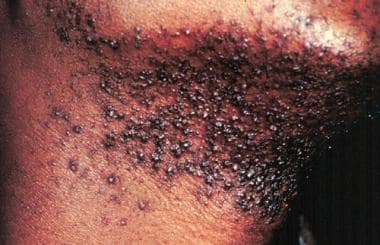
The long-pulsed Nd:YAG lasers have deeply penetrating 1064-nm wavelengths. The reduced melanin absorption at this wavelength necessitates the need for high fluences in order to adequately damage hair. However, the poor melanin absorption at this wavelength coupled with epidermal cooling makes the long-pulsed Nd:YAG a potentially safe laser treatment for darker skin types, up to VI. The Nd:YAG laser is also often used for treatment of pseudofolliculitis barbae, a skin condition commonly seen in persons with darker skin types (see the image below). This modality has also reduced recurrence of pilonidal cysts when used as adjuvant therapy after surgical excision is completed. [25]
Combination lasers
Further studies are required to study the combination effects and dual actions of concurrent multiple laser wavelength treatments.
A study by Khoury et al evaluating the long-pulse alexandrite and long-pulse Nd:YAG laser systems used individually and in combination for axillary hair removal concluded that no added benefit was observed using these 2 lasers in combination compared with using the alexandrite laser alone. [26]
Pulsed, noncoherent broadband light sources
For several years, intense pulsed, nonlaser light sources emitting noncoherent, multiwavelength light have also been used for hair removal. By placing appropriate filters on the light source, wavelengths ranging from 590-1200 nm can be generated. Cut-off filters can be used to eliminate short wavelengths so that only the longer, more deeply penetrating wavelengths are emitted. Pulse durations vary in the millisecond domain and various pulse delay intervals can be chosen. The wide choice of wavelengths, pulse durations, and delay intervals makes this device potentially effective for a wide range of skin types. The devices are usually accompanied with software that can guide the operator in determining treatment parameters depending on the patient's skin type, hair color, and hair coarseness.
Electro-Optical Synergy technology
Electro-Optical Synergy (ELOS) technology uses the synergy between electrical (conducted radiofrequency) and optical (laser or light) energies. The electrical energy causes heat to be focused on the hair follicle and the bulge area while the optical energy heats mainly the hair shaft. When combined, a uniform temperature distribution across the hair shaft and the follicle should be obtained to achieve effective hair removal. The use of the radiofrequency energy should also allow for treatment of all skin types because this form of energy is not absorbed by epidermal melanin. One retrospective study found that ELOS is at best equivalent to other forms of photoepilation. However, the authors note a need for further investigation of this method to be able to make more specific recommendations. [27]
Exogenous chromophore
Rather than targeting endogenous melanin, an exogenous chromophore can be introduced into the hair follicle and then irradiated with light of a wavelength that matches its absorption peak. This eliminates the problem of competition by epidermal melanin. The main problem is finding a reliable method for the chromophore to penetrate into all depths of the hair follicle.
Carbon suspension Q-switched Nd:YAG lasers
The SoftLight technique (ThermoLase; London, England) uses a proprietary suspension of 10-mm diameter carbon particles, with a peak absorption in the near-infrared portion of the spectrum, in combination with a Q-switched Nd:YAG laser. The skin is irradiated with relatively low energies (2-3 J/cm2) of Q-switched Nd:YAG laser light (1064 nm, 10 Hz, 10-nanosecond pulse duration, 7-mm spot size); however, the short pulse duration of the laser used in the SoftLight technique limits the extent of follicular damage.
This technique successfully induces a delay in hair growth, but it fails to produce long-lasting hair removal. A controlled study comparing laser treatment with and without the carbon suspension and with sites that were simply epilated using wax reported a significant delay in hair growth in all laser-treated sites. However, when compared with laser treatment alone, no added benefit was noted with carbon suspension.
Meladine
Meladine is a topical melanin–encased, phosphatidylcholine-based liposome solution which, when sprayed on the desired area, supposedly selectively deposits melanin directly into the hair follicle without staining surrounding skin. The proprietary liposome molecules are small enough to potentially penetrate the infundibulum.
The result should be temporarily melanin-rich follicles, which would allow patients with lighter hair colors to benefit from laser hair removal.
Photodynamic therapy [28]
PDT involves the use of a photosensitizer and light to produce therapeutic effects. The mechanism of action is presumed to involve the generation of toxic reactive oxygen species, subsequent to the photochemical activation of the photosensitizer by light. The introduction of 5-ALA as a topical photosensitizer has opened up a variety of potential therapeutic options. Selective protoporphyrin IX synthesis in pilosebaceous units is a unique feature of ALA over other photosensitizers, and topical application circumvents the photosensitivity induced by systemic agents. [29, 30, 31, 32]
In a small pilot study of 12 subjects, 5-ALA was applied topically to hair-bearing skin. Test sites were irradiated 3 hours later with 630-nm light from an argon-pumped tunable dye laser. At 6 months following a single treatment, a dose-dependent decrease in hair regrowth was observed, with the greatest loss (40%) occurring in areas that received the highest doses of light (200 J/cm2).
Another photosensitizer called Rose Bengal (RB) shows similar results. In the study, 15 women were treated with RB loaded into liposomes and delivered to the hair by a hydrogel prior to PDT to selectively destroy lighter or white hairs that take up the photosensitizer. The participants were subjected to three sessions of RB-PDT within a 4- to 6-week span. Six months after the last treatment, the average reduction of white hairs was observed to be 40%. The most common reported adverse effect was mild-to-moderate pain in the treatment area. [33]
PDT may be a useful approach for hair removal. Because photosensitizers tend to localize in the follicular epithelium, photochemical destruction of all hair follicles, no matter what hair color or growth cycle, could potentially be obtained. Long-term data and large-scale studies are needed to determine the safety and long-term efficacy of this modality.
Technique
Preoperative care
Preoperative considerations are as follows:
-
Presence of conditions that may cause hypertrichosis: These may include hormonal, familial, drug-related, or tumor-related conditions.
-
History of herpes simplex, especially perioral (for facial treatment)
-
History of herpes genitalis (for pubic or inguinal treatment)
-
History of keloids or hypertrophic scarring
-
History of previous treatment modalities: Methods (eg, shaving, waxing, tweezing, depilatory creams, electrolysis, lasers), frequency, last treatment session, and response all should be considered.
-
Present medications, eg, isotretinoin (Accutane) intake in the previous 6-12 months
Preoperative care 6 weeks before laser treatment is as follows:
-
Sunscreen: A broad-spectrum sunscreen is recommended, and sun avoidance must be practiced if hair removal is planned in exposed sites.
-
Bleaching cream: A bleaching cream may be prescribed to patients with darker skin types or a recent suntan.
-
Plucking, waxing, or electrolysis: The patient should avoid these activities. Research has shown greater hair loss at shaved versus epilated sites, suggesting that light absorption by the pigmented hair shaft itself plays an important role.
-
Shaving and depilatory creams: These may be used up to the day before laser treatment. The patient is instructed to shave the area to be treated; however, the area must not be irritated. If the patient is uncomfortable with the idea of shaving the area, a depilatory cream can be used instead.
-
Antivirals: The patient should start prophylactic antiviral medications (eg, acyclovir, valacyclovir, famciclovir) when indicated.
-
Antibiotics: The patient should start oral antibiotics when indicated (eg, nasal, perianal skin).
Day of treatment and technique
Day of treatment concerns are as follows:
-
Cleansing and makeup: The area to be treated should be clean and free of makeup or powder.
-
Preprocedure anesthesia: If desired, a thick layer of a topical anesthetic cream (eg, Emla, ELA-Max, Topicaine) can be applied under occlusion (plastic wrap) for 30 minutes to 2 hours before the scheduled laser treatment.
The procedure for hair removal using all of the devices described above can be summarized as follows:
-
Skin preparation: Remove all anesthetic cream, makeup, or other skin creams or powders.
-
Apply anesthesia, if needed, as described above in the Anesthesia section.
-
Visibility: A treatment grid can be applied in order to provide the operator with an outline of the area to be irradiated. A grid may be manually drawn using a white make-up pencil or a yellow fluorescent highlighter. Dark markers or ink should be avoided in delineating treatment grids since darker colors may interfere with the device optics. In the absence of a grid, careful attention must be given to prevent double laser pulsing and missing areas. Visibility can also be increased by a polarized headlamp with a magnifying loupe (Seymour light).
-
Treatment fluence: The ideal treatment parameters must be individualized for each patient; test sites can be placed at inconspicuous regions of the area to be treated. The fluence is carefully increased while observing the skin for signs of acute epidermal injury, such as whitening, blistering, ablation, or the Nikolsky sign (forced epidermal separation). In general, the treatment fluence should be at 75% of the Nikolsky threshold fluence.
-
Technique: Nonoverlapping or minimally overlapping laser pulses are delivered with a predetermined spot size. The largest spot size and the highest tolerable fluence should be used in order to obtain the best results.
Cooling of the epidermis is as follows:
-
Cooling gel: If the device is not equipped with a cooling device, a thick layer of cooled clear gel is applied before delivery of the laser pulses.
-
Dynamic cooling: Some systems are equipped with a dynamic cooling device that delivers short bursts of cryogen (5-80 milliseconds) on the skin surface automatically prior to delivery of the laser pulse.
-
Contact cooling [34] : Some systems use a sapphire-cooled handpiece that is placed in direct contact with the skin. Prior to pulse delivery, the handpiece is pressed firmly against the skin. After delivery, the handpiece is picked up and placed firmly on an adjacent site, until the entire area is covered. The sapphire cooling tip should be wiped clean every 5-10 pulses to remove debris. Between patients, disinfection of the handpiece with a disinfectant solution is mandatory.
-
Cold airflow: Some systems use a cooling handpiece that allows a continuous flow of chilled air to the treatment area.
Immediate postoperative changes are as follows:
-
Vaporization of hair shaft: The ideal immediate response of treated skin is vaporization of the hair shaft with no other apparent effect.
-
Edema and erythema: After a few minutes, perifollicular edema and erythema should be evident (see the image below).
-
Intensity and duration of changes: The intensity and duration of these tissue changes depend on the hair color and density. The fluence should be reduced if signs of epidermal damage develop.
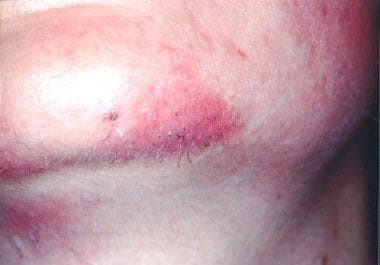 Immediate reaction after laser impact (note erythema, mild edema, sizzling of hairs)

Postoperative care
Ice packs reduce postoperative pain and minimize swelling. Analgesics are not usually required unless extensive areas are treated. Prophylactic courses of antibiotics or antivirals should be completed. Topical antibiotic ointment application twice daily is indicated if epidermal injury has occurred. Potent topical steroid creams such as clobetasol or fluocinonide may be prescribed for 1-2 days to reduce immediate swelling and erythema.
Avoid any trauma, such as picking or scratching of the area. Avoid sun exposure. Use sunscreen with a sun protection factor of 30. Makeup may be applied on the next day unless blistering or crusting has developed. Shedding of hair casts (especially on the face) may be seen; the damaged hair follicle is often shed during the first week after treatment. Patients should be reassured that this is not a sign of hair regrowth.
Treatment interval/subsequent treatments
Research has shown that laser hair removal requires the presence of a pigmented hair shaft. Therefore, retreatment can be performed as soon as regrowth appears. Regrowth is based on the natural cycle, which varies by anatomic location, but the average time is 6-8 weeks. Additional research regarding hair regrowth rates and hair cycles is currently being conducted.
Complications
As with any medical procedure, inherent risks exist with laser- and light-based hair removal. Even in the best and most experienced hands, occasional complications occur with laser treatments. Although most typical complications are minor and easily manageable, all patients should provide verbal and written consent prior to treatment and they should be informed of the possible risks, benefits, and alternatives. [35]
The most common risks with light- and laser-based hair removal systems include skin discoloration [36] (hyperpigmentation or hypopigmentation), pain or discomfort, itching, folliculitis, ingrown hairs, herpes virus reactivation, blistering, infection, temporary result, failure to achieve desired result, or worsening/increased symptoms (paradoxical hypertrichosis, potentiation of coexisting vellus hairs, new growth outside of treated areas). [37] Rare complications include premature grayness of hair, angular cheilitis, inflammatory and pigmentary changes of preexisting nevi, aggravation of acne, allergic reactions to cooling gas, [37] hyperhidrosis, [38] permanent scars, permanent darkening of tattoo or permanent makeup pigments, eye injury, blindness, headache, persistent redness, and bruising. Usually, if skin discoloration occurs, it is temporary and resolves in a few weeks to months. [39]
Rare reports describe patients within proper treatment criteria (dark hair, light skin) who do not respond to any light-based hair removal modality.
Laser hair removal is generally not a painless procedure. Most patients experience some discomfort during and immediately after treatment. Some patients experience no or minimal pain, especially with repeat treatments. The associated discomfort may vary considerably based on the specific area treated, laser type, individual pain tolerance, and density and thickness of hairs in an area. Typically, pain is greater in areas of dense, thick hair such as in men's beards. One can use one or a combination of modalities, including topical or local anesthetics, oral analgesics (ibuprofen, hydrocodone), anxiolytics (diazepam), and/or ice applications before performing the treatments. Ice packs and topical anesthetics creams like lidocaine (L-MX, ELA-Max), lidocaine and prilocaine (EMLA), lidocaine and prilocaine (Betacaine, Betacaine LA,), and lidocaine 7% and tetracaine 7% (Pliagalis) anesthetic mask are most commonly used in laser hair removal procedures. [40]
Perifollicular erythema and edema are expected in all patients treated at the threshold fluence. The intensity and duration depend on hair color, hair density, and fluence. The reaction may last from a few minutes to 1-3 days. [41]
Epidermal damage occurs if excessive fluence is used. It is also more common in patients with a tan.
Herpes simplex outbreaks are uncommon but may occur. In patients with a previous history of herpes simplex and in those receiving treatment to the perioral, pubic, bikini area, or perianal area, the risk is increased.
The risk of bacterial infection is extremely low; however, it may occur following epidermal damage.
Transient pigmentary changes (eg, hypopigmentation and hyperpigmentation, as shown in the image below) can be prevented if the ideal patient and treatment fluence are chosen. Dyspigmentation of skin is seen most often in patients with darker skin types or in patients with a recent tan.
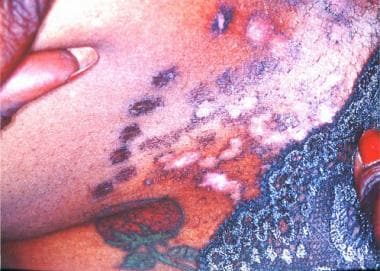 Hyperpigmentation and hypopigmentation following use of inappropriate parameters on a patient with Fitzpatrick phototype IV.
Permanent pigmentary changes are unlikely except in dark-skinned individuals.
Scarring is unlikely except in cases of overaggressive treatment or postoperative infection.
Lightening of tattoos and loss of freckles or pigmented lesions is not uncommon. Caution should be undertaken to avoid treatment of inks in permanent makeup areas. Reports of adverse immediate reactions of pink iron oxide pigment to black with lasers has been reported. Patients should be aware of these possibilities. [42]
Paradoxical hypertrichosis has been noted not uncommonly, particularly in darker or olive-tone patients. A relative increase in the density and/ or thickness of hairs in a laser or intense pulsed light treatment area has been reported by a significant number of laser surgeons all over the world. [43]
Other Considerations
Safety
The systems are designed for strong absorption by melanin and deep tissue penetration. Therefore, they are capable of causing retinal injury. Proper eye protection must be worn by the patient and operating personnel.
Treatment near or on the surface of an eye is not recommended. Safe eyebrow hair removal and "shaping" should be limited to the areas above and between the eyebrows. While most laser surgeons concur that the area below the eyebrow is highly risky and should be avoided, rare reports describe laser treatments below the eyebrows with the use of metal eye shields. Aside from periocular region, all other body sites can be safely treated. [44]
Darkening of cosmetic tattoos (eg, eyeliner, lip liner, eyebrow) can occur with laser-assisted hair removal as a result a reaction of the laser light with iron and titanium oxide pigment. Therefore, patients with cosmetic tattoos should avoid treatment of these areas.
Contact cooling devices pose a small but real risk of infection. Between patients, disinfection of the handpiece with a disinfectant is mandatory.
Reports of mild cryogen burns or hyperpigmentation, particularly with the dynamic cooling systems , have been reported. Caution is warranted to avoid excess cryogen use, particularly on olive skin tone and darker skin types.
Logic would suggest that all patients with a history of skin diseases known to show a Koebner phenomenon (eg, psoriasis vulgaris, vitiligo, lichen planus, Darier disease) should be informed about this possible adverse effect of treatment; clinically, this is rare.
Livedo reticularis, intense pruritus, and urticaria have been reported, including a case of intense swelling and erythema. The pathophysiology of these phenomena is not known. Management included topical corticosteroids, antihistamines, and discontinuance of treatment. Several cases of induction of hair growth following laser hair removal in young female patients with darker skin types have been reported. Two different phenomena have been observed: (1) either conversion of fine, vellus hair to dark, coarse, terminal hair at the site of treatment or (2) induction of growth of long, fine hairs in the immediate vicinity of the treatment area.
The plume generated by the vaporized hair shafts has a typical sulfur smell and, in large quantities, can be irritating to the respiratory tract. In addition, case reports have documented two laser surgeons contracting human papillomavirus (HPV) infection, presumably from the laser plume leading to transmission, with resultant tonsillar cancer and tongue cancer, respectively. [45] However, further studies are needed to determine the contents of these plumes to ensure that appropriate safety precautions are taken. Nevertheless, a smoke evacuator, good ventilation, and the use of an N95 mask are recommended. [45] Electrical and fire hazards are minimal but should be noted.
Patient expectations and outcome
Expectations and goals can be very different for each patient (eg, temporary vs permanent, partial vs complete hair removal). All responses are clinically significant and may be separately desirable to different patients. Growth delay that provides a few months of hairless skin is far more reliable. All laser systems have been shown to temporarily reduce hair growth. It occurs for all hair colors (except white) and at any fluence. Blonde-, red-, or gray-haired patients are unlikely to experience a permanent reduction, but hair loss in these patients can be maintained by treatment at approximately 1- to 3-month intervals.
The effectiveness of permanent hair reduction is strongly correlated with hair color and fluence. Research has shown that in the ideal patient with fair skin and dark hair, the probability for long-term hair removal after a single treatment is approximately 80-89%, depending on the device used. A critical threshold fluence is also needed to obtain this effect. Long-term, controlled hair counts indicate an average of 20% hair loss with each treatment, indicating the need for multiple treatments to obtain complete hair removal. A long-term comparison of different lasers (eg, long-pulse ruby, alexandrite, diode) and light sources (eg, intense pulsed light) has indicated that effective long-term hair removal can be achieved with each of these systems.
Regrowing hairs are often thinner and lighter in color, as indicated by measurements of diameter and color of regrowing hairs. This also contributes to the overall cosmetic outcome because the clinical impression of hairiness is defined not only by the absolute number of hairs, but also by the color, length, and diameter of the hairs.
The number of treatments needed to obtain complete, permanent hair removal for different anatomical sites is unknown. Exceptionally, a patient can obtain long-term complete hair removal after a single treatment, while others may respond poorly for yet unknown reasons; however, most patients (80-89%) respond favorably.
Hair color
Temporary hair loss (1-3 mo) always occurs after laser treatment, regardless of hair color or device used. On the other hand, the ability to induce long-lasting hair reduction is strongly correlated with hair color and fluence. Patients with dark hair are mostly likely to obtain long-lasting hair removal, while blonde-, red-, gray-, or white-haired patients are unlikely to experience a permanent reduction. Hair loss in these patients can be maintained by re-treating at approximately 3-month intervals.
In order to treat patients with blond, gray, white, or red hair, an exogenous chromophore (eg, dyes, photosensitizers, carbon particles) and a wavelength that matches its absorption peak can be used. The main problem is reliable penetration of the chromophore into all depths of the hair follicle. The short pulse duration of the laser used in the SoftLight technique (carbon particles plus Q-switched Nd-YAG laser) also limits the extent of follicular damage. This technique successfully induces a delay in hair growth, but it fails to produce long-lasting hair removal.
Photodynamic therapy may be a useful approach for hair removal. Because photosensitizers tend to localize in the follicular epithelium, photochemical destruction of all hair follicles, regardless of hair color or growth cycle, could potentially be obtained. The technique does not require a laser light source, making it potentially less costly than laser treatment. Long-term data and large-scale studies are needed to determine the safety and long-term efficacy of this modality.
Skin color
The maximum tolerated fluence is determined by the epidermal pigmentation present. Fair-skinned patients with dark hair are most easily treated. While persons with dark skin types are not readily treated with any of the ruby lasers because of melanin interference, the alexandrite and diode lasers and the intense pulsed light sources, operating at longer wavelengths (near infrared) and longer pulse durations, have been shown to treat persons of darker skin types (Fitzpatrick skin phototype IV-V) more safely if combined with cooling devices.
A Q-switched Nd:YAG laser, with or without an external chromophore, has been shown to be very useful for the treatment of dark skin types but appears to be ineffective for permanent hair removal. The long-pulsed, 1064-nm Nd:YAG lasers developed more recently may be the safest way to treat patients with dark skin tones. For patients presenting with a tan, pretreatment with a bleaching agent, sunscreen, and sun avoidance for at least 6 weeks is recommended prior to laser treatment.
Conclusion
Laser and flashlamp technology now offer the potential for rapid, safe, and effective treatment of unwanted hair. An ever-increasing number of published studies have confirmed the long-term efficacy of laser and flashlamp treatment. The procedure is also very attractive because of its noninvasive nature, its ability to cover a large treatment area, and the speed of treatment.
Despite many advances in this field, light-based hair removal is now largely limited to dark hairs. No uniformly effective treatment is available for patients with blond, white, or gray hairs. Research is ongoing to develop efficacious modalities for the treatment of light hairs. Hair removal techniques are rapidly evolving. [46, 47]
Currently, smaller and less expensive light-based devices have become available for self-treatment in a homelike environment following instructions and guidance provided by a physician. Studies showed that with adequate training and instruction, patients may administer self-treatments for hair removal with this small, light-based unit in a safe and effective manner.
Studies have shown that continuous-wave systems, laser systems that emit long laser pulses, could potentially lead to long-term hair removal after repeated treatments at low energy. This has stimulated research to develop portable, light-based hair-removal devices for use at home, rather than being seen in clinic for treatment. Thaysen-Petersen and coworkers conducted a systematic review to assess the efficacy and safety of home-based photoepilatory devices using data from prospective clinical trials. The study found that 3-6 months after treatment, hair reduction ranged from 6-72% based on only seven studies with three different intense pulsed light systems and one home-based diode laser system. One should exercise caution in regard to these devices as more data are needed to better ascertain the efficacy and adverse reactions in using these home-based therapies. [48]
-
Immediate reaction after laser impact (note erythema, mild edema, sizzling of hairs)
-
Hyperpigmentation and hypopigmentation following use of inappropriate parameters on a patient with Fitzpatrick phototype IV.
-
Pseudofolliculitis barbae on the neck of a black man.