Continually Updated Clinical Reference
 
 
  All Sources     eMedicine     Medscape     Drug Reference     MEDLINE
 
eMedicine - Balanitis Xerotica Obliterans : Article by

Quick Find
Authors & Editors
Introduction
Clinical
Differentials
Workup
Treatment
Medication
Follow-up
Miscellaneous
Multimedia
References

Related Articles
Balanitis Circumscripta Plasmacellularis

Candidiasis, Mucosal

Erythroplasia of Queyrat (Bowen Disease of the Glans Penis)

Lichen Planus

Psoriasis, Plaque

Reactive Arthritis

Vitiligo


Patient Education
Click here for patient education.


Author: Noah S Scheinfeld, MD, JD, FAAD, Assistant Clinical Professor, Department of Dermatology, Columbia University; Consulting Staff, Department of Dermatology, St Luke's Roosevelt Hospital Center, Beth Israel Medical Center, New York Eye and Ear Infirmary; Private Practice

Noah S Scheinfeld is a member of the following medical societies: American Academy of Dermatology

Coauthor(s): George C Keough, MD, Chief, Clinical Assistant Professor, Department of Medicine, Dermatology Service, Eisenhower Army Medical Center; Daniel S Lehman, MD, Fellow in Minimally Invasive Urology/Oncology, Department of Urology, Columbia University Medical Center

Editors: Mark W Cobb, MD, Consulting Staff, WNC Dermatological Associates; Richard P Vinson, MD, Assistant Clinical Professor, Department of Dermatology, Texas Tech University School of Medicine; Consulting Staff, Mountain View Dermatology, PA; Jeffrey Meffert, MD, Assistant Clinical Professor of Dermatology, University of Texas Health Science Center-San Antonio; Catherine Quirk, MD, Clinical Assistant Professor, Department of Dermatology, Brown University; William D James, MD, Paul R Gross Professor of Dermatology, University of Pennsylvania School of Medicine; Vice-Chair, Program Director, Department of Dermatology, University of Pennsylvania Health System

Author and Editor Disclosure

Synonyms and related keywords: BXO, penile lichen sclerosus, male genital lichen sclerosus, lichen sclerosus et atrophicus, LS, penile LS, sclerosing inflammatory dermatosis, Koebner phenomenon, vitiligo, thyroid disease, diabetes, alopecia areata,  pseudoepitheliomatous keratotic and micaceous balanitis, PKMB

Background

Lichen sclerosus (LS) is a chronic, progressive, sclerosing inflammatory dermatosis of unclear etiology. Most reported LS cases (83%) involve the genitalia. In men, this genital involvement has traditionally been known as balanitis xerotica obliterans (BXO). A more accurate term is male genital or penile LS.

Yardley et al1 believe that the prevalence of BXO is greater than previous series have shown and that it may manifest in children at an earlier age than previous series have shown. This belief is based on a study of 422 boys at a median age of 6 years 2 months (range, 3 mo to 16 y), of whom 186 (44.1%) received treatment involving surgery (148 circumcision, 33 preputial adhesiolysis, 5 frenuloplasty). Of the 186 boys, 110 had histological tissue examination; 84.8% of skin samples were pathologic. Specifically, tissue showed chronic inflammation (n = 69; 46.6%), BXO (n = 51; 34.5%), and fibrosis (n = 4; 2.7%).

For related eMedicine articles, see Lichen Sclerosus et Atrophicus, Balanitis Circumscripta Plasmacellularis, and Balanitis. Also, Medscape's CME course HPV-Related Disease in Men: Anal and Penile Cancer (Slides With Transcript) may be of interest.

Pathophysiology

The etiology of male genital LS is unknown, but it is thought to be multifactorial. BXO has occurred in monozygotic twins, which suggests a genetic basis for the disease in some cases. Human papillomavirus type 6 or type 16 has not been detected in patients with BXO, which strongly suggests that genital papillomaviruses do not have a strong association with BXO.

Frequency

United States

Kizer et al2 noted that of 153,432 male patients discharged from Brooke Army Medical Center, 108 (0.070%) had a diagnosis of BXO. The age distribution was similar over a range of 2-90 years, with the exception of the third decade, when the incidence almost doubled. Black and Hispanic patients had twice the rate found in white patients (10.59 cases, 10.67 cases, and 5.07 cases per 10,000 patients, respectively).

International

The prevalence of male genital LS has traditionally been estimated at 1 case per 300-1000 males. No recent studies confirm this estimate, but male genital LS is not considered a rare condition. Huntley et al3 reported on 100 consecutive patients seen in pediatric urology clinics who were followed to discharge. Eighteen referrals for circumcision were for religious reasons. Of the other 82 patients, the main reason for referral was retractability or phimosis. Six patients were identified as having BXO, a condition that had not been suggested on referral.

Race

Male genital LS has no known predilection for any racial or ethnic group.

Sex

Male genital LS occurs most frequently in persons who are uncircumcised and who are of middle age. One study4 revealed that 51 (98%) of 52 patients clinically diagnosed with penile LS were uncircumcised.

Age

Although males with genital LS are most frequently of middle age, the condition also may appear in children, ranging from young boys to adolescents. The incidence of BXO in pediatric patients is higher than most physicians realize. Additionally, the incidence of BXO is high in boys with phimosis.5, 6, 7


History

Early in its course, penile LS is relatively asymptomatic with only mild visually observable changes of the penis and glans. Physical changes occur over months or years and may include color or textural changes. Early symptoms are more prevalent in uncircumcised patients.

  • Symptoms occurring with time and progression of penile LS are as follows:
    • Pruritus
    • Burning
    • Hypoesthesia of the glans penis
    • Dysuria
    • Painful erection with altered sexual function
    • Decrease in urinary force or stream caliber
    • Urethritis with or without discharge
  • Symptoms occurring in late penile LS (in uncircumcised patients) are as follows:
    • Phimosis (inability to retract the foreskin over the glans)
    • Paraphimosis (inability to return an already retracted foreskin back over the glans)
  • The development of multifocal squamous cell carcinoma (SCC) in persons with LS et atrophicus of the penis and hepatitis C virus infection has been reported. SCC of the penis arising from BXO alone has also been noted.
  • A urethral stone manifesting as a stop valve, a rare complication of BXO, has been reported.

Physical

Early penile LS demonstrates only subtle physical findings (eg, mild, nonspecific erythema; mild hypopigmentation).

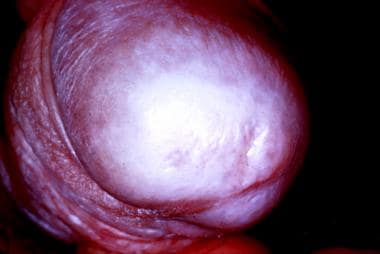
  • As the condition progresses, single or multiple discrete erythematous papules or macules progress and coalesce into atrophic ivory, white, or purple-white patches or plaques.
    • Lesions most commonly affect the glans and prepuce.
    • The frenulum, urethral meatus, fossa navicularis, penile shaft, and perianal areas may become involved.
    • A sclerotic white ring at the tip of the prepuce is diagnostic at this stage.
    • Erosions, fissures, petechiae, serous and hemorrhagic bullae, and telangiectasias of the glans have been reported, albeit uncommonly.
  • With further disease progression, the glans may become adherent to the prepuce.
    • The coronal sulcus and frenulum may be sclerotically destroyed.
    • The urethral meatus may narrow to the point of urinary retention.
    • Urinary retention may be severe enough to cause retrograde damage to the posterior urethra and to the bladder and kidneys.
    • Significant urethral meatal narrowing has led to sloughing of the distal half centimeter of the urethra.
    • Phimosis and paraphimosis of uncircumcised patients may occur at this late stage.
  • Seventeen percent of LS cases are extragenital, beginning as mild, nonspecific erythema with mild hypopigmentation.
  • In one case report8, BXO in a middle-aged man involved the entire anterior urethra and the scrotum. It manifested as a palpable nodular scrotal mass and caused obstructive voiding symptoms. He was treated with a staged urethroplasty.

Causes

The etiology of male genital LS is unknown but is thought to be multifactorial. Several contributing factors are possible, as follows:

  • Circumcision after age 13 years/uncircumcised state
    • This may very well be due to the effect known as the isomorphic, or Koebner, phenomenon. The large majority of inflammatory dermatoses of the male genitalia, including LS, occur in uncircumcised or late-circumcised men.
    • The presence of a foreskin may promote chronic irritation or serve to maintain a friendly environment for an as-yet unidentified infectious agent. Such chronic irritation and subsequent inflammation may initiate the changes noted in LS.
  • Hormonal factors
    • Hormonal influences in the development of LS have long been postulated, mainly in female vulvar LS.
    • Most studies have concentrated on the role of testosterone in the pathogenesis of vulvar LS. Childhood vulvar LS frequently resolves with the onset of menarche and the related pubertal increase in testosterone production in genital skin; additionally, adults with LS have been found to have decreased serum levels of free testosterone, androstenedione, and dihydrotestosterone compared with control subjects.
    • The underlying defect may be a problem with the function of the enzyme 5-alpha reductase.
  • Autoimmune disease
    • Various autoantibodies (including antinuclear, thyroid antimicrosomal, antigastric parietal cell, anti-adrenal cortex, antismooth muscle, and antimitochondrial antibodies) have been detected in patients with LS.
    • Vitiligo, thyroid disease, diabetes, and alopecia areata have also been commonly reported in association with LS.
  • Genetic factors
    • LS (not necessarily genital LS) has been reported in families, including twins (identical and nonidentical), sisters, mothers and daughters, and a brother and sister.
    • Note, however, that no consistent pattern of genetic inheritance has been identified.
  • Presence of human papillomaviruses
    • The presence of human papillomaviruses (HPV) has been reported in some cases of childhood penile LS. Whether the LS is directly attributable to HPV infection, or if LS merely promotes HPV infection is unclear.
    • Patients with penile LS alone have not been demonstrated to have a higher incidence of HPV infection.
  • Other: In a study of 18 patients9 with combined buccal mucosa grafting and genital skin flap reconstruction of extensive anterior urethral strictures, 16.7% of stricture cases were caused by BXO.


Balanitis Circumscripta Plasmacellularis
Candidiasis, Mucosal
Erythroplasia of Queyrat (Bowen Disease of the Glans Penis)
Lichen Planus
Psoriasis, Plaque
Reactive Arthritis
Vitiligo

Other Problems to be Considered

Phimosis
Balanitis
Buried penis
Zoon plasma cell balanitis

Pseudoepitheliomatous keratotic and micaceous balanitis

Pseudoepitheliomatous keratotic and micaceous balanitis (PKMB) is a very rare papulosquamous dermatosis of the glans penis. PKMB presents in elderly, uncircumcised men as a slowly growing, coarsely scaling, micaceous, white-to-gold, laminated, well-demarcated plaque. The lesion may grow to involve the coronal sulcus and the distal penile shaft. Symptoms include phimosis, pain, and interference with sexual activity. PKMB is considered to be a premalignant condition. Nearly all reported patients have had malignant degeneration. Reported associated malignancies include SCC, verrucous carcinoma, and fibrosarcoma.


Lab Studies

  • A rapid protein reagin test helps exclude syphilis

Procedures

  • Skin biopsy aids in the diagnosis of male genital LS.

Histologic Findings

Histopathologic changes of genital LS are similar to those of nongenital LS.

Epidermal findings include orthokeratosis, hyperkeratosis with follicular plugging, hyperkeratosis without follicular plugging, stratum malpighii atrophy, basal layer hydropic degeneration, and dermoepidermal clefting (in some cases).

Follicular plugging is not apparent in mucosal BXO. Significant dermal edema and homogenization of the collagen in the upper dermis occurs, with dilatation of blood and lymph vessels and a loss of elastic fibers.

The immune cells moving into areas of BXO include lymphocytes, plasma cells, and histiocytes in the mid dermis. The inflammatory infiltrate is less pronounced in long-standing lesions.


Medical Care

  • Ebert et al,10 in a retrospective analysis of 13 children with BXO published in 2007, reported that the relapse rate was lower after topical tacrolimus therapy than with betamethasone therapy.
  • In a case series of 3 patients, 2 had softening of the skin and pruritus, tenderness, and inflammatory change resolution within 3 weeks of receiving oral and intramuscular penicillin. Dirithromycin at 500 mg/d abated BXO in a third patient; the BXO returned when dirithromycin was discontinued but it improved again upon resumption of therapy.
  • Further treatment, or treatment of circumcised patients, is more challenging. No consistently effective treatment has been developed; however, the following therapies have varying degrees of reported success:
    • Topical and intralesional steroids: Topical steroids can offer a reliable option only in the management of mild BXO limited to the prepuce in boys with minimal scar formation. Patients and their families must have realistic expectations with regard to the success of such treatments. Steroid-based creams are ineffective in persons with established scarring. Studies have shown that applying a potent topical steroid improves BXO in the histologically early and intermediate stages of disease and may inhibit further worsening in the late stages. However, Kiss11 questioned the utility of topical steroid-based creams for the treatment of clinical BXO.
    • Tacrolimus: Successful treatment of BXO with topical tacrolimus has been reported.
    • Topical testosterone propionate ointment
    • Etretinate (no longer available): Acitretin is the current equivalent.
    • Carbon dioxide laser treatment12

Surgical Care

A variety of surgical techniques can be used to treat more severe BXO.

  • Uncircumcised patients usually benefit from therapeutic circumcision. Provide regular follow-up care to observe any changes in involved areas suggestive of malignancy.
  • Consider surgical intervention for symptoms or signs of urethral meatal stenosis.
  • Dubey et al13 report that in BXO-related strictures with a viable urethral plate, 1-stage dorsal onlay buccal mucosal urethroplasty achieves superb medium-term results. They also state that the intervention created a normal, wide-caliber, slitlike glans, and a 2-stage procedure provides effective treatment but is associated with a higher revision rate.
  • Full-thickness skin grafts from eyelids to penis, plus split-thickness grafts in chronic BXO has been reported.
  • Buccal mucosa appears to be a durable source of nongenital tissue for urethral replacement. Attention to detail in terms of graft harvest, graft preparation, and graft fixation helps to avoid major postoperative complications. Onlay grafts appear to be preferable to tube grafts, and patients with a diagnosis of BXO do not appear to be candidates for the 1-stage urethral reconstruction using buccal mucosa.
  • Circumferential laser vaporization for severe meatal stenosis secondary to BXO reportedly is effective.
  • In 2007, Levine et al14 reported on buccal mucosa graft urethroplasty for anterior urethral stricture repair. They evaluated the impact of stricture location and lichen sclerosus on surgical outcome. When lichen sclerosus affects the penis, complete excision of the diseased urethra with multistage repair decreases the rate of stricture recurrence associated with a 1-stage repair.
  • Palminteri et al15 treated 17 patients, performing y resurfacing or reconstruction of the glans penis for benign, premalignant, and malignant penile lesions (5 glans skinning and resurfacing; 5 glans amputation and reconstruction of the neoglans, and 7 partial penile amputation and reconstruction of the neoglans). Four patients had lichen sclerosus. Glans resurfacing and reconstruction were performed with the use of a skin graft harvested from the thigh. Patients who received glans resurfacing reported glandular sensory restoration and complete sexual ability. Patients receiving glansectomy or partial penectomy with neoglans reconstruction maintained sexual function and activity, albeit with reduced sensitivity secondary to glans/penile amputation. Palminteri et al concluded that glans resurfacing or reconstruction can ensure a normal-appearing and functional penis, without jeopardizing cancer control.

Consultations

  • Consider consultation with urologists for the following:
    • Therapeutic circumcision
    • Circumcision for symptomatic phimosis or paraphimosis
    • Significant narrowing or obstruction of the urethral meatus or changes in urinary flow

Activity

In some cases of male genital LS, painful erections may limit sexual function.


Topical steroids, especially superpotent topical steroids, are the mainstay of medical therapy. Topical testosterone is mostly ineffective and is not discussed further. Etretinate has been used with limited success but is no longer available for prescription in the United States.

Successful treatment of BXO with topical tacrolimus has been reported.

Drug Category: Topical corticosteroids

Help reduce inflammatory lesions and may reduce or resolve lesions.

Drug NameClobetasol propionate (Temovate) 0.05% cream or ointment
DescriptionClass I superpotent topical steroid; suppresses mitosis and increases synthesis of proteins that decrease inflammation and cause vasoconstriction. Used in most studies dealing with treatment of LS.
Adult DoseApply to affected areas qd for up to 12 wk, although continuous treatment for >2 wk may begin to cause atrophic changes; atrophic changes will be more pronounced in genital area than other areas of the body; not to exceed 50 g/wk
Pediatric DoseNot established
ContraindicationsDocumented hypersensitivity; viral or fungal skin infections
InteractionsNone reported
PregnancyC - Fetal risk revealed in studies in animals but not established or not studied in humans; may use if benefits outweigh risk to fetus
PrecautionsSteroid atrophy commonly occurs when superpotent topical steroids are used in genital area for even short periods; observe patients for any such changes; may suppress adrenal function in prolonged therapy

Drug Category: Topical immunomodulators

Drug NameTacrolimus ointment 0.1% or 0.03% (Protopic)
DescriptionMechanism of action in atopic dermatitis is not known. Reduces itching and inflammation by suppressing release of cytokines from T cells. Also inhibits transcription for genes that encode IL-3, IL-4, IL-5, GM-CSF, and TNF-alpha, all of which are involved in early stages of T-cell activation. Additionally, may inhibit release of preformed mediators from skin mast cells and basophils and may down-regulate expression of FCeRI on Langerhans cells. Can be used in patients >2 y. More expensive than topical corticosteroids. Available as ointment in concentrations of 0.03 and 0.1%. Indicated only after other treatment options have failed.
Adult DoseApply thin layer to affected skin areas bid and rub in gently and completely; continue treatment for 1 wk after clearing of signs and symptoms
Short-term and intermittent use only
Pediatric Dose<2 years: Not established
2-15 years: Apply 0.03% ointment bid to affected area(s)
>15 years: Administer as adults
Short-term and intermittent use only
ContraindicationsDocumented hypersensitivity to tacrolimus or components of ointment
InteractionsNone if no systemic absorption occurs
PregnancyC - Fetal risk revealed in studies in animals but not established or not studied in humans; may use if benefits outweigh risk to fetus
PrecautionsPatients may experience a burning sensation during first few days of application; skin can become photosensitive and patients should be cautioned about exposure to direct or artificial sunlight and to use sunscreen; application under occlusion, which may promote systemic exposure, has not been evaluated (do not use with occlusive dressings); absorption following topical applications is minimal (relative to systemic administration), but tacrolimus is excreted in human milk and, thus, a decision should be made whether to discontinue nursing or to discontinue drug, taking into account importance of drug to mother (potential for serious adverse reactions in nursing infants from tacrolimus should also be a concern); caution with conditions that suppress the immune system (eg, AIDS, cancer)
Possible risk of lymph node or skin cancer based on animal studies and a small number of patients
May increase risk of viral infections; other adverse effects include headache, sore throat, flulike symptoms, fever, and cough


Further Outpatient Care

  • Provide regular follow-up care to observe any changes in involved areas suggestive of malignancy.
  • Consider surgical intervention for symptoms or signs of urethral meatal stenosis.
  • Patients can be taught to dilate the urethral meatus at home if the BXO involves the meatus; this sometimes is useful.

Deterrence/Prevention

  • Early circumcision may decrease the risk of developing male genital LS; nearly all cases have been reported in uncircumcised patients.

Complications

  • As the disease progresses, urinary retention may be sufficient to lead to retrograde damage to the posterior urethra, bladder, and kidneys.
  • As previously noted, painful erections in some cases of male genital LS may limit sexual function.
  • Malignancies have been reported to occur in penile lesions (rare). Common signs and symptoms of penile malignancy include nodule or tumor growth, ulceration, blistering, hematuria, erythema, pain, purulent discharge, bleeding, lymphadenopathy, and failure to respond to treatment for presumptive inflammatory or infectious balanitis. For this reason, close follow-up care is indicated in order to quickly diagnose any malignant changes.

Prognosis

  • Male genital LS is chronic and often progressive. Regression or improvement of atrophic areas is unexpected.
  • Malignancies have been reported to arise in penile LS lesions (rare); most common cancers are SCC,16 adenosquamous carcinoma, and verrucous carcinoma.
    • A study of 86 uncircumcised men with genital LS revealed malignant changes (3 SCC, 1 SCC in situ, and 1 verrucous carcinoma) occurring in 5 (5.8%) subjects. The average time between diagnosis of LS and subsequent diagnosis of penile malignancy was 17 years.17
    • Notably, 4 of the 5 patients with malignant changes were found by polymerase chain reaction to have evidence of HPV-16 in their tissue specimens. It has been suggested that LS may promote HPV infection and perhaps the development of SCC.18


Medical/Legal Pitfalls

  • Failure to diagnose male genital LS early is a potential pitfall.
    • Delay in diagnosis or follow-up of patients with urinary symptoms may lead to irreversible damage to the urinary system.
    • No singularly effective therapy exists; however, treatment with surgical and/or medical techniques should be quickly instituted upon diagnosis of this often progressive condition.
  • Failure to provide regular follow-up care is a potential pitfall. Care should include biopsy of ulcerating or nonhealing areas to detect malignancies (rare) developing from lesions of male genital LS.

Special Concerns

  • Men with genital LS may delay presenting to a physician because of fear or embarrassment. Accurate diagnosis, aided with appropriate biopsy, helps calm anxiety.
  • Goolamali and Pakianathan19 reported penile carcinoma arising in BXO in a 46-year-old white man; thus, if BXO is suspected or has occurred in the past, penile carcinoma should be excluded during the examination.


Media file 1:  Balanitis xerotica obliterans (lichen sclerosus). Courtesy of Wilford Hall Medical Center Slide collection.

Click to see larger pictureClick to see detailView Full Size Image
Media type:  Photo


  1. Yardley IE, Cosgrove C, Lambert AW. Paediatric preputial pathology: are we circumcising enough?. Ann R Coll Surg Engl. Jan 2007;89(1):62-5. [Medline].
  2. Kizer WS, Prarie T, Morey AF. Balanitis xerotica obliterans: epidemiologic distribution in an equal access health care system. South Med J. Jan 2003;96(1):9-11. [Medline].
  3. Huntley JS, Bourne MC, Munro FD, Wilson-Storey D. Troubles with the foreskin: one hundred consecutive referrals to paediatric surgeons. J R Soc Med. Sep 2003;96(9):449-51. [Medline].
  4. Mallon E, Hawkins D, Dinneen M, Francics N, Fearfield L, Newson R, et al. Circumcision and genital dermatoses. Arch Dermatol. Mar 2000;136(3):350-4. [Medline].
  5. Chalmers RJ, Burton PA, Bennett RF, Goring CC, Smith PJ. Lichen sclerosus et atrophicus. A common and distinctive cause of phimosis in boys. Arch Dermatol. Aug 1984;120(8):1025-7. [Medline].
  6. Kiss A, Kiraly L, Kutasy B, Merksz M. High incidence of balanitis xerotica obliterans in boys with phimosis: prospective 10-year study. Pediatr Dermatol. Jul-Aug 2005;22(4):305-8. [Medline].
  7. Rossi E, Pavanello P, Franchella A. Lichen sclerosus in children with phimosis. Minerva Pediatr. Dec 2007;59(6):761-5. [Medline].
  8. Singh I, Ansari MS. Extensive balanitis xerotica obliterans (BXO) involving the anterior urethra and scrotum. Int Urol Nephrol. 2006;38(3-4):505-6. [Medline].
  9. Berglund RK, Angermeier KW. Combined buccal mucosa graft and genital skin flap for reconstruction of extensive anterior urethral strictures. Urology. Oct 2006;68(4):707-10; discussion 710. [Medline].
  10. Ebert AK, Vogt T, Rösch WH. Topical therapy of balanitis xerotica obliterans in childhood : Long-term clinical results and an overview. Urologe A. Dec 2007;46(12):1682-1686. [Medline].
  11. Kiss A. The response of clinical balanitis xerotica obliterans to the application of topical steroid-based creams. J Pediatr Surg. Mar 2006;41(3):606; author reply 606-7. [Medline].
  12. Ratz JL. Carbon dioxide laser treatment of balanitis xerotica obliterans. J Am Acad Dermatol. May 1984;10(5 Pt 2):925-8. [Medline].
  13. Dubey D, Sehgal A, Srivastava A, Mandhani A, Kapoor R, Kumar A. Buccal mucosal urethroplasty for balanitis xerotica obliterans related urethral strictures: the outcome of 1 and 2-stage techniques. J Urol. Feb 2005;173(2):463-6. [Medline].
  14. Levine LA, Strom KH, Lux MM. Buccal mucosa graft urethroplasty for anterior urethral stricture repair: evaluation of the impact of stricture location and lichen sclerosus on surgical outcome. J Urol. Nov 2007;178(5):2011-5. [Medline].
  15. Palminteri E, Berdondini E, Lazzeri M, Mirri F, Barbagli G. Resurfacing and reconstruction of the glans penis. Eur Urol. Sep 2007;52(3):893-8. [Medline].
  16. Pugliese JM, Morey AF, Peterson AC. Lichen sclerosus: review of the literature and current recommendations for management. J Urol. Dec 2007;178(6):2268-76. [Medline].
  17. Nasca MR, Innocenzi D, Micali G. Penile cancer among patients with genital lichen sclerosus. J Am Acad Dermatol. Dec 1999;41(6):911-4. [Medline].
  18. Drut RM, Gomez MA, Drut R, Lojo MM. Human papillomavirus is present in some cases of childhood penile lichen sclerosus: an in situ hybridization and SP-PCR study. Pediatr Dermatol. Mar-Apr 1998;15(2):85-90. [Medline].
  19. Goolamali SI, Pakianathan M. Penile carcinoma arising in balanitis xerotica obliterans. Int J STD AIDS. Feb 2006;17(2):135-6. [Medline].
  20. Bainbridge DR, Whitaker RH, Shepheard BG. Balanitis xerotica obliterans and urinary obstruction. Br J Urol. Aug 1971;43(4):487-91. [Medline].
  21. Beljaards RC, van Dijk E, Hausman R. Is pseudoepitheliomatous, micaceous and keratotic balanitis synonymous with verrucous carcinoma?. Br J Dermatol. Nov 1987;117(5):641-6. [Medline].
  22. Bingham JS. Carcinoma of the penis developed in lichen sclerosus et atrophicus. Br J Vener Dis. Oct 1978;54(5):350-1. [Medline].
  23. English JC 3rd, Laws RA, Keough GC, Wilde JL, Foley JP, Elston DM. Dermatoses of the glans penis and prepuce. J Am Acad Dermatol. Jul 1997;37(1):1-24; quiz 25-6. [Medline].
  24. Jenkins D Jr, Jakubovic HR. Pseudoepitheliomatous, keratotic, micaceous balanitis. A clinical lesion with two histologic subsets: hyperplastic dystrophy and verrucous carcinoma. J Am Acad Dermatol. Feb 1988;18(2 Pt 2):419-22. [Medline].
  25. Ledwig PA, Weigand DA. Late circumcision and lichen sclerosus et atrophicus of the penis. J Am Acad Dermatol. Feb 1989;20(2 Pt 1):211-4. [Medline].
  26. Meffert JJ, Davis BM, Grimwood RE. Lichen sclerosus. J Am Acad Dermatol. Mar 1995;32(3):393-416; quiz 417-8. [Medline].
  27. Meyrick Thomas RH, Ridley CM, Black MM. Clinical features and therapy of lichen sclerosus et atrophicus affecting males. Clin Exp Dermatol. Mar 1987;12(2):126-8. [Medline].
  28. Mikat DM, Ackerman HR Jr, Mikat KW. Balanitis xerotica obliterans: report of a case in an 11-year-old and review of the literature. Pediatrics. Jul 1973;52(1):25-8. [Medline].
  29. Peterson AC, Palminteri E, Lazzeri M, Guanzoni G, Barbagli G, Webster GD. Heroic measures may not always be justified in extensive urethral stricture due to lichen sclerosus (balanitis xerotica obliterans). Urology. Sep 2004;64(3):565-8. [Medline].
  30. Pietrzak P, Hadway P, Corbishley CM, Watkin NA. Is the association between balanitis xerotica obliterans and penile carcinoma underestimated?. BJU Int. Jul 2006;98(1):74-6. [Medline].
  31. Read SI, Abell E. Pseudoepitheliomatous, keratotic, and micaceous balanitis. Arch Dermatol. Jul 1981;117(7):435-7. [Medline].
  32. Staff WG. Urethral involvement in balanitis xerotica obliterans. Br J Urol. Apr 1970;42(2):234-9. [Medline].
  33. Wallace HJ. Lichen sclerosus et atrophicus. Trans St Johns Hosp Dermatol Soc. 1971;57(1):9-30. [Medline].

Balanitis Xerotica Obliterans excerpt

Article Last Updated: Mar 17, 2008