Practice Essentials
Urticaria (hives) is a vascular reaction of the skin marked by the transient appearance of smooth, slightly elevated papules or plaques (wheals) that are erythematous and that are often attended by severe pruritus. Individual lesions resolve without scarring in several hours. Most cases of urticaria are self-limited and of short duration; the eruption rarely lasts more than several days, it but may be recurrent over weeks. Chronic urticaria is defined as urticaria with recurrent episodes lasting longer than 6 weeks.
Signs and symptoms
Pruritus (itching) and rash are the primary manifestations of urticaria, and permanent hyperpigmentation or hypopigmentation is rare.
Lesions commonly last 20 minutes to 3 hours, disappear, and then reappear in other skin areas. An entire episode of urticaria often lasts 24–48 hours; individual lesions usually fade within 24 hours or so, but new lesions may be developing continuously. Rarely, acute urticaria can last 3–6 weeks. [1] Scars do not develop.
Diagnosis
In 50% of patients with acute urticaria, a specific etiology can be identified. Brief episodes of urticaria can be associated temporally with identifiable causes, and the method of exposure (ie, direct contact, oral or IV routes) is usually known.
Acute urticaria is generally diagnosed based on a detailed patient history and physical examination (see Clinical Presentation), [2, 3, 4] and laboratory studies generally are not indicated.
Management
Identify the etiology of the acute urticaria if possible. If an inciting agent can be identified, instruct the patient to avoid it. The major goal is to control the severity of acute urticaria lesions until the process resolves over 4-6 weeks.
Inpatient therapy may be required rarely if the urticaria is severe and does not respond to antihistamine therapy, or if the patient's condition progresses to laryngeal angioedema and/or anaphylactic shock.
The EAACI/GA2LEN/EDF/WAO panel consensus released an updated guideline in 2022 on the management of urticaria including a treatment algorithm for symptomatic management of chronic spontaneous urticaria. [5]

Background
Urticaria (hives) is a vascular reaction of the skin marked by the transient appearance of smooth, slightly elevated papules or plaques (wheals) that are erythematous and that are often attended by severe pruritus. Individual lesions resolve without scarring in several hours. Most cases of urticaria are self-limited and of short duration; the eruption rarely lasts more than several days, it but may be recurrent over weeks. Chronic urticaria is defined as urticaria with recurrent episodes lasting longer than 6 weeks.
The development of urticaria is often an isolated event without systemic reaction. Rarely, it can be a prelude to the development of an anaphylactic reaction. (See Anatomy.)
If any features of anaphylaxis (eg, hypotension, respiratory distress, stridor, gastrointestinal distress, swallowing problems, joint swelling, joint pain) are present, immediate medical intervention should occur. (See Physical Examination.)
Acute urticaria may be, in a short time, associated with life-threatening angioedema and/or anaphylactic shock, although it usually presents as rapid-onset shock without urticaria or angioedema. (See Emergency Care and Complications.)
New-onset episodes of urticaria can be associated with identifiable causes, and the method of exposure (ie, direct contact, oral or intravenous [IV] routes) can be deduced by taking a careful history. (See Etiology.)
Acute urticaria is generally diagnosed based on a detailed patient history and physical examination. (See Clinical Presentation.)
Although clinically distinctive, urticaria may be confused with a variety of other dermatologic diseases that can be similar in appearance and are pruritic, including atopic dermatitis (eczema), maculopapular drug eruptions, contact dermatitis, insect bites, erythema multiforme, pityriasis rosea, and others. Usually, however, the experienced clinician is able to distinguish these conditions from urticaria because of the lesions' hallmark appearance (see the images below), a lack of epidermal change, the intense pruritus, the presence of an advancing edge and a receding edge, the complete blanching of the lesions with pressure, and are the transient nature of the lesions. [6] (See Clinical Presentation.)
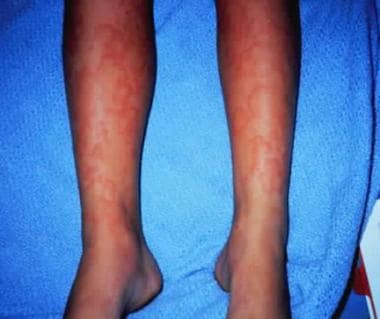
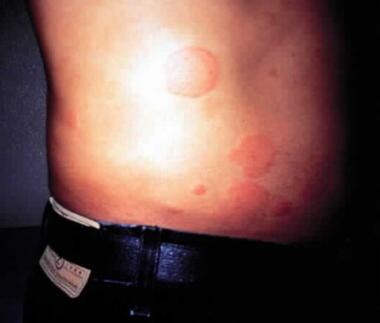
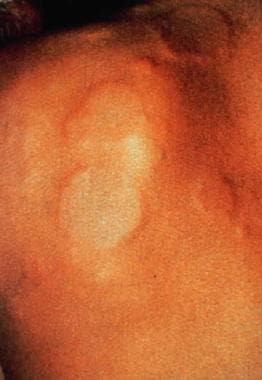 Local urticaria on a patient with latex allergy who was touched with a latex glove.
The major goal of treatment is to control the severity of acute urticarial lesions. Antihistamines are the primary agents used to treat urticaria. (See Treatment Strategies and Management.)
Pathophysiology
Urticaria results from the release of histamine, bradykinin, leukotriene C4, prostaglandin D2, and other vasoactive substances from mast cells and basophils in the dermis. [7] These substances cause extravasation of plasma into the dermis, leading to the urticarial lesion. The intense pruritus of urticaria is a result of histamine released into the dermis. One study showed that D-dimer levels correlate with the severity of acute urticaria and may serve as a marker of disease severity. [8]
Individual lesions of acute urticaria can appear at different locations and fade without scarring, often in a matter of hours. The development of urticaria can be an isolated event without systemic reaction or it can be a prelude to the development of an anaphylactic reaction. Although urticaria results from transient extravasation of plasma into the dermis, angioedema is the subcutaneous extension of urticaria that results in deep swelling within subcutaneous/submucosal tissues and is associated with pain but not pruritus.
Immune-mediated urticaria
Histamine is the ligand for 2 membrane-bound receptors, the H1 and H2 receptors, which are present on many cell types. The activation of the H1 histamine receptors on endothelial and smooth muscle cells leads to increased capillary permeability. The activation of the H2 histamine receptors leads to arteriolar and venule vasodilation. [9, 10, 11] This process is caused by several types of immune hypersensitivity mechanisms as follows:
-
The type I allergic immunoglobulin (Ig) E response is initiated by antigen-mediated IgE immune complexes that bind and cross-link Fc receptors on the surface of mast cells and basophils, thus causing degranulation with histamine release.
-
The type II immune response is mediated by antibodies bound to cell surface, causing complement-mediated or antibody-dependent cell cytotoxicity.
-
The type III immune-complex disease is associated with systemic lupus erythematosus and other autoimmune diseases that cause urticaria. [10]
Non-immune-mediated urticaria
Complement-mediated urticaria includes viral and bacterial infections, serum sickness, and transfusion reactions. Urticarial transfusion reactions occur when allergenic substances in the plasma of the donated blood product react with pre-existing IgE antibodies in the recipient. Certain drugs (opioids, vecuronium, succinylcholine, vancomycin, and others) as well as radiocontrast agents cause urticaria due to mast cell degranulation through a non-IgE-mediated mechanism. Urticaria from nonsteroidal anti-inflammatory drugs (NSAIDs) may be IgE-mediated or due to mast cell degranulation, and there may be significant cross-reactivity among the NSAIDs in causing urticaria and anaphylaxis. [12]
Physical urticaria, in which some physical stimulus causes urticaria, includes immediate pressure urticaria, delayed pressure urticaria, [13] cold urticaria, and cholinergic urticaria. [14]
For some cases of urticaria, especially chronic urticaria, no cause can be found, despite exhaustive efforts. This is known as idiopathic urticaria, [7] although most of these are chronic autoimmune urticaria as defined by a positive autologous serum skin test (ASST). [15]
Etiology
In 50% of patients with acute urticaria, a specific etiology can be identified. Brief episodes of urticaria can be associated with identifiable causes, and the method of exposure (ie, direct contact, oral or intravenous routes) is usually known. Acute urticaria is often associated with a recent infection.
Food allergies
Food allergy should be considered in acute urticaria and urticaria in children. Such foods as tree nuts, peanuts, eggs, shellfish, and tomatoes should be considered (the involvement of food additives or preservatives is controversial). [16] ) Please visit our main article to learn more about food allergies.
Drug allergies
Theoretically, almost any drug can cause an allergic reaction (see the images below); thus, allergic reactions to a wide variety of drugs can occur. Antibiotics, such as penicillin, have been implicated most frequently. [17] Urticarial reactions to penicillin can occur as long as 14 days after a course of treatment has stopped. In this situation, serum sickness may be present.
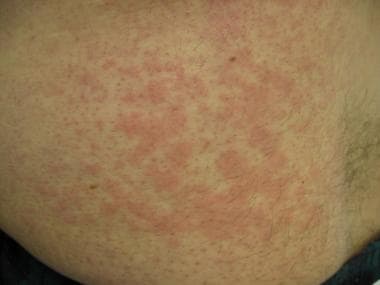
Physical contact
Contact urticaria is an allergic reaction to a substance that comes into contact with the skin (eg, an occupational exposure) (see the image below).
Insect bites
Papular urticaria is a variation of urticaria caused by insect bites (see the image below); the lesions may last longer than 24 hours.
Hypersensitivity
Urticaria may be caused by other immediate hypersensitivity allergic reactions to an ingested, inhaled, or percutaneously inoculated substance (eg, latex, stinging insects, occupational exposures). See the following image.
Local urticaria on a patient with latex allergy who was touched with a latex glove.
Nonallergic release of mediators
A number of drugs, such as aspirin, NSAIDs, opiates, succinylcholine, and certain antibiotics (eg, polymyxin, ciprofloxacin, rifampin, vancomycin, some beta-lactams) can cause urticaria by a nonallergic mechanism rather than by IgE-mediated hypersensitivity.
Certain foods or beverages, such as spoiled fish (scombroidosis), aged cheeses, or red wine, can contain histidine, which is closely related to histamine. These foods are often listed as causes of urticaria in the literature, but experimental evidence is scarce.
Certain venoms may cause urticaria.
Radiocontrast media sensitivity is not related to iodine, fish, or shellfish allergy.
Medical causes
Urticaria has been reported with infectious diseases. Viral infections associated with acute urticaria include acute viral syndromes, hepatitis (A, B, and C), Epstein-Barr virus, and herpes simplex virus. Streptococcal infection (see the photograph below) has been reported as the cause of 17% of acute urticaria cases in children. [18] Urticaria has also been reported with chronic parasitic infections. [19]
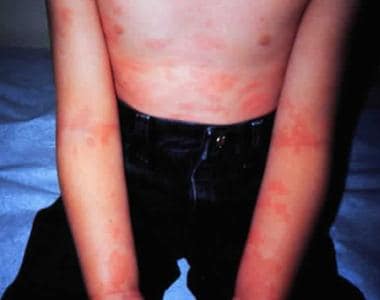
Although sinusitis, cutaneous fungal infections, Helicobacter pylori infection, or other occult infections have been reported in the literature to cause urticaria, the data are not strongly supported. [20, 21, 22, 23, 24]
Hormonal causes via endocrine tumors or ovarian pathology are rare. Oral contraceptive use or changes in the menstrual cycle have been reported as a possible cause of urticaria: patients commonly report worsening of hives with the menstrual cycle. This may be hormonally mediated, and the cyclical use of analgesics should also be considered as a possible etiology.
Urticaria with pruritus can be the presenting symptom of lymphoma, and a careful history and review of systems is important.
Other medical causes of recurrent urticaria include the following:
-
Cryoglobulinemias (eg, associated with hepatitis C, chronic lymphocytic leukemia)
-
Serum sickness
-
Other immune complex–mediated inflammation
-
Systemic lupus erythematosus, rheumatoid arthritis, juvenile rheumatoid arthritis, or other rheumatologic diseases (rare causes of urticaria)
-
Hypothyroidism and hyperthyroidism, although euthyroid patients with antithyroid antibodies (ie, vide infra) can be affected [25]
-
Lymphoreticular malignancies (eg, chronic lymphocytic leukemia)
-
Pregnancy (ie, pruritic urticarial papules and plaques of pregnancy [PUPPP])
Physical causes (physical urticaria)
See the list below:
-
Cold
-
Vibration
-
Cholinergic (triggered by heat, exercise, or emotional stress)
-
Water
-
Dermographism (can occur as an isolated condition)
-
Exercise
Epidemiology
Urticaria (chronic, acute, or both) affects 15-25% of the population at some time in their lives. [28] The incidence of acute urticaria is higher in people with atopy, [28] and the condition occurs most commonly in children and young adults. [29]
Some patients can have both urticaria and angioedema, occurring simultaneously or separately. Approximately 50% of patients have both urticaria and angioedema, whereas 40% have urticaria alone, and 10% have angioedema alone. [30] Hereditary angioedema (C1 inhibitor deficiency) accounts for only 0.4% of cases of angioedema but is associated with a high mortality rate.
Acute urticaria resolves within 6 weeks. Urticaria longer than 6 weeks’ duration is considered chronic and must be ruled out as a symptom associated with a systemic medical illness.
Prognosis
The prognosis in acute urticaria is excellent, with most cases resolving within days. Acute urticaria usually can be controlled using only symptomatic treatment with antihistamines. If a known triggering factor is present, avoidance is the most effective therapy. Acute urticaria causes discomfort, but it does not cause mortality, unless it is associated with angioedema involving the upper airways. [31, 32, 33] If a patient continues to be exposed to a known trigger, the condition may become chronic.
Morbidity depends on the severity and duration of the condition. One study found that urticaria patients can have as much psychologic, social, and occupational distress as patients who are awaiting triple coronary artery bypass surgery. [34]
Patient Education
Avoidance of known triggering factors is important, and patients with urticaria should be discouraged from scratching or irritating the skin when active lesions are present. Pressure urticaria may worsen the intensity of the rash; therefore, avoiding tight-fitting clothes may be helpful.
-
Urticaria associated with a drug reaction.
-
Urticaria developed after bites from an imported fire ant.
-
Local urticaria on a patient with latex allergy who was touched with a latex glove.
-
Urticaria from drug reaction.
-
Photograph of dermographism.
-
Pressure urticaria (dermatographia) developed after strokes.
-
Acute urticaria associated with dermatographism.
-
Urticaria associated with acute group A beta-hemolytic streptococci infection.
-
Acute urticaria in a toddler affecting the face. Likely cause is postviral syndrome.