You are in: eMedicine Specialties >
Dermatology > NAILS
Onycholysis
Article Last Updated: Jan 26, 2007
AUTHOR AND EDITOR INFORMATION
Section 1 of 9
Author: Melanie S Hecker, MD, MBA, President, Hecker Dermatology Group; Consulting Staff, Department of Dermatology, Imperial Point Medical Center, Holy Cross Hospital, and North Broward Hospital
Melanie S Hecker is a member of the following medical societies: American Academy of Dermatology, American Society for Dermatologic Surgery, American Society for Laser Medicine and Surgery, and Medical Society of the State of New York
Coauthor(s):
David Hecker, MD, Consulting Staff, Dermatology Specialists of Palm Beach County
Editors: Richard K Scher, MD, Professor of Dermatology, University of North Carolina; Richard P Vinson, MD, Assistant Clinical Professor, Department of Dermatology, Texas Tech University School of Medicine; Consulting Staff, Mountain View Dermatology, PA; Jeffrey Meffert, MD, Assistant Clinical Professor of Dermatology, University of Texas Health Science Center-San Antonio; Catherine Quirk, MD, Clinical Assistant Professor, Department of Dermatology, Brown University; William D James, MD, Paul R Gross Professor of Dermatology, University of Pennsylvania School of Medicine; Vice-Chair, Program Director, Department of Dermatology, University of Pennsylvania Health System
Author and Editor Disclosure
Synonyms and related keywords:
fingernail disorder, nail dystrophy, toenail disorder, nail plate separation, fingernail fungus, toenail fungus, nail fungus, nail fungal infection
Background
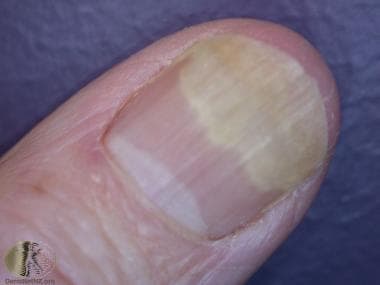
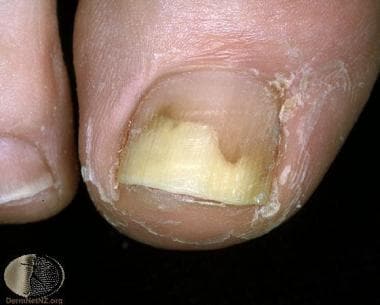
Onycholysis is a nail disorder frequently encountered by dermatologists. Onycholysis is characterized by a spontaneous separation of the nail plate starting at the distal free margin and progressing proximally. The nail plate is separated from the underlying and/or lateral supporting structures. Less often, separation of the nail plate begins at the proximal nail and extends to the free edge, which is seen most often in psoriasis of the nails (termed onychomadesis). Rare cases are confined to the nail's lateral borders.
Pathophysiology
Nails with onycholysis usually are smooth, firm, and without inflammatory reaction. It is not a disease of the nail matrix, but nail discoloration may appear underneath the nail as a result of secondary infection. When onycholysis occurs, a coexistent yeast infection is suggested. Treating primary and secondary factors that exacerbate the condition is important. Left untreated, severe cases of onycholysis may result in nail bed scarring.
Frequency
United States
The incidence of onycholysis in the United States is unknown.
International
The worldwide incidence of onycholysis is unknown.
Race
Distribution of onycholysis by race is unknown; however, it has been observed in all races.
Sex
Individuals of either sex can have onycholysis; however, studies demonstrate an overwhelmingly female predilection.
Age
People of any age can present with onycholysis, although it primarily is a disease of adulthood.
History
Evaluation of patients with onycholysis requires a careful history of exposure to etiologic agents.
Physical
- Nails are smooth, firm, and without inflammatory reaction.
- Discoloration underneath the nail may occur as a result of secondary infection.
- Spontaneous separation of the nail plate starts at the distal free margin and progresses proximally. Less often, nail plate separation may begin at the proximal nail and extend to the free edge. The nail plate is separated from underlying and/or lateral supporting structures.
- Nail plate separation can be confined to the nail's lateral borders (rare).
Causes
Endogenous, exogenous, hereditary, and idiopathic factors can cause onycholysis. Contact irritants, trauma, and moisture are the most common causes of onycholysis, but other associations exist.
- Endogenous factors
- Systemic diseases and states
- Amyloid and multiple myeloma
- Anemia (iron deficient)
- Bronchiectasis
- Diabetes mellitus
- Erythropoietic porphyria
- Histiocytosis X
- Hyperthyroidism
- Hypothyroidism
- Ischemia (peripheral, impaired circulation)
- Leprosy
- Lupus erythematosus
- Neuritis
- Pellagra
- Pemphigus vulgaris
- Pleural effusion
- Porphyria cutanea tarda
- Pregnancy
- Psoriatic arthritis
- Reiter syndrome
- Sarcoidosis
- Scleroderma
- Shell nail syndrome
- Syphilis
- Yellow nail syndrome
- Dermatologic diseases
- Psoriasis
- Lichen planus
- Dermatitis
- Hyperhidrosis
- Pachonychia congenita
- Congenital ectodermal defect
- Pemphigus vegetans
- Lichen striatus
- Atopic dermatitis
- Congenital abnormalities of the nail
- Neoplastic disorders
- Squamous cell carcinoma (of nail bed)
- Carcinoma (lung)
- Exogenous factors
- Nonmicrobial factors (may be encountered at the job site, ie, as occupational onycholysis)
- Mechanical - Mechanical force (trauma), repetitive minor trauma, or maceration
- Chemical - Allergic contact dermatitis from various nail cosmetics (methyl methacrylate monomer, formaldehyde 1-2%, nail base coat/hardeners, polymerized 2-ethylcyanoacrylate adhesive used in artificial nails, nail lacquer), gasoline, paint removers, dicyanodiamide, thioglycolate, solvents, and hydroxylamine sulphate in color developer
- Chemical - Irritant contact dermatitis from prolonged immersion of nails in water, sugar onycholysis in confectioners/bakers, and exposure to highly destructive toxins (eg, hydrofluoric acid)
- Biologic/microbial factors
- Dermatophytosis (ie, Trichophyton rubrum, Trichophyton mentagrophytes infection)
- Yeast (Candida infection)
- Bacteria (Pseudomonas infection)
- Virus (herpes simplex infection)
- Drug associations
- Photo-induced associations, with medication and subsequent exposure to sunlight
- Tetracycline and its derivatives
- Psoralens
- Fluoroquinolones
- Chloramphenicol
- Benoxaprofen
- Chlorpromazine
- Chlortetracycline
- Demethylchlortetracycline
- Doxycycline
- Minocycline
- Oral contraceptives
- 5-methoxypsoralen (Psoraderm 5)
- Photo-induced associations, without medication and exposure to sunlight
- Spontaneous photo-onycholysis
- Bullous photo-onycholysis (during pseudoporphyria resulting from hemodialysis)
- Non-photo–induced associations
- Doxorubicin
- Mitoxantrone
- Captopril
- Bleomycin
- 5-Fluorouracil
- Retinoids
- Tetracycline
- Etoposide
- Paclitaxel
- Docetaxel
- Hydroxylamine
- Other factors
- Congenital onycholysis
- Hereditary partial onycholysis
- Idiopathic acquired onycholysis
- Hereditary distal onycholysis
- Foreign body implantation
Lab Studies
- Perform mycologic studies to exclude onychomycosis, including potassium hydroxide wet mount and fungal cultures. If these studies do not yield a positive result, perform a nail biopsy and stain the specimen with hematoxylin and eosin stain and periodic acid-Schiff (PAS) stain (for fungus).
Histologic Findings
Onycholysis is a clinical diagnosis and has no specific histology; however, if onychomycosis is the etiology for the onycholysis, hyphae are seen lying between the laminae of nail parallel to the surface. The ventral nail and the stratum corneum of the nail bed are affected preferentially. The epidermis may show spongiosis and focal parakeratosis. The inflammatory response in the dermis is minimal. Hyphae may be seen best using PAS stain.
Medical Care
Treatment for onycholysis varies and depends on its cause. Eliminating the predisposing cause is the best treatment.
- Patients should avoid trauma to the affected nail, and keep the nail bed dry.
- Patients should avoid exposure to contact irritants and moisture (important).
- Patients should clip the affected portion of the nail, and keep the nails short.
- Patients should wear light cotton gloves under vinyl gloves for wet work.
Surgical Care
Intralesional injection is an effective therapy if infection is not considered a contributing factor.
- Triamcinolone 2.5-5 mg/mL diluted with normal saline is injected into the proximal nail fold every 4 weeks in a series of 4-6 sessions.
- The proximal nail fold overlying the nail matrix is the ideal site for treatment of diseases that begin at the matrix (eg, psoriasis).
- A 30-gauge needle is adequate for medication delivery; a topical anesthetic may be used to reduce pain.
- Improvement should start after the initial series; continued injections depend on disease recurrence.
- For other nail changes associated with onycholysis (eg, oil drop sign of psoriasis, distal onycholysis, subungual hyperkeratosis), the ideal location for intralesional injection is the nail bed.
- The pain of this procedure necessitates the use of anesthesia.
- This problem can be overcome by injecting the lateral nail folds in an attempt to get medication to the affected area.
Activity
Advise patients to avoid contact irritants, trauma, and moisture.
Apply a topical antifungal imidazole or allylamine twice daily to avoid superinfection of the nail. An oral broad-spectrum antifungal agent (ie, fluconazole, itraconazole, terbinafine) may be used for cases with concomitant onychomycosis.
High-potency topical steroids (ie, clobetasol ointment) under occlusion have been used with less than ideal results for patients unwilling to undergo intralesional injection of corticosteroids in noninfectious causes of onycholysis. Patients follow this regimen for 2 weeks and then discontinue use of topical steroids for 2 weeks to avoid the other local adverse effects of topical steroids.
Massaging 5-fluorouracil 1% solution twice a day into the proximal nail fold for 4 months has been effective for patients with nail pitting and hyperkeratosis from psoriasis. Localized psoralen plus UV-A (PUVA), oral etretinate, hydroxyurea, and isotretinoin are other agents that have had some success in treating onycholysis resulting from psoriasis.
Treatment is not without adverse effects. They may include subungual hematoma secondary to intralesional steroid injections and photo hemolysis secondary to PUVA treatment. Explain risks to patients before initiating therapy.
Drug Category: Antifungals
Treat superinfection of the onycholytic nail by dermatophytic molds and/or candidal yeasts.
| Drug Name | Clotrimazole (Mycelex, Lotrimin) |
| Description | Broad-spectrum antifungal agent that inhibits yeast growth by altering cell membrane permeability, causing death of fungal cells. |
| Adult Dose | Gently massage into affected area and surrounding skin areas bid |
| Pediatric Dose | Not established |
| Contraindications | Documented hypersensitivity |
| Interactions | None reported |
| Pregnancy | B - Usually safe but benefits must outweigh the risks.
|
| Precautions | Not for treatment of systemic fungal infections; avoid contact with the eyes; if irritation or sensitivity develops, discontinue use and institute appropriate therapy |
| Drug Name | Econazole (Spectazole) |
| Description | Effective in cutaneous infections. Interferes with RNA and protein synthesis and metabolism. Disrupts fungal cell wall membrane permeability, causing fungal cell death. |
| Adult Dose | Apply sparingly over affected areas qd/bid |
| Pediatric Dose | Apply as in adults |
| Contraindications | Documented hypersensitivity |
| Interactions | None reported |
| Pregnancy | C - Safety for use during pregnancy has not been established.
|
| Precautions | For external use only; avoid contact with eyes; discontinue if sensitivity or irritation develops |
| Drug Name | Ketoconazole (Nizoral) |
| Description | Imidazole broad-spectrum antifungal agent; inhibits synthesis of ergosterol, causing cellular components to leak, resulting in fungal cell death. |
| Adult Dose | Rub gently into affected area qd or bid |
| Pediatric Dose | Apply as in adults |
| Contraindications | Documented hypersensitivity; fungal meningitis |
| Interactions | None reported |
| Pregnancy | C - Safety for use during pregnancy has not been established.
|
| Precautions | If sensitivity or irritation develops, discontinue use; for external use only; avoid contact with eyes |
| Drug Name | Fluconazole (Diflucan) |
| Description | Synthetic oral antifungal (broad-spectrum bistriazole) that selectively inhibits fungal cytochrome P450 and sterol C-14 alpha-demethylation. |
| Adult Dose | 150-300 mg/wk PO for 4-9 mo |
| Pediatric Dose | Not established |
| Contraindications | Documented hypersensitivity |
| Interactions | Levels may increase with thiazides; fluconazole levels may decrease with chronic coadministration of rifampin; coadministration of fluconazole may decrease phenytoin clearance; may increase concentrations of theophylline, tolbutamide, glyburide, and glipizide; effects of anticoagulants may increase with fluconazole coadministration; increases in cyclosporine concentrations may occur when coadministered |
| Pregnancy | C - Safety for use during pregnancy has not been established.
|
| Precautions | Monitor closely if rash develops and discontinue if lesions progress; may cause clinical hepatitis, cholestasis, and fulminant hepatic failure (including death) with underlying medical conditions (eg, AIDS or malignancy), and while taking multiple concomitant medications; not recommended in breastfeeding |
| Drug Name | Itraconazole (Sporanox) |
| Description | Fungistatic activity. Synthetic triazole antifungal agent that slows fungal cell growth by inhibiting cytochrome P-450-dependent synthesis of ergosterol, a vital component of fungal cell membranes. |
| Adult Dose | 200 mg PO bid for 1 wk each mo for 3-4 mo (pulse dosing) |
| Pediatric Dose | Not established |
| Contraindications | Documented hypersensitivity; coadministration with cisapride may cause adverse cardiovascular effects (possibly death) |
| Interactions | Antacids may reduce absorption of itraconazole; edema may occur with coadministration of calcium channel blockers (eg, amlodipine, nifedipine); hypoglycemia may occur with sulfonylureas; may increase tacrolimus and cyclosporine plasma concentrations when high doses are used; rhabdomyolysis may occur with coadministration of HMG-CoA reductase inhibitors (lovastatin, simvastatin); coadministration with cisapride can cause cardiac rhythm abnormalities and death; may increase digoxin levels; coadministration may increase plasma levels of midazolam or triazolam; phenytoin and rifampin may reduce itraconazole levels (phenytoin metabolism may be altered) |
| Pregnancy | C - Safety for use during pregnancy has not been established.
|
| Precautions | Caution in hepatic insufficiencies |
| Drug Name | Terbinafine (Lamisil) |
| Description | First oral allylamine antimycotic agent to be released, having a different mode of action than the azoles. Considered to be fungicidal, rather than fungistatic. Inhibits the enzyme squalene epoxidase in the sterol synthesis pathway. |
| Adult Dose | 250 mg PO qd for 6 wk (fingernails) or 90 d (toenails) or 500 mg PO qd for 7 d/mo for 2 mo (fingernails) or 3-4 mo (toenails) |
| Pediatric Dose | Not established |
| Contraindications | Documented hypersensitivity |
| Interactions | When administered concurrently with cyclosporine, oral administration of terbinafine may increase cyclosporine clearance; rifampin may decrease terbinafine clearance; cimetidine may decrease terbinafine clearance |
| Pregnancy | B - Usually safe but benefits must outweigh the risks.
|
| Precautions | Reports of elevated liver enzymes and neutropenia warrant monitoring liver function tests and CBC counts with differential; hypersensitivity reactions have been reported; discontinue treatment if symptoms or signs of hepatobiliary dysfunction or cholestatic hepatitis develop or if chemical irritation occurs; avoid contact with the eyes. |
Drug Category: Corticosteroids
Treat noninfectious causes of onycholysis. Have anti-inflammatory properties and cause profound and varied metabolic effects. Modify the body's immune response to diverse stimuli. Intralesional and topical corticosteroids are designed to treat any noninfectious inflammatory condition associated with onycholysis with minimal risk for systemic absorption.
| Drug Name | Triamcinolone (Aristocort) |
| Description | For inflammatory dermatosis responsive to steroids. Decreases inflammation by suppressing migration of polymorphonuclear leukocytes and reversing capillary permeability. |
| Adult Dose | Up to 5 mg/mL injected intralesionally at proximal and/or lateral nail folds, repeated monthly up to 6 mo |
| Pediatric Dose | Not established |
| Contraindications | Documented hypersensitivity; fungal, viral, and bacterial skin infections |
| Interactions | None reported |
| Pregnancy | C - Safety for use during pregnancy has not been established.
|
| Precautions | Do not use in decreased skin circulation; prolonged use, applications over large areas, and use of potent steroids and occlusive dressings may result in systemic absorption; systemic absorption may cause Cushing syndrome, reversible HPA-axis suppression, hyperglycemia, and glycosuria |
| Drug Name | Clobetasol (Temovate) |
| Description | Class I superpotent topical steroid; suppresses mitosis and increases synthesis of proteins that decrease inflammation and cause vasoconstriction. |
| Adult Dose | Apply to affected areas bid for 2 wk; discontinue for 2 wk; repeat until resolved; not to exceed 50 g/wk |
| Pediatric Dose | <12 years: Not recommended >12 years: Apply as in adults |
| Contraindications | Documented hypersensitivity; viral or fungal skin infections |
| Interactions | None reported |
| Pregnancy | C - Safety for use during pregnancy has not been established.
|
| Precautions | May suppress adrenal function in prolonged therapy |
Drug Category: Pyrimidine antagonists, topical
Inhibit cell growth and proliferation. Mechanism is unknown for treating onycholysis. Reported to be effective in the treatment of nail pitting and onycholysis associated with psoriasis.
| Drug Name | Fluorouracil (Fluoroplex) |
| Description | Fluorinated pyrimidine analog used in topical form to treat actinic keratoses. Has unknown mechanism in treating onycholysis. Use 1% solution. |
| Adult Dose | Massage into proximal nail fold bid for 4 mo |
| Pediatric Dose | Not established |
| Contraindications | Documented hypersensitivity; potentially serious infections |
| Interactions | None reported |
| Pregnancy | X - Contraindicated in pregnancy
|
| Precautions | Incidence of inflammatory reactions may occur with occlusive dressings; porous gauze dressing may be applied for cosmetic reasons without increase in reaction; patients should expect inflammatory reaction with crusting |
Deterrence/Prevention:
- Avoid contact irritants, trauma, and moisture.
- Keep nail beds dry.
- Keep nails short; clip affected portions.
- Wear light cotton gloves under vinyl gloves for wet work.
Prognosis:
- Severe cases that are left untreated may result in nail bed scarring.
Patient Education:
- Educate patients about avoiding possible contact irritants, trauma, and moisture.
- For excellent patient education resources, visit eMedicine's Skin, Hair, and Nails Center, Psoriasis Center, and Yeast and Fungal Infections Center. Also, see eMedicine's patient education articles Subungual Hematoma (Bleeding Under Nail), Nail Psoriasis, and Onychomycosis.
Medical/Legal Pitfalls
- Failure to explain risk of adverse effects of treatment (eg, subungual hematoma secondary to intralesional steroid injections, photo hemolysis secondary to PUVA treatment)
- Bazex J, Baran R, Monbrun F, et al. Hereditary distal onycholysis--a case report. Clin Exp Dermatol. Mar 1990;15(2):146-8. [Medline].
- Bodman MA. Nail dystrophies. Clin Podiatr Med Surg. Oct 2004;21(4):663-87, viii. [Medline].
- Daniel CR 3rd, Daniel MP, Daniel CM, et al. Chronic paronychia and onycholysis: a thirteen-year experience. Cutis. Dec 1996;58(6):397-401. [Medline].
- Horio T. Spontaneous photo-onycholysis. J Dermatol. Dec 1988;15(6):540-2. [Medline].
- Kechijian P. Onycholysis of the fingernails: evaluation and management. J Am Acad Dermatol. Mar 1985;12(3):552-60. [Medline].
- Makris A, Mortimer P, Powles TJ. Chemotherapy-induced onycholysis. Eur J Cancer. Feb 1996;32A(2):374-5. [Medline].
- Passier A, Smits-van Herwaarden A, van Puijenbroek E. Photo-onycholysis associated with the use of doxycycline. BMJ. Jul 31 2004;329(7460):265. [Medline].
- Rabar D, Combemale P, Peyron F. Doxycycline-induced photo-onycholysis. J Travel Med. Nov-Dec 2004;11(6):386-7. [Medline].
- Scher RK, Daniel CR. Nails: Therapy, Diagnosis, Surgery. 2nd ed. Philadelphia, Pa: WB Saunders; 1997:. 140, 169, 227-9.
- Tinio P, Bershad S, Levitt JO. Medical Pearl: Docetaxel-induced onycholysis. J Am Acad Dermatol. Feb 2005;52(2):350-1. [Medline].
Onycholysis excerpt Article Last Updated: Jan 26, 2007
|