Background
Lichen sclerosus (LS) is a chronic inflammatory dermatosis of unknown cause that most commonly affects the genitalia (vulvar and penile lichen sclerosus), but it can occur at any skin site (extragenital lichen sclerosus). Outdated terms for this conditions include lichen sclerosus et atrophicus, balanitis xerotica obliterans (glans penis presentation), and kraurosis vulvae (older description of vulvar presentation). Lichen sclerosus can occur in males or females of any age, but it more commonly affects prepubertal or perimenopausal females or males between puberty and age 60 years. It is characterized by white, often atrophic, plaques associated with pruritus and pain that result in genital scarring and adhesion. Complications include pain, sexual and/or urinary dysfunction, reduced quality of life, and an increased risk of squamous cell carcinoma (< 5%) with genital lichen sclerosus.

Pathophysiology
Inflammation and altered fibroblast function in the papillary dermis lead to fibrosis of the upper dermis. Genital skin and mucosa are affected most frequently, with only rare reports of oral presentations. It has been hypothesized that oral manifestations are underdiagnosed or misdiagnosed as oral lichen planus, or that environmental effects play a large role in disease expression.
Findings within lichen sclerosus (LS) tissue include the following:
-
Increased glut-1 and decreased vascular endothelial growth factor (VEGF) expression - Suggesting a role for hypoxia and ischemia) [1]
-
Higher expression of extracellular matrix (ECM) proteins and connective-tissue growth factor (CTGF) - Up-regulation may induce accumulation of ECM proteins and maintain fibrosis in chronic vulval lichen sclerosus [2]
-
Altered expression of isocitrate dehydrogenase enzymes and aberrant hydroxymethylation - Indicating an epigenetic background for the pathogenesis of vulval lichen sclerosus) [3]
-
Increased levels of TH1-specific cytokines, a dense T-cell infiltrate and enhanced BIC/miR-155 expression, and a microRNA involved in regulation of the immune response - Demonstrating an autoimmune phenotype in vulvar lichen sclerosus [4]
-
Distinct expression patterns of tissue remodelling–associated genes in boys with congenital phimosis and lichen sclerosus [5]
-
Decreased or absent epidermal expression of CD44 - Suggesting lichen sclerosus might result from epidermal damage of unknown origin, resulting in CD44-deficient dermal changes with hyaluronic acid accumulation [6]
-
Increased incidence of autoantibodies to EMC protein 1 and to BP180 antigen, with increased circulation of NC16A domain–specific T cells [7]
Etiology
The etiology and pathogenesis of lichen sclerosus (LS) is unknown but may include genetic, infectious, environmental, and hormonal factors.
Several older studies have linked borrelial or other infections with lichen sclerosus, yet most other studies have disputed this, with polymerase chain reaction–based studies showing no increased incidence of borrelial infection. [8]
Genetic and autoimmune factors have been explored, without identification of consistent, reproducible patterns, although autoantibodies to extracellular extracellular matrix (ECM) protein 1 have now been reported by several independent authors. Increased circulating autoantibodies may be as high as 28%, comparable to the rate seen in bullous lichen planus. [9] Baldo et al reported that more than 40% of vulvar lichen sclerosus and lichen planus patients have reactive T cells to the NC16A domain of bullous pemphigoid antigen 180 [7] ; however, other studies suggest that the level of autoantibodies is poorly correlated to disease activity and response to treatment. Women with lichen sclerosus have a higher rate of associated autoimmune disease (odds ratio, 4.3), especially for autoimmune thyroid disease, compared with men. [10]
Local irritation or trauma seems to play a role in some cases of lichen sclerosus, especially in genetically predisposed individuals. [11] However, the sequence of events that leads to the altered fibroblast function, microvascular changes, and hyaluronic acid accumulation in the upper dermis continues to be researched.
Oral contraceptives in premenopausal women have been shown to give a relative risk of 2.5, which suggests an altered hormonal axis as a possible contributory factor. [12]
Lichen sclerosus may occur in association with other inflammatory conditions, including psoriasis. [13] This is surprising because the histopathological findings of lichen sclerosus and psoriasis are dissimilar.
Epidemiology
Frequency
Lichen sclerosus (LS) is a relatively common dermatosis, although the true prevalence of lichen sclerosus is unknown and likely underestimated. This may be because patients are distributed among different specialties (gynecology, dermatology, family practice, urology), but also because one third of cases can be asymptomatic.
The prevalence of genital lichen sclerosus in prepubertal girls is 0.1% (1 in 900). [14]
The prevalence of vulvar lichen sclerosus in elderly nursing home women in one study was found to be 3% (1 in 30). [15]
One study found the rate to be approximately 1.7% among women seen in a gynecology practice. The prevalence of male lichen sclerosus is thought to be influenced by the rate of circumcision, as male genital lichen sclerosus is seen almost exclusively in uncircumcised or incompletely circumcised men and boys. Therefore, the rate of circumcision in a given population would thus influence the rate in this subset.
The prevalence of extragenital lichen sclerosus is unclear as a study of foreskins submitted after therapeutic circumcision for phimosis revealed many cases of unrecognized lichen sclerosus. Extragenital lichen sclerosus is much less common than genital lichen sclerosus and is rare in children.
Race
Lichen sclerosus, both genital and extragenital, has no known racial predilection. A genetic predisposition, based on family clustering, is apparent. [16] . Of patients with vulvar lichen sclerosus, 8-39% report a family history of the condition, while only 1% of male genital lichen sclerosus patients have a family history. [17]
Sex
The female-to-male ratio is 3:1-10:1. [17]
Age
Vulvar lichen sclerosus can occur at any age, with increasing incidence with age. In females, the two peaks of onset are during prepubertal and perimenopausal/postmenopausal ages. Interestingly, both are low estrogen states. It is unclear if there is a hormonal relationship or whether this low estrogen state promotes koebnerization due to reduced lubrication. In males, the incidence increases after puberty and then decreases again in older age (>60 years).
Prognosis
Prognosis is good for more acute genital cases of lichen sclerosus (LS), especially for those in the pediatric age group, in whom it may resolve spontaneously. Prognosis for improvement is poor for extragenital cases and for chronic atrophic genital disease.
Many pediatric cases improve with puberty. In contrast, some authors suggest the rate of spontaneous resolution may be lower than 25%. [18]
Lichen sclerosus has no associated increased mortality unless the patient develops a malignancy in the area. Cancer arising in extragenital presentations is described only rarely and may be coincident with other factors.
Extragenital cases and many genital cases are asymptomatic, except for the cosmetic aspect or pruritus. Recalcitrant cases, especially those associated with erosion or progressive scarring, may result in severe sexual dysfunction.
An increased risk of squamous cell carcinoma may exist in genital disease, but the precise increase in risk and what cofactors (human papillomavirus infection or prior radiotherapy) may be involved are not yet completely defined. In patients who have been treated for vulvar cancer, the presence or absence of lichen sclerosus does not appear to affect the timing of recurrence.
Patient Education
Education relating to sexual dysfunction and dyspareunia may be required. Patients with genital lichen sclerosus should be educated on what changes (eg, ulceration) might indicate malignant transformation and mandate an immediate reevaluation.
-
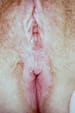
Lichen sclerosus demonstrating classic hourglass or figure 8 vulvar and perianal distribution. Courtesy of Wilford Hall Medical Center slide files.
-
Extragenital lichen sclerosus demonstrating coalescing pitted white papules. Courtesy of Wilford Hall Medical Center slide files.
-
Typical lichen sclerosus histology demonstrating homogenized edematous papillary (upper) dermis and effaced epidermis.
-
More advanced vulvar lichen sclerosus; eroded areas need to be carefully examined and a biopsy sample should be taken to exclude coexistent squamous cell carcinoma. Courtesy of Wilford Hall Medical Center Dermatology slide files.
-
Male genital lichen sclerosus may present with a sclerotic ring at the edge of the prepuce or anywhere on the glans itself. Advanced disease at the urethral os may lead to urinary obstruction. Courtesy of Wilford Hall Medical Center Dermatology Slide files.
-
Late lichen sclerosus may show less edema in the upper dermis and more sclerosis throughout the dermis. Involvement of the lower dermis or fat may occur in lichen sclerosus/scleroderma overlap presentations.