Continually Updated Clinical Reference
 
 
  All Sources     eMedicine     Medscape     Drug Reference     MEDLINE
 
eMedicine - Hydroa Vacciniforme : Article by

Quick Find
Authors & Editors
Introduction
Clinical
Differentials
Workup
Treatment
Medication
Follow-up
Miscellaneous
Multimedia
References

Related Articles
Actinic Prurigo

Chickenpox

Epidermolysis Bullosa

Epidermolysis Bullosa Acquisita

Erythropoietic Protoporphyria

Hartnup Disease

Herpes Simplex

Polymorphous Light Eruption

Porphyria Cutanea Tarda

Pseudoporphyria

Urticaria, Solar


Patient Education
Click here for patient education.


Author: Quynh L Sebastian, MD, Clinical Instructor, Division of Dermatology, UCLA David Geffen School of Medicine

Quynh L Sebastian is a member of the following medical societies: American Academy of Dermatology, American Society for Dermatologic Surgery, and American Society for Laser Medicine and Surgery

Coauthor(s): Raul DelRosario, MD, Surgical Pathology and Dermatopathology, South Coast Medical

Editors: Maureen B Poh-Fitzpatrick, MD, Professor Emerita of Dermatology and Special Lecturer, Columbia University; Professor of Medicine (Dermatology), University of Tennessee; Michael J Wells, MD, Associate Professor, Department of Dermatology, Texas Tech University Health Sciences Center; Van Perry, MD, Assistant Professor, Department of Medicine, Division of Dermatology, University of Texas Health Science Center; Catherine Quirk, MD, Clinical Assistant Professor, Department of Dermatology, Brown University; Dirk M Elston, MD, Director, Department of Dermatology, Geisinger Medical Center

Author and Editor Disclosure

Synonyms and related keywords: Bazin hydroa vacciniforme, HV, photodermatosis

Background

Hydroa vacciniforme (HV) is a rare, chronic photodermatosis of unknown origin occurring in childhood. Recurrent vesicles on sun-exposed skin that heal with vacciniform or varioliform scarring characterize HV. The histopathologic features are distinctive and demonstrate intraepidermal reticular degeneration and cellular necrosis. Most cases remit spontaneously by late adolescence.

Pathophysiology

The etiology of HV is not known. HV may be a distinct entity distinguished by scarring or may occur within the spectrum of polymorphous light eruption. Skin lesions occur on sun-exposed skin, such as the face, ears, and hands, and they may be accompanied by a mild keratoconjunctivitis, photophobia, or constitutional symptoms.

Frequency

United States

The frequency of HV in the United States is unknown.

International

The frequency of HV varies according to country. In Scotland, for example, the reported prevalence is 0.34 cases per 100,000 people.

Mortality/Morbidity

No mortality is associated with typical HV.

Sex

Females have a higher incidence of HV than males and report earlier onset. Males who are affected have a longer course of disease than females.

Age

HV predominately affects children aged 3-15 years. Cases of HV in infants and elderly persons have also been described.


History

  • Mild burning, itching or stinging in exposed sites beginning 30 minutes to 2 hours after sun exposure (common)
    • Vesicles heal with varioliform scarring.
    • The initial onset of lesions occurs in spring with recurrences in summer months.
  • Constitutional symptoms (uncommon)
  • Photophobia (seldom)

Physical

Skin and mucous membranes are the primary sites affected by HV.

  • Skin
    • Tense, edematous papules progress to clear, then, cloudy discrete vesicles.
    • Lesions become umbilicated, necrotic papules on an erythematous base.
    • Papules heal with hypopigmented depressed scars.
  • Eye
    • Mild keratoconjunctivitis
    • Corneal clouding and stellate keratotic precipitates in the cornea, indicating an inflammatory keratitis (one report)
  • Other symptoms
    • Photo-onycholysis
    • Limited partial absorption of bone and cartilage in severe HV
    • Earlobe mutilation and flexion contracture of a digit (reported in 1 patient)

Causes

The development of lesions and their distribution suggest a causal relationship between HV and ultraviolet (UV) exposure, although the pathogenetic mechanism remains unknown. Ultraviolet A (UV-A) radiation is most often implicated. Two reports of HV in siblings have been documented, suggesting a genetic component to HV. Some cases have occurred in the setting of hematopoietic malignancy.


Actinic Prurigo
Chickenpox
Epidermolysis Bullosa
Epidermolysis Bullosa Acquisita
Erythropoietic Protoporphyria
Hartnup Disease
Herpes Simplex
Polymorphous Light Eruption
Porphyria Cutanea Tarda
Pseudoporphyria
Urticaria, Solar

Other Problems to be Considered

Hydroa aestivale
Lymphoproliferative disorders


Lab Studies

  • CBC count to investigate constitutional symptoms
  • Viral culture of blister fluid to rule out herpes virus infection
  • Erythrocyte sedimentation rate and antinuclear antibody, anti-Ro, and anti-La antibody tests to rule out bullous lupus erythematosus
  • Plasma or serum porphyrin assay to exclude cutaneous porphyrias
  • DNA repair studies to rule out xeroderma pigmentosum

Imaging Studies

  • Imaging studies are not routinely obtained as part of the workup of HV.

Other Tests

  • Repetitive, broad-spectrum, UV-A phototesting
    • Repetitive, broad-spectrum, low-dose UV-A irradiation can elicit lesions clinically and histologically identical to those produced by natural UV exposure, although results are inconsistent.
    • The minimal erythemal dose of ultraviolet B (UV-B) and UV-A in these patients is usually normal.

Histologic Findings

Early lesions reveal an epidermal, multilocular vesicle with reticular degeneration. A dense, perivascular, lymphohistiocytic infiltrate with vessel hemorrhage and thrombosis may occur in the dermis. Late lesions show epidermal and dermal necrosis with a surrounding, chronic, inflammatory infiltrate. Direct immunofluorescence study results are usually normal, except for rare reports (2 patients) of C3 deposits at the dermoepidermal junction and in the small dermal vessels.


Medical Care

In addition to medication and certain restrictions on activity, management may include a prophylactic "hardening" course of phototherapy.

  • Low-dose, narrow-band UV-B (TL-01) phototherapy, either daily or 3 times a week in the spring, may confer relative photoprotection.
  • Psoralen photochemotherapy (PUVA) administered prophylactically in older patients may be effective in desensitization.

Consultations

  • Consult a dermatologist for evaluation and management of HV.
  • Consult an ophthalmologist for evaluation and management of associated eye findings.

Diet

Generally, no diet restrictions or requirements are indicated in the management of HV.

Activity

Strict sun avoidance, appropriate clothing, and frequent application of high sun protection factor (SPF) sunscreens with UV-A blocking agents are advised.


To date, no oral therapy reliably prevents the appearance of HV lesions. Oral antimalarials and beta-carotene are most commonly used and are occasionally useful, especially when combined with a strict sun avoidance program. Other therapies that have been used with varying success include thalidomide, azathioprine, cyclosporine, and fish oil supplementation.

Drug Category: Antimalarials

These agents suppress cutaneous lesions associated with many photodermatoses.

Drug NameHydroxychloroquine (Plaquenil)
DescriptionCan be used for suppression of lesions; mechanism of action in HV is unknown.
Adult DoseActive disease: 200-400 mg PO qd
Maintenance: 100-200 mg PO qd
Pediatric Dose6 mg/kg/d PO for 4-6 wk, followed by 5 mg/kg/d; not to exceed 400 mg/d
ContraindicationsDocumented hypersensitivity; psoriasis; retinal and visual field changes attributable to 4-aminoquinolones
InteractionsSerum levels increase with cimetidine; magnesium trisilicate may decrease absorption
PregnancyC - Safety for use during pregnancy has not been established.
PrecautionsCaution in hepatic disease, alcoholism, and G-6-PD deficiency; coadministration with other hepatotoxic drugs; children are especially sensitive to 4-aminoquinolone compounds in antimalarials; fatalities reported following accidental ingestion; perform periodic (6 mo) ophthalmologic examinations; test periodically for muscle weakness

Drug NameChloroquine (Aralen)
DescriptionAnti-inflammatory activity by suppressing lymphocyte transformation and may have photoprotective effect. Can be used for suppression of lesions; mechanism of action in HV is unknown.
Adult Dose500 mg (300 mg base) PO qd
Pediatric Dose3.5 mg base/kg/d PO
ContraindicationsDocumented hypersensitivity; psoriasis; retinal and visual field changes attributable to 4-aminoquinolones
InteractionsCimetidine may increase serum levels (possibly other 4-aminoquinolones); magnesium trisilicate may decrease absorption of 4-aminoquinolones
PregnancyC - Safety for use during pregnancy has not been established.
PrecautionsCaution in hepatic disease, G-6-PD deficiency, psoriasis, and porphyria; not recommended for long-term use in children; perform periodic ophthalmologic examinations; test for muscle weakness; retinopathy, tinnitus, nerve deafness, skin eruption, headache, anorexia, nausea, vomiting, and diarrhea may occur

Drug Category: Carotenoids

These agents are yellow-orange pigments that may have photoprotective properties in selected photodermatoses.

Drug NameBeta-carotene
DescriptionMechanism of action not completely elucidated but may relate to ability of carotenoids to quench photoexcited molecular species. Reduces severity of photosensitivity reactions in some patients with photodermatoses, especially erythropoietic protoporphyria (EPP).
Adult Dose30-300 mg PO qd in divided doses
Pediatric Dose30-150 mg PO qd in divided doses
ContraindicationsDocumented hypersensitivity
InteractionsCoadministration with vitamin A may result in additive toxic effects
PregnancyB - Usually safe but benefits must outweigh the risks.
PrecautionsCaution in patients with renal or hepatic impairment; may increase risk for lung cancer in heavy smokers; may cause orange stools and cause diarrhea or loose stools at onset of therapy that tend to resolve with continued use

Drug Category: Psoralens

After intercalating with DNA and irradiation by UVA, it leads to formation of DNA psoralen adducts that cross-link DNA. This affects gene expression by inhibiting DNA replication, mitosis, and cell division. 5-methoxypsoralen (5-MOP, Bergapten, Psoraderm 5) has also been used, although it is not currently available in the United States.

Drug NameMethoxsalen (8-MOP, Oxsoralen)
DescriptionInhibits mitosis by binding covalently to pyrimidine bases in DNA when photoactivated by UV-A.
Adult Dose0.57 mg/kg PO 1.5-2 h before exposure to UV light, at least 48 h apart
Pediatric DoseNot established
ContraindicationsDocumented hypersensitivity; squamous cell cancer; cataract; light sensitive diseases, such as lupus or porphyria; ingestion of photosensitizing drugs; hepatitic disease; arsenic therapy
InteractionsToxicity increases with phenothiazines, griseofulvin, nalidixic acid, tetracyclines, thiazides, and sulfanilamides
PregnancyC - Safety for use during pregnancy has not been established.
PrecautionsSevere burns may occur from sunlight or UV-A if dose or treatment frequency exceeded; use only if response to other forms of therapy is inadequate; long-term use may increase risk of skin cancer


Further Inpatient Care

  • HV is managed on an outpatient basis.

Further Outpatient Care

  • Patients with extracutaneous findings associated with HV should be referred to the appropriate specialist.

In/Out Patient Meds

Deterrence/Prevention

  • Avoiding the sun, frequently applying high SPF sunscreens with UV-A blocking agents, and wearing protective clothing may prevent episodes of HV.

Complications

  • Complications are rare in HV. The most common severe sequela is the varioliform scarring.

Prognosis

  • The prognosis is excellent; HV remits by adolescence.

Patient Education

  • Patients are advised regarding strict sun avoidance, frequent application of high SPF sunscreens with UV-A blocking agents, and protective clothing.


Medical/Legal Pitfalls

  • Failure to educate the patient regarding sun avoidance measures is poor management. The physician should also monitor for adverse effects and laboratory abnormalities while the patient is on oral therapy, particularly antimalarials.

Special Concerns

  • Rigid sun avoidance may be socially devastating for the pediatric patient with HV. The physician should work closely with the parents and management team in supporting and educating the child regarding this disease.


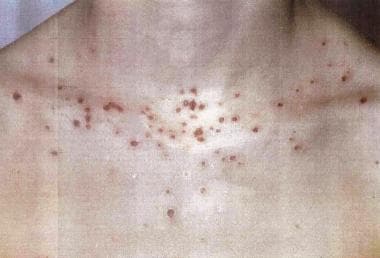
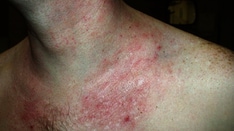
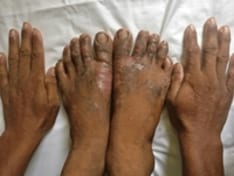
Media file 1:  Characteristic vesicular lesions occur on sun-exposed skin and heal with varioliform scarring.
Click to see larger pictureClick to see detailView Full Size Image
Media type:  Photo


  • Annamalai R. Hydroa vacciniforme in three alternate siblings. Arch Dermatol. Feb 1971;103(2):224-5. [Medline].
  • Ashurst PJ. Hydroa vacciniforme occurring in association with Hartnup disease. Br J Dermatol. Jul 1969;81(7):486-92. [Medline].
  • Bickers DR, Demar LK, DeLeo V, et al. Hydroa vacciniforme. Arch Dermatol. Aug 1978;114(8):1193-6. [Medline].
  • Blackwell V, McGregor JM, Hawk JL. Hydroa vacciniforme presenting in an adult successfully treated withcyclosporin A. Clin Exp Dermatol. Mar 1998;23(2):73-6. [Medline].
  • Bruderer P, Shahabpour M, Christoffersen S, et al. Hydroa vacciniforme treated by a combination of beta-carotene andcanthaxanthin. Dermatology. 1995;190(4):343-5. [Medline].
  • Collins P, Ferguson J. Narrow-band UVB (TL-01) phototherapy: an effective preventative treatmentfor the photodermatoses. Br J Dermatol. Jun 1995;132(6):956-63. [Medline].
  • De Pietro U, Simoni R, Barbieri C, Girolomoni G. Hydroa vacciniforme persistent in a 60-year-old man. Eur J Dermatol. Jun 1999;9(4):311-2. [Medline].
  • Ferguson J, Ibbotson S. The idiopathic photodermatoses. Semin Cutan Med Surg. Dec 1999;18(4):257-73. [Medline].
  • Goldgeier MH, Nordlund JJ, Lucky AW, et al. Hydroa vacciniforme: diagnosis and therapy. Arch Dermatol. Aug 1982;118(8):588-91. [Medline].
  • Gu H, Chang B, Qian H, Li G. A clinical study on severe hydroa vacciniforme. Chin Med J (Engl). Aug 1996;109(8):645-7. [Medline].
  • Gupta G, Man I, Kemmett D. Hydroa vacciniforme: A clinical and follow-up study of 17 cases. J Am Acad Dermatol. Feb 2000;42(2 Pt 1):208-13. [Medline].
  • Halasz CL, Leach EE, Walther RR, Poh-Fitzpatrick MB. Hydroa vacciniforme: induction of lesions with ultraviolet A. J Am Acad Dermatol. Feb 1983;8(2):171-6. [Medline].
  • Hashizume H, Tokura Y, Oku T, et al. Photodynamic DNA-breaking activity of serum from patients with various photosensitivity dermatoses. Arch Dermatol Res. 1995;287(6):586-90. [Medline].
  • Iwatsuki K, Ohtsuka M, Akiba H, Kaneko F. Atypical hydroa vacciniforme in childhood: from a smoldering stage toEpstein-Barr virus-associated lymphoid malignancy. J Am Acad Dermatol. Feb 1999;40(2 Pt 1):283-4. [Medline].
  • Iwatsuki K, Ohtsuka M, Harada H, et al. Clinicopathologic manifestations of Epstein-Barr virus-associatedcutaneous lymphoproliferative disorders. Arch Dermatol. Sep 1997;133(9):1081-6. [Medline].
  • Jeng BH, Margolis TP, Chandra NS, McCalmont TH. Ocular findings as a presenting sign of hydroa vacciniforme. Br J Ophthalmol. Nov 2004;88(11):1478-9. [Medline].
  • Kim WS, Yeo UC, Chun HS, Lee ES. A case of hydroa vacciniforme with unusual ear mutilation. Clin Exp Dermatol. Mar 1998;23(2):70-2. [Medline].
  • Magana M, Sangueza P, Gil-Beristain J, et al. Angiocentric cutaneous T-cell lymphoma of childhood (hydroa-likelymphoma): a distinctive type of cutaneous T-cell lymphoma. J Am Acad Dermatol. Apr 1998;38(4):574-9. [Medline].
  • Omenn GS, Goodman GE, Thornquist MD, et al. Effects of a combination of beta carotene and vitamin A on lung cancer andcardiovascular disease. N Engl J Med. May 2 1996;334(18):1150-5. [Medline].
  • Rhodes LE, White SI. Dietary fish oil as a photoprotective agent in hydroa vacciniforme. Br J Dermatol. Jan 1998;138(1):173-8. [Medline].
  • Rhodes LE, Durham BH, Fraser WD, Friedmann PS. Dietary fish oil reduces basal and ultraviolet B-generated PGE2 levels inskin and increases the threshold to provocation of polymorphic lighteruption. J Invest Dermatol. Oct 1995;105(4):532-5. [Medline].
  • Ruiz-Maldonado R, Parrilla FM, Orozco-Covarrubias ML, et al. Edematous, scarring vasculitic panniculitis: a new multisystemic disease with malignant potential. J Am Acad Dermatol. Jan 1995;32(1):37-44. [Medline].
  • Sato K, Taguchi H, Maeda T, et al. The primary cytotoxicity in ultraviolet-a-irradiated riboflavin solutionis derived from hydrogen peroxide. J Invest Dermatol. Oct 1995;105(4):608-12. [Medline].
  • Taylor CR, Duke D. Blistering, scarring, and photosensitivity in a male teenager. Arch Dermatol. Oct 1999;135(10):1267, 1270. [Medline].
  • The Alpha-Tocopherol, Beta Carotene Cancer Prevention Study Group. The effect of vitamin E and beta carotene on the incidence of lung cancer and other cancers in male smokers. N Engl J Med. Apr 14 1994;330(15):1029-35. [Medline].
  • Tokura Y, Ishihara S, Ohshima K, et al. Severe mosquito bite hypersensitivity, natural killer cell leukaemia,latent or chronic active Epstein-Barr virus infection and hydroavacciniforme-like eruption. Br J Dermatol. May 1998;138(5):905-6. [Medline].
  • Wisuthsarewong W, Leenutaphong V, Viravan S. Hydroa vacciniforme with ocular involvement. J Med Assoc Thai. Oct 1998;81(10):807-11. [Medline].
  • Yesudian PD, Sharpe GR. Hydroa vacciniforme with oral mucosal involvement. Pediatr Dermatol. Sep-Oct 2004;21(5):555-7. [Medline].
  • Yoon TY, Kim YG, Kim JW, Kim MK. Nodal marginal zone lymphoma in association with hydroa vacciniforme-like papulovesicular eruption, hypersensitivity to mosquito bites and insect bite-like reaction. Br J Dermatol. Jul 2005;153(1):210-2. [Medline].
  • Ziering CL, Rabinowitz LG, Esterly NB. Antimalarials for children: indications, toxicities, and guidelines. J Am Acad Dermatol. May 1993;28(5 Pt 1):764-70. [Medline].

Hydroa Vacciniforme excerpt

Article Last Updated: Feb 28, 2006