Continually Updated Clinical Reference
 
 
  All Sources     eMedicine     Medscape     Drug Reference     MEDLINE
 
eMedicine - Favre-Racouchot Syndrome (Nodular Elastosis With Cysts and Comedones) : Article by

Quick Find
Authors & Editors
Introduction
Clinical
Differentials
Workup
Treatment
Medication
Follow-up
Miscellaneous
References

Related Articles
Acne Vulgaris

Colloid Milium

Milia

Sebaceous Hyperplasia

Syringoma

Trichoepithelioma


Patient Education
Click here for patient education.


Author: Robert P Feinstein, MD, Associate Clinical Professor, Department of Dermatology, Columbia University College of Physicians and Surgeons

Robert P Feinstein is a member of the following medical societies: American Academy of Dermatology, American Medical Association, Noah Worcester Dermatological Society, and Phi Beta Kappa

Editors: James W Patterson, MD, Director of Dermatopathology, Professor of Pathology and Dermatology, Departments of Pathology and Dermatology, University of Virginia Medical Center; David F Butler, MD, Professor of Dermatology, Texas A&M University College of Medicine; Director, Division of Dermatology, Scott and White Clinic; Director Dermatology Residency Training Program, Scott and White Clinic; Edward F Chan, MD, Clinical Assistant Professor, Department of Dermatology, University of Pennsylvania School of Medicine; Catherine Quirk, MD, Clinical Assistant Professor, Department of Dermatology, Brown University; William D James, MD, Paul R Gross Professor of Dermatology, University of Pennsylvania School of Medicine; Vice-Chair, Program Director, Department of Dermatology, University of Pennsylvania Health System

Author and Editor Disclosure

Synonyms and related keywords: l'élasteïdose cutanée nodulaire à kystes et à comédons, nodular cutaneous elastoidosis with cysts and comedones, senile comedones, solar comedones, smoker's comedones

Background

Favre-Racouchot syndrome is a disorder consisting of multiple open and closed comedones in the presence of actinically damaged skin. The disease was originally described in 1932 by Favre and reviewed in detail by Favre and Racouchot in 1951.

Pathophysiology

This syndrome is limited to the skin. No internal manifestations occur.

Frequency

United States

In the United States and worldwide, this disorder has been reported to occur in 6% of adults older than 50 years.

Mortality/Morbidity

Favre-Racouchot syndrome is of cosmetic concern. It is an indication that the individual has had chronic excessive exposure to UV light. It is also strongly associated with heavy cigarette smoking.

Race

This disorder is found most commonly in whites, but isolated cases have been reported in dark-skinned people.

Sex

Males are affected much more commonly, but cases have been reported in women.

Age

Middle-aged to elderly individuals mostly are affected, although reports of young adults developing the problem exist.


History

The patient will relate considerable sun exposure over a long period of time. Recent evidence suggests that the association with smoking is even stronger than the association with sun exposure. Rarely, the patient will mention a past experience of radiation therapy.

Physical

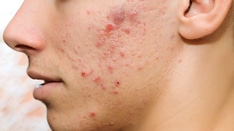
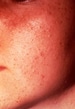
Multiple open and closed comedones are present in the periorbital and temporal areas. Rarely, the lateral neck, postauricular areas, and forearms may be involved. Marked actinically damaged skin with yellowish discoloration, yellowish nodules, atrophy, wrinkles, and furrows are present. The eruption is usually bilaterally symmetrical, although one side may predominate, particularly if that side experienced greater sun exposure. No inflammation is present, unlike the comedones seen in acne vulgaris.

Causes

Although the pathogenesis of the disorder is unknown, it develops in individuals with a heavy smoking history and chronic exposure to UV light. The disorder also may follow exposure to radiation therapy.


Acne Vulgaris
Colloid Milium
Milia
Sebaceous Hyperplasia
Syringoma
Trichoepithelioma

Other Problems to be Considered

Actinic granuloma
Chronic exposure to pitch tar
Chloracne
Cutis rhomboidalis nuchae
Vellus hair cyst


Lab Studies

The clinical findings of multiple open and closed comedones with yellowish nodules of elastotic material in a middle-aged to elderly individual are sufficient to establish the diagnosis. In the absence of elastotic nodules, the differential diagnosis includes chloracne. History and porphyrin studies could be helpful.

Histologic Findings

The lesions appear identical to the comedones seen in acne vulgaris. However, the surrounding dermis contains significant actinic elastosis, including nodules of elastin. Although the disorder has been described as containing cysts, many of the apparent cysts really are nodules of elastotic material. Gram-positive bacteria that stain periodic acid-Schiff positive have been noted. The bacteria are probably Propionibacterium acnes. Hair shafts may or may not be found within the comedones.


Medical Care

Sun protection may be of benefit in preventing progression. Advise the patient to avoid sun exposure, particularly between 10:00 am and 2:00 pm. Select sunscreen to provide good protection throughout the UV-A and UV-B range. Sunscreens containing micropulverized titanium dioxide or Parsol 1789 provide the best protection throughout the UV-A range. Smoking cessation also is critical. Application of topical retinoids including tretinoin, adapalene, or tazarotene in various bases will loosen the comedones and assist in the extraction of individual comedones.

Surgical Care

Comedo extraction is effective. However, these comedones are more difficult to extract than are those seen in acne vulgaris.

  • The concomitant use of topical retinoids assists in the extraction process.
  • Dermabrasion of the affected area has been reported to produce variable cosmetic results.
  • The comedones can be removed via careful curettage with good cosmetic results.
  • Chemical peels, laser peels, and staged excision of the involved area have been reported, but the cosmetic result is highly variable.
  • Treatment with carbon dioxide laser has been reported.


In general, the most effective medication has been the use of topical retinoids including tretinoin, adapalene, or tazarotene in various bases.

Drug Category: Retinoids

Treatment of choice in the elimination of comedones. These medications assist in the removal of the comedones and also may reduce the appearance of actinic damage in the area. More severe cases have been treated with oral isotretinoin, but oral therapy should be reserved for severe cases refractory to topical therapy.

Drug NameTretinoin (Avita, Retin-A)
DescriptionInhibits microcomedo formation and eliminates lesions present. Makes keratinocytes in sebaceous follicles less adherent and easier to remove. Available as 0.025, 0.05, and 0.1% creams. Available also as 0.01 and 0.025% gels. Cream formulations usually are well tolerated. Individuals may begin with the 0.025% cream. Those who do not respond to this concentration may require the 0.05% or 0.1% concentration.
Adult DoseApply topically twice per wk; if no irritation occurs, may apply more frequently (as often as qd); lower frequency of application if irritation develops
Pediatric Dose<12 years: Not established
>12 years: Administer as in adults
ContraindicationsDocumented hypersensitivity
InteractionsToxicity increases with coadministration of benzoyl peroxide, salicylic acid, and resorcinol; avoid topical sulfur, resorcinol, salicylic acid, other keratolytics, abrasives, astringents, spices and lime
PregnancyC - Fetal risk revealed in studies in animals but not established or not studied in humans; may use if benefits outweigh risk to fetus
PrecautionsPhotosensitivity may occur with excessive sunlight exposure; caution in eczema; do not apply to mucous membranes, mouth, and angles of nose

Drug NameAdapalene (Differin)
DescriptionModulates cellular differentiation, inflammation, and keratinization. May be tolerated by individuals who cannot tolerate tretinoin creams. A therapeutic response can be expected following 8-12 wk of therapy. Available as 0.1% gel or solution.
Adult DoseApply topically twice/wk, then more frequently as tolerated
Pediatric DoseNot established
ContraindicationsDocumented hypersensitivity
InteractionsNone reported
PregnancyC - Fetal risk revealed in studies in animals but not established or not studied in humans; may use if benefits outweigh risk to fetus
PrecautionsAvoid contact with mucous membranes, eyes, mouth, and nostrils; avoid exposure to sunlight and sunlamps; dryness of skin, scaling, erythema, burning, and pruritus may occur

Drug NameTazarotene (Tazorac)
DescriptionRetinoid prodrug whose active metabolite modulates differentiation and proliferation of epithelial tissue; may also have anti-inflammatory and immunomodulatory properties.
Adult DoseApply topically twice/wk; not to exceed >20% of BSA; then more frequently as tolerated
Pediatric Dose<12 years: Not established
>12 years: Administer as in adults
ContraindicationsDocumented hypersensitivity
InteractionsNone reported
PregnancyX - Contraindicated; benefit does not outweigh risk
PrecautionsMay cause burning or stinging sensations; discontinue if excessive irritation; rinse thoroughly if contact with eyes, eyelids, or mouth; may cause severe irritation in eczematous skin; photosensitivity may occur

Drug NameIsotretinoin (Accutane)
DescriptionOral agent that treats serious dermatologic conditions. Isotretinoin is the synthetic 13-cis isomer of the naturally occurring tretinoin (trans-retinoic acid). Both agents are structurally related to vitamin A.
Decreases sebaceous gland size and sebum production. May inhibit sebaceous gland differentiation and abnormal keratinization.
Should only be prescribed by individuals who are completely familiar with drug and appropriate prescribing practices and precautions.
Adult Dose0.05-2 mg/kg/d PO
Pediatric DoseNot established
ContraindicationsDocumented hypersensitivity; pregnancy
InteractionsToxicity may occur with vitamin A coadministration; pseudotumor cerebri or papilledema may occur when coadministered with tetracyclines; may reduce plasma levels of carbamazepine; in diabetes, isotretinoin may cause alterations in blood glucose; corticosteroids, if used with isotretinoin, may produce hyperlipidemia and benign intracranial hypertension; with methotrexate, may increase risk of liver toxicity; with alcohol, may produce a disulfiramlike reaction or cause elevations in serum triglycerides; with trimethoprim and sulfamethoxazole, may increase risk of intracranial hypertension
PregnancyX - Contraindicated; benefit does not outweigh risk
PrecautionsAdvise against pregnancy while taking isotretinoin and for at least 1 mo after discontinuing medication; women should use at least 2 effective forms of birth control (an oral contraceptive plus another effective contraceptive); perform pregnancy tests prior to institution of therapy and then monthly; tests must be sensitive and performed within 1 wk of starting drug; start drug on 2nd or 3rd day of menstrual period; repeat pregnancy test monthly until 1 mo after drug is stopped; obtain baseline CBC count, LFTs, fasting triglycerides, and cholesterol prior to institution of therapy with isotretinoin and q2-4wk until response is established


Further Outpatient Care

Follow up all cases to note the effect of topical retinoids and for subsequent removal of remaining comedones. Carefully observe the patient to note the development of skin cancers and precancers in view of the association with actinic damage.

Prognosis

Prognosis is excellent, if properly treated.

Patient Education

Strongly advise the patient to avoid sun exposure and to use a sunblock daily, as continued UV damage will aggravate the disorder and potentiate the development of precancers and skin cancers.


Medical/Legal Pitfalls

It is essential for the physician to appreciate the significance of chronic actinic damage and the potential for skin cancers and precancers.


  • Adams BB, Chetty VB, Mutasim DF. Periorbital comedones and their relationship to pitch tar: a cross-sectional analysis and a review of the literature. J Am Acad Dermatol. Apr 2000;42(4):624-7. [Medline].
  • Breit S, Flaig MJ, Wolff H, Plewig G. Favre-Racouchot-like disease after radiation therapy. J Am Acad Dermatol. Jul 2003;49(1):117-9. [Medline].
  • English DT, Martin GC, Reisner JE. Dermabrasion for nodular cutaneous elastosis with cysts and comedones. Favre-Racouchot syndrome. Arch Dermatol. 1971;104:92-93. [Medline].
  • Favre M. Sur une kystique des appareils pilo-sebaces localis ertaines r'ons de la face. Bull Soc Fr Dermatol Syph. 1932;39:93-6.
  • Favre M, Racouchot J. [Nodular cutaneous elasteidosis with cysts and comedones.]. Ann Dermatol Syphiligr (Paris). Nov-Dec 1951;78(6):681-702. [Medline].
  • Friedman SJ, Su WP. Favre-Racouchot syndrome associated with radiation therapy. Cutis. Mar 1983;31(3):306-10. [Medline].
  • Jansen T, Plewig G. Favre-Racouchot Syndrome. Clin Dermatol. 1975;Unit 4-44:1-4.
  • Keough GC, Laws RA, Elston DM. Favre-Racouchot syndrome: a case for smokers' comedones. Arch Dermatol. Jun 1997;133(6):796-7. [Medline].
  • Kligman AM, Plewig G, Mills OH Jr. Topically applied tretinoin for senile (solar) comedones. Arch Dermatol. Oct 1971;104(4):420-1. [Medline].
  • Lewis KG, Bercovitch L, Dill SW, Robinson-Bostom L. Acquired disorders of elastic tissue: part I. Increased elastic tissue and solar elastotic syndromes. J Am Acad Dermatol. Jul 2004;51(1):1-21; quiz 22-4. [Medline].
  • Mohs FE, McCall MW, Greenway HT. Curettage for removal of the comedones and cysts of the Favre-Racouchot syndrome. Arch Dermatol. May 1982;118(5):365-6. [Medline].
  • Morgan MB, Stevens GL, Somach S. Multiple follicular cysts, infundibular type with vellus hairs and solar elastosis of the ears: a new dermatoheliosis?. J Cutan Pathol. Jan 2003;30(1):29-31. [Medline].
  • Patterson WM, Fox MD, Schwartz RA. Favre-Racouchot disease. Int J Dermatol. Mar 2004;43(3):167-9. [Medline].
  • Plewig G, Kligman AM. Acne and Rosacea. Germany: Universitat Munchen; 1993:79-81,83,93,97,113,119,121,129,396.
  • Sanchez-Yus E, del Rio E, Simon P, Requena L, Vazquez H. The histopathology of closed and open comedones of Favre-Racouchot disease. Arch Dermatol. Jun 1997;133(6):743-5. [Medline].
  • Sharkey MJ, Keller RA, Grabski WJ, McCollough ML. Favre-Racouchot syndrome. A combined therapeutic approach. Arch Dermatol. May 1992;128(5):615-6. [Medline].

Favre-Racouchot Syndrome (Nodular Elastosis With Cysts and Comedones) excerpt

Article Last Updated: Dec 5, 2006