You are in: eMedicine Specialties > Dermatology > DISEASES OF THE VESSELS Erythema Induratum (Nodular Vasculitis)Article Last Updated: Mar 17, 2008AUTHOR AND EDITOR INFORMATIONAuthor: Noah S Scheinfeld, MD, JD, FAAD, Assistant Clinical Professor, Department of Dermatology, Columbia University; Consulting Staff, Department of Dermatology, St Luke's Roosevelt Hospital Center, Beth Israel Medical Center, New York Eye and Ear Infirmary; Private Practice Noah S Scheinfeld is a member of the following medical societies: American Academy of Dermatology Coauthor(s): Kwang-Hyun Cho, MD, Professor, Department of Dermatology, Seoul National University College of Medicine, Korea; Beom Joon Kim, Clinical Fellow, Clinical Fellow of Dermatology, Department of Dermatology, Seoul National University Hospital Editors: Jean-Hilaire Saurat, MD, Chair, Professor, Department of Dermatology, University of Geneva, Switzerland; Richard P Vinson, MD, Assistant Clinical Professor, Department of Dermatology, Texas Tech University School of Medicine; Consulting Staff, Mountain View Dermatology, PA; Lester F Libow, MD, Dermatopathologist, South Texas Dermatopathology Laboratory; Joel M Gelfand, MD, MSCE, Medical Director, Clinical Studies Unit, Assistant Professor, Department of Dermatology, Associate Scholar, Center for Clinical Epidemiology and Biostatistics, University of Pennsylvania; William D James, MD, Paul R Gross Professor of Dermatology, University of Pennsylvania School of Medicine; Vice-Chair, Program Director, Department of Dermatology, University of Pennsylvania Health System Author and Editor Disclosure Synonyms and related keywords: tuberculosis-associated erythema induratum, TB-associated erythema induratum, erythema induratum of Bazin INTRODUCTIONBackgroundIn 1861, Bazin gave the name erythema induratum to a nodular eruption that occurred on the lower legs of young women with tuberculosis. In 1945, Montgomery et al, while fully acknowledging the existence of tuberculosis-associated erythema induratum, coined the term nodular vasculitis to describe chronic inflammatory nodules of the legs that showed histopathologic changes similar to those of erythema induratum, that is, vasculitis of the larger vessels and panniculitis. Erythema induratum and nodular vasculitis had been considered the same disease entity for a long time. However, nodular vasculitis is now considered a multifactorial syndrome of lobular panniculitis in which tuberculosis may or may not be one of a multitude of etiologic components. Therefore, erythema induratum/nodular vasculitis complex is classified into 2 variants. Erythema induratum of Bazin type and nodular vasculitis or erythema induratum of Whitfield type. Bazin type is related with tuberculous origin, but Whitfield type is not. Motswaledi and Schulz1 noted that erythema induratum of Bazin, lichen scrofulosorum, and papulonecrotic tuberculide are the 3 recognized tuberculides, which are sequelae of immunologic reactions to hematogenously dispersed antigenic components of Mycobacterium tuberculosis. A fourth tuberculide, called nodular granulomatous phlebitis, is distinct from erythema induratum. PathophysiologyThe morphologic, molecular, and clinical data suggest that erythema induratum and nodular vasculitis represent a common inflammatory pathway, that is, a hypersensitivity reaction to endogenous or exogenous antigens. One such antigen is the tubercle bacillus. Patients with erythema induratum have a positive tuberculin skin test result and a marked increase in their peripheral T lymphocyte response to purified protein derivative (PPD) of tuberculin, which can cause a delayed-type hypersensitivity reaction. FrequencyUnited StatesIsolated cases have been reported in the United States. InternationalWhile nodular vasculitis is quite common, particularly in Europe, erythema induratum is rare in Western countries. Erythema induratum is still prevalent in India, Hong Kong, and some areas of South Africa. Erythema induratum was the most common (86%) form of cutaneous tuberculosis (tuberculid) in Hong Kong found between 1993 and 20022 and was mostly found in women and mostly on the legs. In this period (1993-2002), 127 patients with erythema induratum out of a total of 147 patients with either cutaneous tuberculosis or tuberculids were reported. Mortality/MorbidityTo date, no fatal cases of erythema induratum have been reported. However, the chronic, recurrent, painful nodules and resultant scarring can be a source of significant morbidity. SexErythema induratum shows female predominance, and lower extremities are the most common sites in both male and female patients; however, it also may occur in other areas. AgeErythema induratum most commonly affects women aged 20-30 years. The condition is more common in young women than in other people, but it may occur later in life. CLINICALHistory
Physical
CausesErythema induratum/nodular vasculitis complex is a multifactorial disorder. M tuberculosis and delayed-type hypersensitivity are considered etiologic factors for erythema induratum of Bazin type. Recently, hepatitis C virus has been suggested, but a direct relationship remains unclear.
DIFFERENTIALSCold Panniculitis
| |||||||||||||||||||||||||||||||||||||||||||||||||||||||||||||||||||||||||||||||||||||||||||||||||||||||||||||||||||
| Drug Name | Isoniazid (Nydrazid, Laniazid) |
|---|---|
| Description | Best combination of effectiveness, low cost, and minor adverse effects. First-line drug unless resistance or another contraindication is known. Therapeutic regimens of <6 mo demonstrate unacceptably high relapse rate. Coadministration of pyridoxine is recommended if peripheral neuropathies secondary to isoniazid therapy develop. Prophylactic doses of 6-50 mg of pyridoxine daily are recommended. Available as syr (50 mg/5 mL) and tab (100 or 300 mg). |
| Adult Dose | 5-10 mg/kg PO qd or divided bid; not to exceed 300 mg/d |
| Pediatric Dose | 10-20 mg/kg PO qd or divided bid; not to exceed 300 mg/d |
| Contraindications | Documented hypersensitivity; previous isoniazid-associated hepatic injury or other severe adverse reactions |
| Interactions | Higher incidence of isoniazid-related hepatitis can occur with alcohol ingestion on daily basis; aluminum salts may decrease serum levels (administer 1-2 h before taking aluminum salts); may increase anticoagulant effects with coadministration; may inhibit metabolic clearance of benzodiazepines; carbamazepine toxicity or isoniazid hepatotoxicity may result from concurrent use (monitor carbamazepine concentrations and liver function); coadministration with cycloserine may increase CNS adverse effects (eg, dizziness); acute behavioral and coordination changes may occur with coadministration of disulfiram; coadministration with rifampin after halothane anesthesia may result in hepatotoxicity and hepatic encephalopathy; may inhibit hepatic microsomal enzymes and increase toxicity of hydantoin |
| Pregnancy | C - Fetal risk revealed in studies in animals but not established or not studied in humans; may use if benefits outweigh risk to fetus |
| Precautions | Monitor patients with active chronic liver disease or severe renal dysfunction; periodic ophthalmologic examinations during therapy are recommended even when visual symptoms do not occur |
| Drug Name | Rifampin (Rifadin, Rimactane) |
|---|---|
| Description | For use in combination with at least one other antituberculous drug; inhibits DNA-dependent bacterial but not mammalian RNA polymerase. Cross-resistance may occur. Treat for 6-9 mo or until 6 mo have elapsed from conversion to sputum culture negativity. Available as cap (150 mg or 300 mg) and powder for injection (600 mg). |
| Adult Dose | 10 mg/kg/d PO or 450-600 mg PO qd; not to exceed 600 mg qd |
| Pediatric Dose | 15-25 mg/kg PO qd |
| Contraindications | Documented hypersensitivity |
| Interactions | Induces microsomal enzymes, which may decrease effects of acetaminophen, oral anticoagulants, barbiturates, benzodiazepines, beta-blockers, chloramphenicol, oral contraceptives, corticosteroids, mexiletine, cyclosporine, digitoxin, disopyramide, estrogens, hydantoins, methadone, clofibrate, quinidine, dapsone, tazobactam, sulfonylureas, theophyllines, tocainide, and digoxin; blood pressure may increase with coadministration of enalapril; coadministration with isoniazid may result in higher rate of hepatotoxicity than with either agent alone (discontinue 1 or both agents if alterations in LFTs occur) |
| Pregnancy | C - Fetal risk revealed in studies in animals but not established or not studied in humans; may use if benefits outweigh risk to fetus |
| Precautions | Obtain CBC counts and baseline clinical chemistries prior to and throughout therapy; in liver disease, weigh benefits against risk of further liver damage; interruption of therapy and high-dose intermittent therapy are associated with thrombocytopenia that is reversible if therapy is discontinued as soon as purpura occurs; if treatment is continued or resumed after appearance of purpura, cerebral hemorrhage or death may occur Body fluids (tears, saliva, urine) and feces may turn a red-orange color; warn patients of this side effect |
| Drug Name | Ethambutol (Myambutol) |
|---|---|
| Description | Diffuses into actively growing mycobacterial cells, such as tubercle bacilli. Impairs cell metabolism by inhibiting synthesis of 1 or more metabolites, which, in turn, causes cell death. No cross-resistance demonstrated. Mycobacterial resistance is frequent with previous therapy. Use in these patients in combination with second-line drugs not previously administered. Administer q24h until permanent bacteriologic conversion and maximal clinical improvement is seen. Absorption is not significantly altered by food. Available as 100- and 400-mg tab. |
| Adult Dose | 15-25 mg/kg PO qd |
| Pediatric Dose | 10-15 mg/kg PO qd |
| Contraindications | Documented hypersensitivity; optic neuritis (unless clinically indicated); children <12 y, owing to oculopathy |
| Interactions | Aluminum salts may delay and reduce absorption (give several hours before or after ethambutol dose) |
| Pregnancy | C - Fetal risk revealed in studies in animals but not established or not studied in humans; may use if benefits outweigh risk to fetus |
| Precautions | Reduce dose in impaired renal function; may have reversible visual adverse effects if promptly discontinued |
| Drug Name | Pyrazinamide |
|---|---|
| Description | Pyrazine analog of nicotinamide that may be bacteriostatic or bactericidal against M tuberculosis, depending on concentration of drug attained at site of infection; mechanism of action is unknown. Administer for initial 2 mo of a 6-mo or longer treatment regimen for patients who are susceptible to drug. Treat patients who are resistant to drug with individualized regimens. Available as 500-mg scored tab. |
| Adult Dose | 15-30 mg/kg PO qd; not to exceed 2 g/d |
| Pediatric Dose | 20 mg/kg PO qd; not to exceed 2 g/d |
| Contraindications | Documented hypersensitivity; severe hepatic damage and acute gout; |
| Interactions | None reported |
| Pregnancy | C - Fetal risk revealed in studies in animals but not established or not studied in humans; may use if benefits outweigh risk to fetus |
| Precautions | Use only in combination with other effective antituberculous agents; inhibits renal excretion of urates; may result in hyperuricemia (usually asymptomatic); perform baseline serum uric acid determinations; discontinue drug if signs of hyperuricemia with acute gouty arthritis; perform baseline LFTs (closely monitor in liver disease); discontinue if signs of hepatocellular damage appear; caution in history of diabetes mellitus; CDC has recommended not to combine pyrazinamide and rifampin due to several reports of severe liver injury and death of patients |
These agents relieve lesional tenderness, arthralgia, and fever. Relief may occur in 24 h. Most lesions completely subside within 10-14 d.
| Drug Name | Potassium iodide (Thyro-Block, SSKI, Pima) |
|---|---|
| Description | Mechanism of action unknown, but potassium iodide is known to enhance response by potentiating neutrophil activity. Not effective for all patients with erythema induratum. Patients who receive medication shortly after the initial onset of induratum respond more satisfactorily than those with chronic induratum. |
| Adult Dose | 300-500 mg PO (6-10 gtt) tid Liquid supersaturated potassium iodide (SSKI): 3 gtt tid in juice and increase by 1 gtt tid; not to exceed 15 gtt tid |
| Pediatric Dose | Infants: 150-250 mg (3-6 gtt) PO tid Children: Administer as in adults |
| Contraindications | Documented hypersensitivity; pulmonary edema; bronchitis; tuberculosis; hyperkalemia |
| Interactions | Increases lithium toxicity by producing additive hypothyroid effects |
| Pregnancy | D - Fetal risk shown in humans; use only if benefits outweigh risk to fetus |
| Precautions | Prolonged use may result in hypothyroidism; caution in renal failure and GI obstruction; iododerma, coryza, cough, nausea, rhinorrhea, and parotiditis may occur |
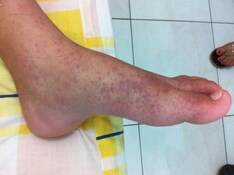
| Media file 1: This patient exhibited tender, erythematous nodules confined to the lower third of the legs. | |
![]() | View Full Size Image | Media type: Photo |
| Media file 2: Vasculitis and granulomatous inflammation in the dermis and subcutaneous fat tissues. | |
![]() | View Full Size Image | Media type: Photo |
| Media file 3: Evidence of panniculitis exhibiting lobular, granulomatous, and lymphohistiocytic inflammation. | |
![]() | View Full Size Image | Media type: Photo |
| Media file 4: A positive Mantoux test reaction in a patient with erythema induratum. | |

![]() | View Full Size Image | Media type: Photo |
Erythema Induratum (Nodular Vasculitis) excerpt
Article Last Updated: Mar 17, 2008