| Patient Education |
|
Click here for patient education.
|
|
You are in: eMedicine Specialties >
Dermatology > DISEASES OF THE SUBCUTANEOUS TISSUE
Erythema Gyratum Repens
Article Last Updated: Feb 21, 2007
AUTHOR AND EDITOR INFORMATION
Section 1 of 10
Author: Raul Del Rosario, MD, Consulting Staff, Surgical Pathology and Dermatopathology, South Coast Medical
Raul Del Rosario is a member of the following medical societies: American Society of Clinical Pathologists
Coauthor(s):
Karen Allen, MD, Consulting Dermatologist;
Suzanne Kaneshiro, MD, Staff Physician, Department of Dermatology, University of California at Irvine
Editors: Carrie L Kovarik, MD, Assistant Professor, Department of Dermatology and Dermatopathology, University of Pennsylvania School of Medicine; Richard P Vinson, MD, Assistant Clinical Professor, Department of Dermatology, Texas Tech University School of Medicine; Consulting Staff, Mountain View Dermatology, PA; Jeffrey P Callen, MD, Professor of Medicine, Chief, Division of Dermatology, University of Louisville School of Medicine; Catherine Quirk, MD, Clinical Assistant Professor, Department of Dermatology, Brown University; Dirk M Elston, MD, Director, Department of Dermatology, Geisinger Medical Center
Author and Editor Disclosure
Synonyms and related keywords:
Background
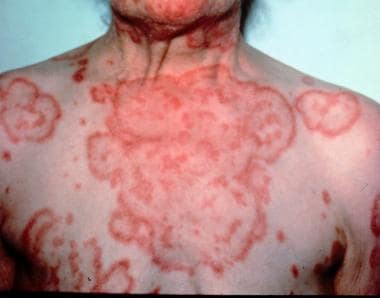
Erythema gyratum repens (EGR) is a figurate erythema that is believed to be a paraneoplastic process. In addition to other features, characteristic concentric erythematous bands forming a wood-grain appearance help distinguish EGR from other figurate erythemas, such as erythema annulare centrifugum, erythema migrans, and erythema marginatum.
Pathophysiology
The pathogenesis of EGR remains unknown. The following hypotheses have been proposed:
- First, tumor antigens may form and cross-react with endogenous skin antigens.
- Second, tumor products may alter endogenous skin antigens making them susceptible to autoimmune recognition.
- Third, tumor antigens may form immune complexes with antibodies, which are then deposited into cutaneous tissue.
A mechanism explaining the clinically apparent migrating erythema also has been proposed. This model involves a localized ground substance phenomenon. Granulocytes release factors that stimulate proliferating fibroblasts, producing ground substance with increased viscosity. This viscous ground substance serves to impede or "wall off" the tissue spread of inflammatory mediators. In EGR, the advancing erythema may represent the advancement of inflammatory mediators through stroma that is unable to keep them walled off.
Frequency
United States
EGR is believed to be rare. A clinical review in 1992 by Boyd cited 49 patients reported in the literature. A current literature search yielded a handful of additional case reports.
Mortality/Morbidity
No specific complications are associated with the skin manifestations of EGR, and the condition alone does not lead to death. Symptoms include intense pruritus, and morbidity and mortality may occur related to the underlying condition.
Race
The disease reportedly occurs predominantly in white persons.
Sex
Male-to-female ratio is 2:1.
Age
EGR usually occurs in patients older than 40 years, with a mean age of 63 years, but it has been reported to occur from age 16-75 years.
History
- The appearance of EGR often precedes the detection of malignancy.
- The skin eruption is present an average of 9 months prior to the diagnosis of malignancy, with a range of 1-72 months.
- In a minority of patients, EGR occurred simultaneously with, or up to 9 months after, the detection of the neoplasm.
Physical
- EGR has distinctive dermatologic manifestations characterized by the following:
- Wood-grain appearance created by concentric mildly scaling bands of flat-to-raised erythema
- Fairly rapid migration (up to 1 cm/d)
- Intense pruritus
- A course of rash that closely mirrors the course of the underlying illness, with clearance of rash and relief of pruritus within 6 weeks subsequent to resolution of underlying illness
- Sites of predilection that include the trunk and extremities (Image 1)
- Associated findings with EGR include ichthyosis and palmoplantar hyperkeratosis.
Causes
EGR is associated with malignancy in as many as 80% of patients. Among visceral malignancies, the lung is the most common site, followed by the breast, urinary bladder, uterus and/or cervix, GI tract (stomach), and prostate. Most patients with EGR develop the eruption before the symptoms of tumor. The time interval between the eruption of EGR and the detection of the tumor can range from simultaneous presentation to up to 6 years after the rash. EGR also has occurred up to 7 months after the detection of malignancy. EGR is associated with some nonneoplastic conditions, such as pulmonary tuberculosis, lupus erythematosus, CREST (calcinosis, Raynaud phenomenon, esophageal motility disorder, sclerodactyly, and telangiectasia) syndrome, virginal breast hypertrophy, pityriasis rubra pilaris, psoriasis, and as a drug reaction to azathioprine in a patient with type I autoimmune hepatitis. In a few patients, no associated conditions exist.
Bullous Pemphigoid
Erythema Annulare Centrifugum
Erythema Multiforme
Glucagonoma Syndrome
Granuloma Annulare
Lupus Erythematosus, Subacute Cutaneous
Lyme Disease
Pityriasis Rubra Pilaris
Psoriasis, Plaque
Tinea Corporis
Urticaria, Chronic
Other Problems to be Considered
Erythema marginatum
Carriers of chronic granulomatous disease
Lab Studies
- A basic workup is warranted when approaching a patient with EGR to search for common or clinically suspected malignancies. This includes the following:
- Complete physical examination (including pelvic examination and Papanicolaou test [Pap smear] for women, prostate examination and prostate-specific antigen test for men)
- Urinalysis
- Basic hematologic panel
- Blood chemistries (including liver function test, calcium, phosphorus, total protein)
- Stool guaiac and/or Hemoccult test
Imaging Studies
- Examine patients with EGR for common or clinically suspected malignancies. This workup can include a chest radiograph and CT scan of the abdomen and pelvis.
Procedures
- Esophagogastroduodenoscopy
- Colonoscopy
- Ear, nose, and throat examination (for malignancy)
Histologic Findings
The primary finding is mild spongiosis, focal parakeratosis, and a superficial perivascular lymphohistiocytic infiltrate that also may include eosinophils and melanophages. Exocytosis of neutrophils and eosinophils may be observed. Direct immunofluorescence tests sometimes reveal C3, C4, and immunoglobulin G at the basement membrane zone.
Medical Care
Topical steroids are of no benefit. Corticosteroid injections may improve the pruritus but reportedly do not change the appearance of the skin eruption.
Prognosis
- Prognosis depends on the underlying illness. In most patients, symptoms disappear with the resolution of underlying disease.
Medical/Legal Pitfalls
- Failure to note the physical findings of EGR, which are distinctive and should arouse a high index of suspicion for underlying malignancy
- Failure to monitor the patient annually if the initial workup is negative, since a high incidence of concurrent or subsequent development of underlying malignancy is seen
| Media file 1:
Erythema gyratum repens. Courtesy of Jeffrey P. Callen, MD. |
 | View Full Size Image | |
Media type: Photo
|
- Appell ML, Ward WQ, Tyring SK. Erythema gyratum repens. A cutaneous marker of malignancy. Cancer. Aug 1 1988;62(3):548-50. [Medline].
- Boyd AS, Neldner KH, Menter A. Erythema gyratum repens: a paraneoplastic eruption. J Am Acad Dermatol. May 1992;26(5 Pt 1):757-62. [Medline].
- Bryan ME, Lienhart K, Smoller BR, Johnson SM. Erythema gyratum repens in a case of resolving psoriasis. J Drugs Dermatol. Jun 2003;2(3):315-7. [Medline].
- Caux F, Lebbe C, Thomine E, et al. Erythema gyratum repens. A case studied with immunofluorescence, immunoelectron microscopy and immunohistochemistry. Br J Dermatol. Jul 1994;131(1):102-7. [Medline].
- Cheesbrough MJ, Williamson DM. Erythema gyratum repens, a stage in the resolution of pityriasis rubra pilaris?. Clin Exp Dermatol. Sep 1985;10(5):466-71. [Medline].
- Eubanks LE, McBurney E, Reed R. Erythema gyratum repens. Am J Med Sci. May 2001;321(5):302-5. [Medline].
- Gunther R, Nasser S, Hinrichsen H, Folsch UR. [Erythema gyratum repens: drug reaction following azathioprine administration in a patient with type I autoimmune hepatitis]. Med Klin (Munich). Jul 15 2002;97(7):414-7. [Medline].
- Hauschild A, Swensson O, Christophers E. Paraneoplastic bullous pemphigoid resembling erythema gyratum repens. Br J Dermatol. Mar 1999;140(3):550-2. [Medline].
- Lomholt H, Thestrup-Pedersen K. Paraneoplastic skin manifestations of lung cancer. Acta Derm Venereol. May 2000;80(3):200-2. [Medline].
- Olsen TG, Milroy SK, Jones-Olsen S. Erythema gyratum repens with associated squamous cell carcinoma of the lung. Cutis. Oct 1984;34(4):351-3, 355. [Medline].
- Stone SP, Buescher LS. Life-threatening paraneoplastic cutaneous syndromes. Clin Dermatol. May-Jun 2005;23(3):301-6. [Medline].
Erythema Gyratum Repens excerpt Article Last Updated: Feb 21, 2007
|