Continually Updated Clinical Reference
 
 
  All Sources     eMedicine     Medscape     Drug Reference     MEDLINE
 
eMedicine - Eosinophilic Fasciitis : Article by

Quick Find
Authors & Editors
Introduction
Clinical
Differentials
Workup
Treatment
Medication
Follow-up
Multimedia
References

Related Articles
Eosinophilia-Myalgia Syndrome

Morphea


Patient Education
Click here for patient education.


Author: Brad S Graham, MD, Consulting Staff, Dermatology Associates of Tyler, East Texas Medical Center; Trinity Mother Francis Hospital

Brad S Graham is a member of the following medical societies: Alpha Omega Alpha, American Academy of Dermatology, American Medical Association, and American Society of Dermatopathology

Editors: Ponciano D Cruz Jr, MD, Vice-Chair, JB Shelmire Professor, Department of Dermatology, University of Texas Southwestern Medical Center; David F Butler, MD, Professor of Dermatology, Texas A&M University College of Medicine; Director, Division of Dermatology, Scott and White Clinic; Director Dermatology Residency Training Program, Scott and White Clinic; Edward F Chan, MD, Clinical Assistant Professor, Department of Dermatology, University of Pennsylvania School of Medicine; Catherine Quirk, MD, Clinical Assistant Professor, Department of Dermatology, Brown University; William D James, MD, Paul R Gross Professor of Dermatology, University of Pennsylvania School of Medicine; Vice-Chair, Program Director, Department of Dermatology, University of Pennsylvania Health System

Author and Editor Disclosure

Synonyms and related keywords: Shulman syndrome, morphea, fascial fibrosis, joint contractures, arthritis, neuropathy, myositis

Background

Eosinophilic fasciitis is an idiopathic, fibrotic disorder with the histopathologic hallmark of fascial fibrosis. The presentation is acute with painful, swollen extremities progressing to disabling cutaneous fibrosis. Joint contractures, arthritis, neuropathy, and myositis may be associated. Many authors consider eosinophilic fasciitis to be a variant of morphea; others consider it a distinct entity.

Pathophysiology

The etiology is unknown, but aberrant immune responses may play a role because hypergammaglobulinemia and antinuclear antibodies are associated. In addition, toxic, environmental, or drug exposures have been implicated. A recent case report (Degiovanni, 2006) implicated atorvastatin in a temporal relationship as the cause of a patient's eosinophilic fasciitis.

Recent reports indicate that Borrelia burgdorferi may be a possible etiologic agent in some cases. However, a recent report of a patient with eosinophilic fasciitis and a review of the literature of cases in which Borrelia species were implicated in the pathogenesis failed to show a relationship between eosinophilic fasciitis and Borrelia infection. Borrelia species were not identified by direct microscopic examination of tissue samples or by polymerase chain reaction amplification of tissue samples in any of these reported cases. The conclusion was that positive serology alone for Borrelia does not implicate Borrelia infection in the pathogenesis of eosinophilic fasciitis in the absence of the positive demonstration of Borrelia by histochemical stains, immunohistochemical stains, or polymerase chain reaction amplification in tissue samples (Anton, 2006).

In vitro fibroblasts from involved fascia produce increased levels of mRNA for collagen types I, III, and IV compared with adjacent dermal fibroblasts. In addition, fascial fibroblasts express transforming growth factor-beta I and connective-tissue growth factor mRNA, which may account for the clinical fibrosis. Eosinophil degranulation may lead to fibroblast activation.

Further research has shown elevations of transforming growth factor-beta and interleukin 5, which normalize with corticosteroid therapy. Another study has show that the fascial inflammatory infiltrate is predominately composed of CD8+ T lymphocytes, macrophages, and fewer eosinophils, suggesting a possible cytotoxic immune reaction in response to possible infectious or environmental agents. Other studies have shown elevated serum levels of manganese superoxide dismutase and tissue inhibitor of metalloproteinase (TIMP-1). Serum TIMP-1 may also serve as a marker of disease severity.

Frequency

International

Eosinophilic fasciitis is uncommon.

Mortality/Morbidity

The end stage of the fibrotic process leads to substantial morbidity due to skin sclerosis and joint contractures. In addition, arthritis, neuropathies, and myositis may be present. Ten percent of cases may result in myelodysplasia, such as aplastic anemia, which portends a poor prognosis. Spontaneous resolution is possible, and treatment with corticosteroids usually results in recovery; however, skin sclerosis and joint contractures may persist.

Race

Whites are primarily affected.

Sex

Eosinophilic fasciitis occurs equally in males and females.

Age

Most patients are in their third to sixth decades of life; however, cases in children have been reported.


History

  • Patients present with the sudden onset of painful, tender, edematous, and erythematous extremities.
    • The disorder progresses rapidly; within weeks to months, patients develop stiffness and sclerodermatous induration, resulting in characteristic flexion contractures and impaired mobility.
    • The forearms, the upper arms, the lower legs, the thighs, and the trunk are involved (in order of decreasing frequency).
  • As many as 50% of patients report an episode of strenuous physical exercise or activity immediately preceding the onset of the illness.
  • Malaise, weakness, and fever are frequently present.
  • Overt arthritis occurs in as many as 40% of patients.
  • Symptoms of carpal tunnel syndrome have been reported.
  • Visceral involvement and Raynaud phenomenon are rare.

Physical

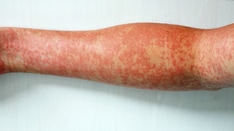
The clinical presentation evolves through 3 stages; the various stages present simultaneously in different areas of the body. The first stage presents with symmetric, diffuse, erythematous tenderness of the extremities, followed by an edematous phase that produces a coarsely dimpled appearance (cobblestoning) or a finely dimpled appearance (peau d'orange). The last phase involves rippling of the skin with areas of hypopigmentation, induration, and skin tightness. In severely affected areas, both the skin and the subcutaneous tissues are bound-down and inseparable from the underlying muscle, and they have a woody-type appearance. With elevation of the involved extremities, furrows along the course of the superficial veins may be present; this finding is referred to as the groove sign. Although the extremities are preferentially involved (88%), the trunk may be involved. The hands, the feet, and the face are spared.

  • Joint contractures of the elbows, the wrists, the ankles, the knees, and the shoulders may be found in 55-75% of patients.
  • Carpal tunnel syndrome is present in 20% of patients.
  • Inflammatory arthritis is present in as many as 40% of patients.
  • Subclinical myositis is present in a minority of patients.
  • A concurrent localized lesion of morphea may be seen in 25% of patients.
  • In contrast to scleroderma, Raynaud phenomenon, abnormal nail fold capillaries, and sclerodactyly are not present. Visceral involvement is rare, with few reports of involvement of the lungs, the esophagus, and the myocardium.

Causes

See Pathophysiology.


Eosinophilia-Myalgia Syndrome
Morphea

Other Problems to be Considered

Eosinophilic-myalgia (L-tryptophan) syndrome
Scleroderma
Toxic oil syndrome


Lab Studies

  • CBC count shows eosinophilia (10-40%) in as many as 80-90% of patients. In addition, pancytopenia, anemia, or thrombocytopenia may be encountered.
  • The erythrocyte sedimentation rate is elevated in as many as 60-80% of patients.
  • Immunoglobulin levels show hypergammaglobulinemia, usually polyclonal immunoglobulin G.
  • Muscle enzyme levels are sometimes elevated, especially aldolase.
  • The antinuclear antibody result is occasionally positive.
  • The rheumatoid factor result is occasionally positive.

Imaging Studies

  • If clinically indicated, MRI of the involved areas shows a high-intensity signal in the fascia. A recent study demonstrated that MRI shows characteristic findings of fascial thickening, abnormal signal intensity, and contrast enhancement. According to the authors, these findings are useful to make the diagnosis, to guide the location for biopsy, and to monitor the response to therapy.

Other Tests

  • If clinically indicated, electromyograms may show slow motor unit potentials with reduced duration and amplitude consistent with a myositis.
  • Pulmonary function test results may show a restrictive pattern with severe truncal involvement.

Procedures

  • If abnormal values other than eosinophilia are found on the CBC count, a bone marrow examination may be necessary.
  • A full-thickness incisional biopsy that includes the dermis, the subcutaneous fat, and the fascia is necessary to confirm a diagnosis of eosinophilic fasciitis.

Histologic Findings

The most profound changes occur in the superficial fascia, which is markedly thickened, fibrosed, and sclerotic. In the early stages, fibrinoid necrosis or myxoid degeneration may be seen. The fibrosis extends into the septae of the subcutaneous fat, which entrap the fat within intersecting bands of fibrosis. The fibrotic process also extends into the lower dermis and the underlying musculature. The muscle may show focal necrosis, degeneration, and regeneration.

The inflammatory infiltrate is usually mild to moderate and consists of lymphocytes, histiocytes, plasma cells, and variable numbers of eosinophils. Eosinophils are not required to make the diagnosis; the term eosinophilic fasciitis refers to peripheral eosinophilia not tissue eosinophilia. The inflammatory infiltrate, including lymphoid follicles, involves the lower dermis, the septae, the fascia, and the muscle. The epidermis, the papillary dermis, and the adnexa are usually spared. On direct immunofluorescence, immunoglobulin M is found at the dermal-epidermal junction, and immunoglobulin G and C3 are found around blood vessels in the lower dermis, the fascia, and the skeletal muscle.


Medical Care

  • Many cases respond to corticosteroids (88%, with 25% obtaining complete recovery), although spontaneous resolution is possible. Complete recovery may take up to 1-3 years. No consensus on the treatment of eosinophilic fasciitis exists, but most studies indicate that the best response is with moderate-to-high doses of corticosteroids, especially if started early in the disease course. No set dosing schedule is available, but most studies advocate doses of 0.5-1 mg/kg/d until response, with rapid tapering to alternate day therapy.
  • Several cases exist in the literature of recalcitrant disease to corticosteroids in which adjunctive therapy may be required.
  • Adjunctive medications include hydroxychloroquine, colchicine, cimetidine, cyclosporin, azathioprine, and methotrexate. A more recent study looked at extracorporal photochemotherapy in the treatment of corticosteroid-resistant cases. After 1 year of therapy, 2 of 3 patients showed considerable improvement when combined with low-dose corticosteroids.

Surgical Care

Surgical decompression of carpal tunnel syndrome may be required.

Consultations

A physical therapist may be consulted. Active and passive range of motion therapy of the involved extremities and joints is crucial along with medical therapy to prevent and to treat joint contractures.


The mainstay of therapy is anti-inflammatory agents.

Drug Category: Corticosteroids

These agents halt active inflammatory process, ensuing fibrosis, and restriction of mobility.

Drug NamePrednisone (Deltasone, Orasone)
DescriptionSynthetic adrenocortical steroid drug with predominantly glucocorticoid properties. Anti-inflammatory effects include depressed production of eosinophils and lymphocytes. Anti-inflammatory processes (eg, edema, fibrin deposition, capillary dilatation, migration of leukocytes, phagocytosis) and the later stages of wound healing (eg, capillary proliferation, deposition of collagen, cicatrization) are inhibited.
Adult Dose0.5-1 mg/kg/d PO/IV/IM; taper as condition improves to qod; single morning dose is safer for long-term use, but divided doses have more anti-inflammatory effect
Pediatric DoseAdminister as in adults
ContraindicationsDocumented hypersensitivity; viral, fungal, connective tissue, or tubercular skin infections; peptic ulcer disease; hepatic dysfunction; GI disease
InteractionsCoadministration with estrogens may decrease clearance; concurrent use with digoxin may cause digitalis toxicity secondary to hypokalemia; phenobarbital, phenytoin, and rifampin may increase metabolism of glucocorticoids (consider increasing maintenance dose); monitor for hypokalemia with coadministration of diuretics
PregnancyB - Usually safe but benefits must outweigh the risks.
PrecautionsIn patients on corticosteroid therapy subjected to unusual stress, increase dose of rapidly acting corticosteroids before, during, and after stressful situation is indicated; may mask signs of infection, and new infections may appear during use; resistance and inability to localize infection may decrease when used; prolonged use may produce posterior subcapsular cataracts, glaucoma, hypertension, salt and water retention, and increased excretion of potassium; all corticosteroids increase calcium excretion, leading to osteoporosis; regardless of dosing schedule, avascular necrosis of long bones (femoral head) may occur; while taking corticosteroids, patients should not undergo immunization procedures; psychic derangements may appear when corticosteroids are used, ranging from euphoria, insomnia, mood swings, personality changes, severe depression, or frank psychotic manifestations; existing emotional instability or psychotic tendencies may be aggravated; caution in nonspecific ulcerative colitis ifprobability
of impending perforation or fresh intestinal anastomoses; active or latent peptic ulcer; renal insufficiency; hypertension; osteoporosis; myasthenia gravis; growth and development of infants and children on prolonged corticosteroid therapy should be carefully observed


Complications

  • Aplastic anemia and other forms of myelodysplasia may complicate eosinophilic fasciitis in as many as 10% of patients. Some authors advocate a bone marrow examination in all patients. More recent case reports have shown associations of eosinophilic fasciitis with multiple myeloma, polycythemia vera, peripheral T-cell lymphoma, immunoglobulin A nephropathy, and idiopathic hypercalcemia.

Prognosis

  • The prognosis is good. Most patients experience partial or complete recovery.


Media file 1:  Lower back part of the legs shows hypopigmentation, induration, biopsy site, and asymmetric involvement (same patient as in Images 2-3).
Click to see larger pictureClick to see detailView Full Size Image
Media type:  Photo

Media file 2:  Posterior thigh shows woody induration, sclerosis, and hypopigmentation (same patient as in Images 1 and 3).
Click to see larger pictureClick to see detailView Full Size Image
Media type:  Photo

Media file 3:  Close-up view of left posterior thigh 2 weeks later shows erythema, scaling, alopecia, and rippled induration (same patient as in Images 1-2).
Click to see larger pictureClick to see detailView Full Size Image
Media type:  Photo

Media file 4:  Posterior part of the calf in the first week of illness shows erythema, edema, alopecia, scaling, and early induration. The right calf is relatively uninvolved with patchy erythema only (same patient as in Image 5).
Click to see larger pictureClick to see detailView Full Size Image
Media type:  Photo

Media file 5:  Photograph of the posterior part of the calf at 3 weeks shows complete sclerosis and induration with patchy erythema (same patient as in Image 4).
Click to see larger pictureClick to see detailView Full Size Image
Media type:  Photo

Media file 6:  Note the marked thickening and replacement of the entire dermis with sclerotic collagen on this incisional biopsy sample from the left posterior part of the thigh.
Click to see larger pictureClick to see detailView Full Size Image
Media type:  Photo

Media file 7:  Photomicrograph of subcutaneous fat-fascia junction shows entrapment of subcutaneous fat by intersecting thick bands of fibrosis. Thickening and fibrosis of fascia and lymphoid aggregates are seen.
Click to see larger pictureClick to see detailView Full Size Image
Media type:  Photo

Media file 8:  Photomicrograph of fascia-skeletal muscle junction shows markedly thickened fascia with heavy inflammatory infiltration.
Click to see larger pictureClick to see detailView Full Size Image
Media type:  Photo

Media file 9:  High-power photomicrograph of fascia shows heavy inflammatory infiltration with numerous eosinophils, lymphocytes, and occasional plasma cells.

Click to see larger pictureClick to see detailView Full Size Image
Media type:  Photo


  • Anton E. Failure to demonstrate Borrelia burgdorferi-specific DNA in lesions of eosinophilic fasciitis. Histopathology. 2006;49:88-90. [Medline].
  • Baumann F, Brühlmann P, Andreisek G, et al. MRI for diagnosis and monitoring of patients with eosinophilic fasciitis. AJR Am J Roentgenol. Jan 2005;184(1):169-74. [Medline].
  • Clauw DJ, Crofford LJ. Eosinophilic rheumatic disorders. Rheum Dis Clin North Am. Feb 1995;21(1):231-46. [Medline].
  • DeGiovanni C, Chard M, Woollons A. Eosinophlic fasciitis secondary to treatment with atorvastatin. Clin Exp Dermatol. 2006;31:131-132. [Medline].
  • Dziadzio L, Kelly EA, Panzer SE, et al. Cytokine abnormalities in a patient with eosinophilic fasciitis. Ann Allergy Asthma Immunol. 2003;90 (4):452-5. [Medline].
  • Jinnin M, Ihn H, Yazawa N, et al. Elevated serum levels of manganese superoxide dismutase in patients with eosinophilic fasciitis. Clin Rheumatol. Dec 2003;22(6):505. [Medline].
  • Jinnin M, Ihn H, Yamane K, et al. Serum levels of tissue inhibitor of metalloproteinase-1 and 2 in patients with eosinophilic fasciitis. Br J Dermatol. Aug 2004;151(2):407-12. [Medline].
  • McKee PH. Idiopathic connective tissue disorders. In: Pathology of the Skin. 2nd ed. 1996:11.29-11.30.
  • Romano C, Rubegni P, De Aloe G, et al. Extracorporeal photochemotherapy in the treatment of eosinophilic fasciitis. J Eur Acad Dermatol Venereol. Jan 2003;17(1):10-3. [Medline].
  • Toquet C, Hamidou MA, Renaudin K, et al. In situ immunophenotype of the inflammatory infiltrate in eosinophilic fasciitis. J Rheumatol. Aug 2003;30(8):1811-5. [Medline].
  • Valencia IC, Chang A, Kirsner RS, Kerdel FA. Eosinophilic fasciitis responsive to treatment with pulsed steroids and cyclosporine. Int J Dermatol. May 1999;38(5):369-72. [Medline].
  • Varga J, Griffin R, Newman JH, Jimenez SA. Eosinophilic fasciitis is clinically distinguishable from the eosinophilia-myalgia syndrome and is not associated with L-tryptophan use. J Rheumatol. Feb 1991;18(2):259-63. [Medline].
  • Varga J, Kahari VM. Eosinophilia-myalgia syndrome, eosinophilic fasciitis, and related fibrosing disorders. Curr Opin Rheumatol. Nov 1997;9(6):562-70. [Medline].

Eosinophilic Fasciitis excerpt

Article Last Updated: Dec 5, 2006