Practice Essentials
Cnidaria (formerly Coelenterata) is a phylum of aquatic invertebrates responsible for more envenomations than any other marine phylum. Approximately 11,000 species of Cnidaria are known; roughly 100 are toxic to humans. These animals feature a gastrovascular cavity with a single opening used in digestion and circulation. They also possess a stinging mechanism that enables the organism to envenomate.
Though taxonomic classification is a dynamic process, there are currently 3 recognized Cnidaria subphyla. The subphylum Medusozoa contains 5 classes: (1) Hydrozoa, (2) Scyphozoa, (3) Cubozoa, (4) Polypodiozoa, and (5) Staurozoa. Species from each class have caused human envenomations. The subphyla Anthozoa and Myxozoa have also been implicated in envenomation.
See the image below.
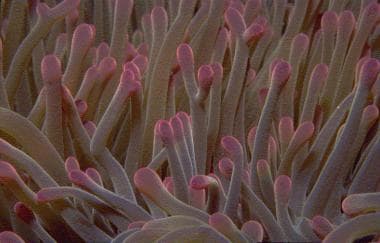 Cnidaria and jellyfish envenomations. Close-up photograph of a sea anemone demonstrating one of several tentacle types observed among different species. Photo courtesy of Scott A. Gallagher, MD.
Of the many venomous species, 3 deserve particular attention because of their potential to cause significant morbidity or mortality: the box jellyfish Chironex fleckeri, the carybdeid Carukia barnesi, and the Portuguese man-of-war Physalia physalis.
See Deadly Sea Encounters, a Critical Images slideshow, to help correctly identify and treat these injuries.
The constellation of low back pain, abdominal cramping, nausea, vomiting, diaphoresis, headache, and tachycardia is suggestive of Irukandji syndrome. [1, 2] This entity, named for the Aboriginal tribe that formerly inhabited the areas in and around Cairns, Australia, was first described in 1952 by Dr. Hugo Flecker. In 1964, Dr. Jack Barnes identified C. barnesi as the Cnidarian responsible for the condition, and since then other cubozoans have been implicated in the syndrome. Typically, 30 minutes after envenomation (range, 5 min to 2 h) patients develop the aforementioned signs and symptoms. Major envenomations also feature restlessness, agitation, and progress to pulmonary edema and cardiac failure. [3] Despite the severity of the systemic reaction, the findings at the envenomation site are barely detectable.
Although C. barnesi is closely related taxonomically to C. fleckeri, envenomation from these 2 species produce a widely different constellation of symptoms and clinical course. [4]
Causes
Contact with a Cnidarian is the cause of envenomation, although some patients have developed mild symptoms after ingestion of jellyfish.
Complications
Immediate- and short-term complications from Cnidaria envenomations include (1) wound infection, (2) rhabdomyolysis, (3) acute renal failure, (4) hemolysis, (5) pulmonary edema, (6) respiratory paralysis, (7) cardiovascular collapse, and (8) death.
Long-term sequelae of jellyfish stings include keloid formation, granulomas, hyperpigmentation, fatty atrophy, contractions, and vascular spasms. Sclerosing dacrocystadenitis, possibly due to an immune response to an antigen challenge, developed in a 3-year old child several weeks after an envenomation to the lower extremities. [5]
Diagnostics
Radiographs of the affected extremity are unnecessary, but a chest radiograph is recommended in patients with significant cardiopulmonary signs or symptoms. An electrocardiogram is recommended in severe envenomations to detect any cardiotoxic effects of the envenomation and to identify or exclude other conditions in the differential diagnosis.
Treatment
See Treatment.
Prevention
Prevention of jellyfish stings is best accomplished with a dive suit and avoidance of areas known to have large Cnidaria populations. A sunscreen containing jellyfish sting inhibitor is also available and has been shown to reduce the risk of envenomation by 82%. [6]
Long-term monitoring
Warn patients that recurrent episodes of urticaria might occur for as long as 4 weeks at the site of envenomation. This delayed reaction responds well to a 2-week taper of glucocorticoids.
Consultations
A poison center toxicologist can be consulted for treatment advice and access to antivenom.

Pathophysiology
Cnidaria possess thousands of stinging cells found near the mouth and distributed along the tentacles, as shown in the image below.
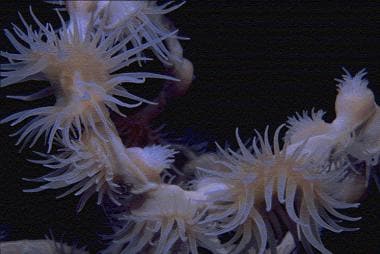 Cnidaria and jellyfish envenomations. Close-up photograph of sea anemone demonstrating tentacles surrounding the central mouth structure. Contact with tentacles results in discharge of nematocysts. Photo courtesy of Scott A. Gallagher, MD.
Cnidocytes encapsulate stinging nematocysts, which are hollow, pointed tubular structures ranging from 200-1000 µm that are bathed in venom. [7] On the external surface of the cnidoblast is a trigger mechanism, the cnidocil, that can be stimulated by mechanical or chemical stimuli. The nematocyst is located at the base of the cnidocil, and activation due to pressure from contact with a victim's skin or chemical triggers such as osmotic changes causes the nematocyst to be discharged in an explosive exocytotic mechanism. It is currently believed that the explosive release of the thread is caused by a sudden release of springlike tensions stored in the collagenous structural compartment. This is likely due to the sudden removal of bound calcium ions, resulting in a sudden increase in osmotic pressure in the capsular fluid. Longer nematocysts may reach up to 1 mm in length, a distance that is sufficient to penetrate the dermis of human skin.
The venom of many species is complex. The majority of toxins contain a complex mixture of polypeptides and proteins including (1) catecholamines, (2) histamine, (3) hyaluronidase, (4) fibrinolysins, (5) kinins, (6) phospholipases, and (7) various hemolytic, cytolytic, cardiotoxic, neurotoxic, and dermatonecrotic toxins. [8]
Medusozoa subphylum
These free-swimming marine animals are found in every ocean and at varying depths.
Hydrozoa class
Hydrozoa include solitary and colonial predatory animals. The most clinically significant species are found in the genus Physalia, and several deaths have been attributed to envenomations from these animals . Physalia physalis, the Portuguese man-of-war (also know as bluebottle), is found in the Atlantic Ocean from Nova Scotia to the Caribbean Sea. Physalia utriculus, the Pacific man-of-war, is located in the Pacific and Indian Oceans. The man-of-war in not a true jellyfish but rather a siphonophore colony of hydrozoans with 4 different groups of animals. The result is a free-swimming organism with tentacles up to 100 feet in length hanging from a gas-filled float. The float then acts as a sail, allowing for wind-assisted travel. These tentacles, each containing up to 1 million nematocysts, remain dangerous even after they become detached because they are capable of releasing venom for several weeks.
Fire coral (Millepora species) and stinging hydroids are sessile organisms that can produce significant envenomation when divers contact these animals with uncovered skin.
Scyphozoa class
The Scyphozoa, often referred to as "true jellyfish", are found worldwide and are responsible for the greatest number of jellyfish envenomations in the United States. The sea nettle, genus Chrysaora, can be found in both the Atlantic and Pacific oceans and is generally less than 20 cm in diameter.Pelagia noctiluca, the mauve stinger, is a common cause of envenomation in the seas around the British Isles and in the Mediterranean sea and tropical and subtropical Atlantic Ocean. [9] The lion's mane jellyfish, Cyanea capillata, is among the largest known species of jellyfish and can reach a diameter of nearly 8 feet with tentacles up to 120 feet long. The Mediterranean jellyfish, Rhopilema nomadica, and the moon jellyfish, Aurelia aurita, are generally considered to be harmless but have also caused moderate envenomations. [10]
Generally, envenomations caused by organisms in the class Scyphozoa are less severe than those caused by the Portuguese man-of-war, although serious morbidity is still possible.
Cubozoa class
The most toxic marine organisms, including the box jellyfish, Chironex fleckeri, and the sea wasp, Chiropsalmus quadrigatus, are species in the Cubozoa class of jellyfish. Over 60 deaths have been attributed to C. fleckeri in Australia, and others have likely gone unreported. [11] They are known to move into shallow waters in pursuit of prey, thereby invading popular swimming areas. It is the only jellyfish for which an antivenom is available. These animals are found in northern Australia and have not been reported in North American waters.
Another cubozoan, Carukia barnesi, commonly known as the Irukandji jellyfish for the syndrome it can cause, is a tiny species with a bell diameter no larger than 30 mm. [12] Malo maximus (previously referred to as M. maxima) is another of the Irukandji jellyfish that may also be responsible for the clinical syndrome. [13] The venom of C. barnesi contains a sodium channel modulator that enhances catecholamine release, which explains the early hyperadrenergic state experienced by these patients. [14] Cardiac dysfunction is also observed, although its mechanism has yet to be elucidated.
Staurozoa and Polypodiozoa classes
The species assigned to these classes do not typically result in significant envenomation.
Anthozoa subphylum
The Anthozoa subphylum consists of sea anemones and corals. Most Anthozoa organisms are sessile creatures, and anemones found within the United States tidal zones have minimal toxicity. The sea anemone Phyllodiscus semoni (night or wasp-sea anemone) located in the Western Pacific Ocean is reported to cause fulminant dermatitis and acute renal failure in humans
Corals are important components of living reefs. Risk of infection from a coral cut is of greater concern than the toxic effects of the coral.
Epidemiology
United States
Jellyfish envenomations occur in coastal areas of the United States, with highest frequency during summer. The American Association of Poison Control Centers reported 354 jellyfish stings in 2013, and undoubtedly many more went unreported. [15] Envenomations by Physalia species are the most common jellyfish encounter prompting evaluation in the emergency department. Cases of seabather's eruption occur in clusters along the East Coast and Caribbean.
International
An estimated 150 million marine envenomations occur annually, but very few require medical attention other than basic first aid. Each season, the Royal Darwin Hospital in Australia treats more than 40 patients with jellyfish encounters. A prospective evaluation of envenomations from that hospital over a 12-month period from 1999-2000 revealed that 70% resulted from the box jellyfish. [16] The remaining 30% mostly involved other Cubozoa species. This study may suggest that box jellyfish envenomations are common but also suggests the severity of the encounters. In Australia, containers of vinegar are commonly placed in prominent positions along swimming beaches in jellyfish-endemic areas. This likely reduces the amount of emergency department visits for mild-to-moderate encounters.
No scientific data substantiate any differences in Cnidaria envenomation that are attributable to race, ethnicity, or sex.
Although not well studied, a large number of pediatric cases are reported in the literature, likely due to the shallow water swimming. The smaller body mass and thinner skin may make infants and children more susceptible to jellyfish envenomations.
Prognosis
The overwhelming majority of Cnidaria envenomation patients recover with little to no sequelae. If timely prehospital and hospital-based therapy is initiated for patients experiencing Irukandji syndrome or severe envenomations due to Portuguese man-of-war or box jellyfish, the prognosis is also excellent.
Fatal envenomations due to box jellyfish in the tropical waters of northern Australia have been reported. Fatalities have occurred rapidly, often within 60 seconds. At least 67 deaths have been attributed to the box jellyfish. Another box jellyfish, Chiropsalmus quadrigatus, was responsible for the death of a 4-year-old boy in the Gulf of Mexico. [17]
Physalia species have also accounted for at least 3 deaths since 1989 in the United States.
Most patients who develop Irukandji syndrome recover within 1-2 days, but 2 deaths were reported in Queensland, Australia, in 2002.
-
Cnidaria and jellyfish envenomations. Close-up photograph of sea anemone demonstrating tentacles surrounding the central mouth structure. Contact with tentacles results in discharge of nematocysts. Photo courtesy of Scott A. Gallagher, MD.
-
Cnidaria and jellyfish envenomations. Close-up photograph of a sea anemone demonstrating one of several tentacle types observed among different species. Photo courtesy of Scott A. Gallagher, MD.