Background
Dermatofibrosarcoma protuberans (DFSP) is a relatively uncommon soft tissue neoplasm of intermediate- to low-grade malignancy. Metastasis rarely occurs. DFSP is a locally aggressive tumor with a high recurrence rate.
Although DFSP may have been reported in the literature as early as 1890, Darier and Ferrand first described it in 1924 as a distinct cutaneous disease entity called progressive and recurring dermatofibroma. Hoffman officially coined the term dermatofibrosarcoma protuberans in 1925. [1] Note the images below.
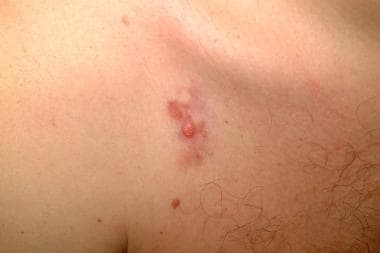 Dermatofibrosarcoma protuberans manifesting as an irregular red-to-violaceous plaque on the chest.
 Closer view of dermatofibrosarcoma protuberans. It has an irregular surface and borders with palpable dermal and subcutaneous induration.

Pathophysiology
Dermatofibrosarcoma protuberans (DFSP) is a cutaneous malignancy that arises from the dermis and invades deeper tissue (eg, fat, fascia, muscle, bone).
The cellular origin of DFSP is not clear. Evidence supports the cellular origin being fibroblastic, histiocytic, or neuroectodermal. DFSP manifests partial features of each. Therefore, many authorities suggest pluripotential progenitor cells, such as undifferentiated mesenchymal cells, may be the origin of DFSP, because they have the capacity to differentiate into all 3 cell types. [2]
Cultured DFSP tumor cells have increased growth in response to platelet-derived growth factor (PDGF)–beta. Cytogenetic studies reveal specific abnormalities in DFSP tumor cells, such as reciprocal translocations of chromosomes 17 and 22, t(17;22), and supernumerary ring chromosomes composed of interspersed sequences from bands 17(17q22) and 22(22q12). These rearrangements fuse the collagen type I alpha 1 (COL1A1) and the PDGF-beta chain (PDGFB, c-sis proto-oncogene) genes. The collagen promoter drives COL1A1 and PDGFB fusion protein production. The fusion protein is then processed into functional PDGF-B and subsequently interacts with the PDGF receptor on the cell surface of DFSP tumor cells. The activation of the PDGF receptor tyrosine kinase triggers the proliferation of DFSP tumor cells. [2, 3, 4, 5, 6, 7, 8]
Etiology
The cause of dermatofibrosarcoma protuberans (DFSP) is unknown. Laboratory studies have shown that chromosomal aberrations may contribute to the pathogenesis of DFSP; however, no evidence of hereditary or familial predisposition exists. In 10-20% of patients with this tumor, trauma at the site seems to be incriminated. Surgical and burn scars and sites of vaccinations have been reported as sites of DFSP. [9]
Epidemiology
Frequency
United States
Dermatofibrosarcoma protuberans (DFSP) accounts for less than 0.1% of all malignant neoplasms and approximately 1% of all soft tissue sarcomas. DFSP is the most common type of cutaneous sarcoma. The incidence of DFSP has been estimated to be 0.8-5 case per million population per year in 2 separate studies. [2] In a another study based on data from 9 cancer registries from 1973-2002, the annual incidence of DFSP in the United States is 4.2 cases per million population per year. [8]
International
The annual incidence of DFSP is reported as 3 cases per million population from a population-based cancer registry from 1982-2002 in France. [10] A study of the population-based National Cancer Registry shows the incidence of DFSP is approximately 4 cases per million per year in Sweden from 1990-2005. [11]
Race
Dermatofibrosarcoma protuberans (DFSP) has been reported in persons of all races, and no racial predilection seems to exist in previous reports. However, a study conducted by Criscione and Weinstock found the incidence among African Americans (6.5 cases per million population) was almost double the incidence among American whites (3.9 cases per million population).
An uncommon pigmented variant of DFSP, accounting for 1% of all DFSP cases, is called the Bednar tumor. Annual incidence of Bednar tumor among blacks is 7.5 times higher than that of white patients. [8] Note the images below.
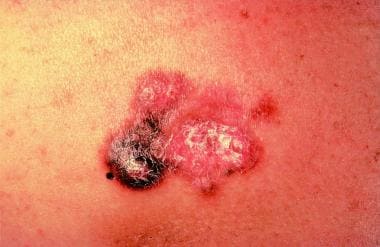 Bednar tumor, a pigmented variant of dermatofibrosarcoma protuberans, contains melanin-rich dendritic cells scattered among neoplastic spindle-shaped cells.
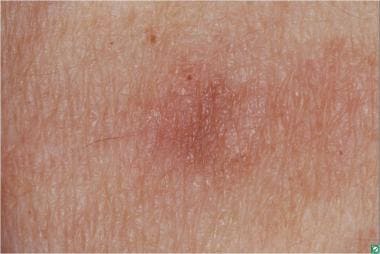 A featureless reddish brown plaque on the arm of a white female. Another example of Bednar tumor.
Sex
Several studies of dermatofibrosarcoma protuberans (DFSP) reveal an almost equal sexual distribution or a slight male predominance. In a large study of 902 patients with DFSP conducted by Rutgers et al, 514 (57%) patients were male and 388 (43%) patients were female. [12] A study based on 405 DFSP cases from the Swedish National Cancer Registry between 1990 and 2005 shows a very small difference in annual incidence of male (4.4 cases per million) versus female (4.0 cases per million). [11] However, a larger cancer registry study of 2885 cases reveals females might have a slightly higher incidence of DFSP, 4.4 cases versus 4.2 cases per million population per year. [8]
Age
Dermatofibrosarcoma protuberans (DFSP) usually occurs in adults aged 20-50 years. Rarely, DFSP has been reported in newborns and elderly individuals (80 y). [13]
Prognosis
Dermatofibrosarcoma protuberans (DFSP) is characterized by its aggressive local invasion. The tumor invades local tissue by extending tentaclelike projections underneath healthy skin, rendering complete removal of the tumor very difficult. Incomplete removal of these neoplastic cells results in a high local recurrence rate.
Despite the local invasiveness, DFSP rarely metastasizes. For the classic form of DFSP, the risk is assumed to be only 0.5%. According to the literature, the overall risk for the development of metastatic disease is 5%, including 1% with regional lymph node metastasis and 4% with distant metastasis. Regional lymph node involvement represents a sign of poor prognosis; most patients die within 2 years. [8] The lungs are the most common site of distant metastasis that occurs via hematogenous spread. Usually, metastatic disease is preceded by multiple local recurrences. [14]
A small subset of DFSP patients presents with fibrosarcomatous progression. This fibrosarcomatous progression DFSP variant is more aggressive in nature, and the clinical outcome usually is poor. [15]
The extent of surgical excision determines the prognosis for the patient. To reduce the local recurrence rate, a wide surgical excision with adequate margins or Mohs technique are used. The latter imparts a better outcome.
Histologic features of DFSP may also serve as prognostic indicators. A high number of mitotic figures, increased cellularity, DNA aneuploidy, TP53 gene overexpression, and the presence of fibrosarcomatous changes within the tumor are poor prognostic indicators. Of note, fibrosarcomatous variants of DFSP lacking a genetic marker of translocation between chromosomes 17 and 22 may not respond to imatinib. The loss of the t(17,22) cytogenetic marker in the fibrosarcomatous progression DFSP variant may represent progression of the malignancy. [1, 16, 17]
Age older than 50 years is also a risk factor associated with a poor clinical outcome. [18]
Patient Education
Patients are advised to seek evaluation by a dermatologist if they have noticed a slow-growing skin lump or scarlike lesion on any part of their body.
-
Dermatofibrosarcoma protuberans manifesting as an irregular red-to-violaceous plaque on the chest.
-
Closer view of dermatofibrosarcoma protuberans. It has an irregular surface and borders with palpable dermal and subcutaneous induration.
-
A large dermatofibrosarcoma protuberans is seen on the abdomen. It has an appearance of atrophic plaque, while foci of nodularity also can be seen.
-
Bednar tumor, a pigmented variant of dermatofibrosarcoma protuberans, contains melanin-rich dendritic cells scattered among neoplastic spindle-shaped cells.
-
A featureless reddish brown plaque on the arm of a white female. Another example of Bednar tumor.
-
Dermatofibrosarcoma protuberans (DFSP) tumor cells take over the dermis and subcutaneous adipose tissue and then approach the fascia plane. The tumor nodule manifests with high cellularity. Under histopathologic examination, these DFSP tumor cells are spindle shaped. They tend to grow in a storiform pattern in the center portion of the tumor. They may also grow in a diffuse infiltrative pattern at the periphery, forming a honeycomb pattern. Often, no defined border can be recognized between the tumor and normal tissue.
-
Higher-power view of dermatofibrosarcoma protuberans reveals subcutaneous adipocytes entrapped by densely infiltrative spindle-shaped tumor cells.
-
DFSP demonstrates strong CD34 staining with immunohistochemistry.