Practice Essentials
A corn (also termed clavus) is a thickening of the skin due to intermittent pressure and frictional forces. These forces result in hyperkeratosis, clinically and histologically. The extensive thickening of the skin in a corn may result in chronic pain, particularly in the forefoot; in certain situations, this thickening may result in ulcer formation. The word clavus has many synonyms and innumerable vernacular terms, some of which are listed in the Table in Background below; these terms describe the related activities that have induced clavus formation.
Synonyms for clavus include callosity, a hyperkeratotic response to trauma; corn, heloma, or a circumscribed hyperkeratotic lesion that may be hard (ie, heloma durum) or soft (ie, heloma molle); and callous, callus, or a diffusely hyperkeratotic lesion. Localized callosities of the soles, which do not resolve, are termed plantar callus, heloma, tyloma, keratoma, or plantar corn. When callosities occur over one or more lateral metatarsals, they are termed intractable plantar keratoses. [1]
Corns are often seen in athletes and in patient populations exposed to uneven friction from footwear or gait abnormalities, including elderly persons, diabetic patients, and amputees. [2] Abnormal foot mechanics, foot deformities, high activity level, and more serious conditions such as peripheral neuropathy also contribute to the formation of corns. [3] Corns are associated with considerable morbidity secondary to pain; fortunately, many treatment and preventative options are available that provide a high rate of mitigation. [4]
Clinically, all these lesions look like hyperkeratotic or thickened skin. Maceration and secondary fungal or bacterial infections are a common overlying feature in heloma molle and diabetes. Plantar helomas tend to have a central keratin plug, which, when pared, reveals a clear, firm, central core. The most common sites for clavus formation are the feet, specifically the dorsolateral aspect of the fifth toe for heloma durum, in the fourth interdigital web of the foot for heloma molle, and under the metatarsal heads for calluses. Clinically, three types of corns have been described. The first is a hard corn, or heloma durum, notable for its dry, horny appearance. It is found most commonly over the interphalangeal joints. The second is a soft corn, or heloma molle, described as such because of its macerated texture secondary to moisture. It is generally found in interdigital locations. [5, 6] The third type is a periungual corn, and this type occurs near or on the edge of a nail. [7] Note the image below.
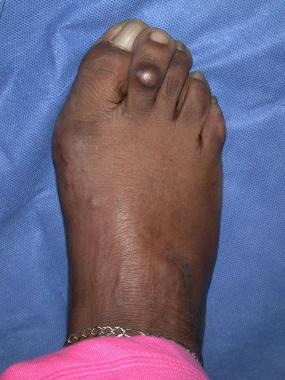 Hard corn over the proximal interphalangeal joint of second toe. Courtesy of James K. DeOrio, MD.
Signs and symptoms
Commonly, a patient reports the development of a localized growth on their foot or toes that causes pain with ambulation or when wearing shoes. [4, 7]
Clinically, all variants of clavus lesions look like hyperkeratotic or thick skin; maceration and secondary fungal or bacterial infections are a common overlying feature in heloma molle and diabetes. Plantar helomas tend to have a central keratin plug, which, when pared, reveals a clear, firm, central core. The most common sites for clavus formation are the feet, specifically the dorsolateral aspect of the fifth toe for heloma durum, in the fourth interdigital web of the foot for heloma molle, and under the metatarsal heads for calluses.
See Presentation for a full discussion.
Diagnostics
No routine laboratory tests are necessary to evaluate a patient with corns (clavus). [6] Diabetes mellitus, tertiary lues, and other causes of neuropathy should be excluded.
Blood glucose testing is required when paring of a clavus reveals an ulcer or when diabetes mellitus is suspected. In the setting of neuropathy, neuroborreliosis should be considered, and testing is performed with Lyme titers. Rheumatoid factor testing for deformities consistent with rheumatoid arthritis may be indicated. Also see Lyme Disease and Rheumatoid Arthritis.
Imaging studies
Imaging studies are required in clavus patients only to detect underlying bony abnormalities. Studies may include radiography and, occasionally, CT scanning of the affected area with bone window settings. [8] Radiographs of the feet in a weight-bearing position are useful for identifying bony prominences and the presence of underlying pathology contributing to foot pain. [9] However, a physical examination may be sufficient to evaluate smaller toe abnormalities. [9]
Other tests
Pedobarographic studies are pressure assessments that may be used in clavus patients to detect an altered distribution of foot pressure.
Dermoscopic examination before and after trimming can be helpful with the differential diagnosis of plantar warts, corns, calluses, and healed warts. The translucent central core known as a nucleus may be visualized more easily in a corn using dermoscopy. [10] Also, skin lines and punctate hemorrhages characteristic of plantar warts will be absent in clavi. [11]
Biopsy of the lesions reveals hyperkeratosis and, occasionally, mucin deposition. Paring of the corn can relieve pressure temporarily. Biopsy may be helpful in considering some of the other differential diagnoses, such as warts. Additionally, biopsy can be performed to differentiate clavus from porokeratosis palmoplantaris et disseminatum or discreta. These disorders occur in those aged 20-40 years who have hyperkeratotic plaques on the palms and soles. Biopsy shows a cornoid lamella.
Also see Histologic Findings.
Management
See Treatment for a full discussion.
When treating hard corns (clavi), the primary objective is to debulk or pare the lesion without drawing blood. Treatment should be aimed at reducing symptoms such as pain and discomfort with walking. Paring of the lesions immediately reduces pain. Following preparation of the skin with alcohol or iodine, a No. 15 surgical blade can be used with or without anesthesia to gradually remove sequential layers of keratin. [6] Once the etiology of the foot pressure irregularity is determined, attempts at pressure redistribution should be made. The final treatment goals are to remove the central keratin core for short-term pain relief and to reshape the skin to provide long-term prevention of excess friction. [7, 12] Regular debridement in high-risk populations, such as diabetic patients, may decrease the incidence of ulceration and, consequently, the need for surgical intervention. [13]

Background
Differentiation from callus
Corns are often misdiagnosed as calluses, which are also hyperkeratotic skin lesions resulting from excess friction. However, calluses develop from forces distributed over a broad area of skin, whereas corns develop from more localized forces. [12] Calluses are often considered desirable for some activities (eg, gymnastics, weightlifting), and they lack a central core, which is characteristically revealed in corns upon removal of the upper hyperkeratotic layer of skin. [14] Corns can occur within an area of callus, [15] such as on the plantar surface. Note the image below.
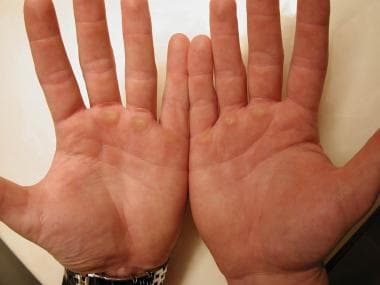 Calluses on the palmar surface of the hands of a body builder. Courtesy of James K. DeOrio, MD.
Table. Clavus Formation Named for Specific Etiology or Location (Open Table in a new window)
Vernacular Term |
Location |
Association |
Jeweler's callus, cherry pitter's thumb, [16] cameo engraver's corn [17] |
Thumb |
Digital changes, including callosities related to repetitive use of fine jeweler's instruments, which also may be seen with the use of cherry-pitting tools |
Weight lifter's callus [18] |
Callosities over the palmar metacarpophalangeal joints |
Caused by the friction of weight-lifting apparatus (This also may be seen in athletes who participate in crew.) |
Callosity on the forehead |
From kneeling prayer with the hands on the forehead |
|
Cigarette lighter's thumb [21] |
Hyperkeratosis of the radial aspect of the thumb |
Caused by excessive cigarette lighter flicking |
Knuckle pads [22] |
Hyperkeratosis over the knuckles |
Caused by boxing training |
Russell sign [23] |
Callosities of the dorsum of the hand over the metacarpophalangeal and interphalangeal joints |
Caused by the friction involved with self-induced emesis in bulimia nervosa |
Screwdriver operator's clavus [24] |
Palmar surface of the hand |
Occurs at the site of contact with a screwdriver handle |
Spine bumps |
Hyperkeratosis over the spinal column |
Caused by dancing with spinning on one's back |
Hairdresser's hand |
First finger on dominant hand |
Callus formation at the site of friction caused by scissors around the first finger on the dominant hand |
Sucking calluses [25] |
Lip, hand, or foot of a newborn |
Callus formation at the site of an area of suction on the lip, hand, or foot of a newborn |
Vamp disease [26] |
Feet |
Clavus formation due to wearing tight high-heeled shoes |
Muay Thai kickboxers [27] |
Feet |
Callosities on the forefoot (77.5%), on the plantar first metatarsal (55.3%), and on the big toe (33.3%) |
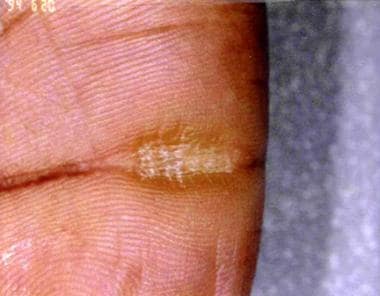
A clinical image of a screwdriver operator's clavus is below.
Pathophysiology
Corns are the result of mechanical trauma to the skin culminating in hyperplasia of the epidermis. Most commonly, friction and pressure between the bones of the foot and ill-fitting footwear cause a normal physiological response—proliferation of the stratum corneum. One of the primary roles of the stratum corneum is to provide a barrier to mechanical injury. Any insult compromising this barrier causes homeostatic changes and the release of cytokines into the epidermis, stimulating an increase in synthesis of the stratum corneum. When the insult is chronic and the mechanical defect is not repaired, hyperplasia and inflammation are common. [28] With corns, external mechanical forces are focused on a localized area of the skin, ultimately leading to impaction of the stratum corneum and the formation of a hard keratin plug that presses painfully into the papillary dermis, which is known as a radix or nucleus. [6, 12]
The shape of the hands and feet are important in corn (clavus) formation. Specifically, the bony prominences of the metacarpophalangeal and metatarsophalangeal joints often are shaped in such a way as to induce overlying skin friction. As corn formation ensues, friction against the footwear is likely to perpetuate hyperkeratosis. Repetitive motion can produce callosities, as would be seen in musicians. [29]
Toe deformity, including contractures and claw, hammer, and mallet-shaped toes, may contribute to pathogenesis. Deformity of the feet from underlying conditions such as rheumatoid arthritis can contribute to clavus formation. [30] Bunionettes, ie, callosities over the lateral fifth metatarsal head, may be associated with neuritic symptoms due to compression of the underlying lateral digital nerves. Furthermore, Morton toe, in which the second toe is longer than the first toe, occurs in 25% of the population; this may be one of the most important pathogenic factors in a callus of the common second metatarsal head, ie, an intractable plantar keratosis.
Long-term or repetitive motion may also induce clavus formation, as is seen in computer users and text messengers (ie, "mousing" callus). [31] Callosities can also form from excessive leg crossing. [32]
Etiology
Both hard and soft corns are caused by pressure from unyielding structures. [5] Abnormal mechanical stress may be intrinsic or extrinsic. Intrinsic factors include foot deformities (eg, hammer toe, bunion) [33] ; abnormal foot mechanics (acquired or hereditary); and peripheral neuropathy. Extrinsic factors include poorly fitting footwear and heavy activity (athletics).
A 2005 study conducted by Menz et al reported that in older populations, plantar pressures are significantly higher under callused regions of the foot. [34] These data support the idea that increased pressures are related to a hyperkeratotic response and that the target for treatment should be eliminating excess pressures on the foot.
Conditions associated with clavus formation include the following:
-
Advanced patient age
-
Amputation (ie, stump callosities)
-
Use of a brace or orthopedic stabilizing product
-
Costa acrokeratoelastoidosis [35]
-
Doxorubicin toxicity [36]
-
Obesity
-
Sensory neuropathies, including neuroborreliosis
-
Tethered spinal cord syndrome [38]
-
Vascular occlusion syndromes [39]
Faulty mechanics play a role. Irregular distribution of pressure and repetitive motion injury (especially in athletes) are believed to be the main inciting causes; however, inappropriately shaped or constrictive footwear in the presence of bony prominences (eg, talar bone prominences [40] ) may exacerbate corn formation. Furthermore, some disorders may alter the shape or sensation of the soles of the feet. Bony prominences and faulty foot mechanics then allow clavus formation to continue. [41, 42, 43, 44, 45]
-
Rheumatoid arthritis [46] : About 17% of patients with rheumatoid arthritis present with intractable foot pain. Chronic arthritis leads to foot deformities and consequent callus formation. Bleeding into callosities in patients with rheumatoid arthritis may be a sign of rheumatoid angiitis.
-
Diabetes mellitus with associated peripheral neuropathy [47] : In patients with diabetes, chronic callosities in the presence of neurovascular deterioration may lead to ulcerations and superinfections.
-
Obsessive-compulsive disorder (pseudo-knuckle pads)
-
Ectopic nail
Epidemiology
Frequency
United States
Corns are one of the most common foot conditions in the United States, particularly amongst older patients. It is a common disorder because of the frequency of usage of occlusive footwear and participation in repetitive activities, such as running.
International
Corns are common worldwide. Any weight-bearing human is susceptible to the development of corns.
Race
An epidemiological study evaluating the prevalence of foot conditions amongst a diverse sample of adults from the northeastern United States revealed a significant difference in rates of corns amongst ethnic groups. African Americans had a significantly higher rate of corns and calluses compared with non-Hispanic white and Puerto Rican participants (70% vs 58% vs 34.1%). [48]
Sex
Amongst elderly populations, both men and women have been reported to wear shoes too narrow for their feet. Women have been reported to wear shoes that are also shorter than their feet. Both narrow and short footwear can lead to the development of corns, in addition to foot deformities. [49] They are more common in women than in men because of this use of occlusive and poorly fitted footwear.
Age
Hyperkeratotic lesions of the foot (including corns and calluses) have been reported to affect 20-65% of people aged 65 or older. [48, 50, 51]
Anyone can have a clavus, but most individuals acquire the risk factors for clavus formation after puberty because of the onset of traumatic footwear use, repetitive motion injuries, and progressive foot deformities.
Prognosis
Recurrence is common. The most common symptoms associated with corns are pain upon ambulation and restriction of activity secondary to pain. Corns are generally not associated with mortality; however, recognizing the potential for a maltreated corn, soft corns in particular, to develop into a life-threatening secondary infection (bacterial or fungal) is important in patients with diabetes mellitus or immunosuppression.
The prognosis depends on the underlying cause of the callous formation and whether interventions can successfully be introduced to eliminate the repetitive motion. Chronic clavus generally occurs because of the difficulty in removing inciting factors in most situations. Extensive thickening of the skin may result in chronic pain, particularly in the forefoot; in certain situations, ulcer formation may result. Clavus may be a sign of underlying neuropathy due to diabetes or neuroborreliosis, or owing to the deformities of rheumatoid arthritis. In the case of neuropathy, a clavus may hide ulceration or denote abnormal neurovasculature of the feet. In the case of rheumatoid arthritis, corns may enhance the pain of deformed joints.
See Type 1 Diabetes Mellitus, Type 2 Diabetes Mellitus, and Diabetic Foot Infections for follow-up information.
Patient Education
Patients must be taught to wear less traumatic footwear, such as shoes with a wide toe space. Using inner soles, lowering the heel (if second metatarsal head lesions are present), and preventing the repetitive injuries that cause occupational clavus formation may be helpful. Review of proper footwear and trauma reduction may reduce disease severity over time.
-
Hard corn on the lateral surface of fifth toe. Courtesy of James K. DeOrio, MD.
-
Hard corn over the proximal interphalangeal joint of second toe. Courtesy of James K. DeOrio, MD.
-
Calluses on the palmar surface of the hands of a body builder. Courtesy of James K. DeOrio, MD.
-
Screwdriver operator's callus (ie, clavus).
Tables
Vernacular Term |
Location |
Association |
Jeweler's callus, cherry pitter's thumb, [16] cameo engraver's corn [17] |
Thumb |
Digital changes, including callosities related to repetitive use of fine jeweler's instruments, which also may be seen with the use of cherry-pitting tools |
Weight lifter's callus [18] |
Callosities over the palmar metacarpophalangeal joints |
Caused by the friction of weight-lifting apparatus (This also may be seen in athletes who participate in crew.) |
Callosity on the forehead |
From kneeling prayer with the hands on the forehead |
|
Cigarette lighter's thumb [21] |
Hyperkeratosis of the radial aspect of the thumb |
Caused by excessive cigarette lighter flicking |
Knuckle pads [22] |
Hyperkeratosis over the knuckles |
Caused by boxing training |
Russell sign [23] |
Callosities of the dorsum of the hand over the metacarpophalangeal and interphalangeal joints |
Caused by the friction involved with self-induced emesis in bulimia nervosa |
Screwdriver operator's clavus [24] |
Palmar surface of the hand |
Occurs at the site of contact with a screwdriver handle |
Spine bumps |
Hyperkeratosis over the spinal column |
Caused by dancing with spinning on one's back |
Hairdresser's hand |
First finger on dominant hand |
Callus formation at the site of friction caused by scissors around the first finger on the dominant hand |
Sucking calluses [25] |
Lip, hand, or foot of a newborn |
Callus formation at the site of an area of suction on the lip, hand, or foot of a newborn |
Vamp disease [26] |
Feet |
Clavus formation due to wearing tight high-heeled shoes |
Muay Thai kickboxers [27] |
Feet |
Callosities on the forefoot (77.5%), on the plantar first metatarsal (55.3%), and on the big toe (33.3%) |