Practice Essentials
Diagnosis of Dercum disease (adiposis dolorosa) is made clinically and is a diagnosis of exclusion. [1] A multidisciplinary approach to treatment is recommended. Referrals should be made to the following specialties: pain medicine, surgery, and psychiatric care, with treatment focused on both pain relief and restoring normal appearance. [2] While classically a disease of adults, a rare case of a child with Dercum disease was reported in 2018. [3]

Background
Adiposis dolorosa is most commonly known as Dercum disease, but it is also known as Ander syndrome, morbus Dercum, adipose tissue rheumatism, adiposalgia, or lipomatosis dolorosa. [1] First described in 1892 by the American neurologist Francis Xavier Dercum at Jefferson Medical College in Philadelphia, Pennsylvania, Dercum disease (adiposis dolorosa) is an unusual progressive syndrome of unknown etiology characterized by multiple painful lipomas (see images below) that usually arise in adult life, most often affecting obese postmenopausal women. [4] Dercum disease is a subcutaneous adipose tissue disease that involves the adipose tissue and its fascia (ie, adipofascial disorders). Adipofascial disorders represent variations in the spectrum of obesity. [5]
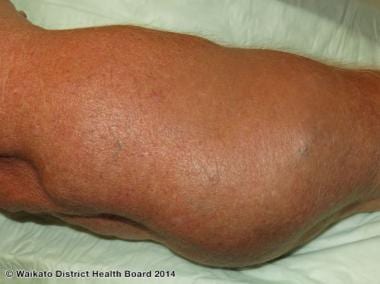 Multiple painful lipomas. Courtesy of Waikato District Health Board and DermNet New Zealand (http://www.dermnetnz.org/assets/Uploads/dermal-infiltrative/w/dercum-1.jpg).
The onset of Dercum disease is insidious, but it has been described in at least one patient as having occurred after puerperal weight gain. [6] The pain is out of proportion to the physical findings and is often described by patients as "painful fat.” The pain increases with increases in fatty tissue and in connection with menstruation. Estrogen replacement at menopause has not been shown to reduce the pain.
Since its original description, the clinical spectrum has changed to include other components of Dercum disease to various degrees. [7] This is in addition to the painful nodular fatty deposits (which are often unaffected by weight loss). More recently, general obesity, easy fatigability and weakness (asthenia), and a wide variety of unexplained emotional disturbances, such as depression, confusion, and dementia, have been reported. This observation is why Dercum disease has been proposed to be relabeled as Dercum syndrome. [8]
Dercum disease has been classified by the World Health Organization (WHO) as a distinct entity. The National Organization of Rare Diseases (NORD) notes, "Dercum Disease is a rare disorder in which there are fatty deposits which apply pressure to the nerves, resulting in weakness and pain. Various areas of the body may swell for no apparent reason. The swelling may disappear without treatment, leaving hardened tissue or pendulous skin folds."
Criteria for diagnosis
In 1901, Roux and Vitaut first proposed the following four cardinal symptoms of Dercum disease, and these remain the standard for diagnosis of classic disease, although they have not been validated [9, 10, 11] :
-
Multiple, painful, fatty masses
-
Generalized obesity, usually in menopausal age
-
Asthenia
-
Neuropsychiatric disturbances, including emotional instability, depression, epilepsy, confusion, and dementia
As early as 1910, Stern noted that neuropsychiatric disturbances and asthenia did not accompany every case, and numerous case reports were subsequently described without all four cardinal features. [12] Therefore, some have lobbied for a “minimal definition” of adiposis dolorosa, which was proposed to include the following [13] :
-
Generalized obesity
-
Chronic pain (>3 mo) in the adipose tissue
Associated conditions
Associated conditions include sleep disturbances; slight-to-moderate dryness of the eyes and the mouth, with a gritty feeling in the eyes in spite of normal tear production (the criteria for Sjögren syndrome are not completely satisfied); an irritable bowel; coccygodynia; vulvovaginitis; vulvodynia; carpal tunnel syndrome; Tietze syndrome; chondromalacia patellae; thyroid malfunction, mainly hypothyreosis; trochanteritis; localized tendonitis; and onset of fibromyalgia (sometimes). [14, 15]
Mode of inheritance
Dercum disease is believed to be transmitted in an autosomal dominant manner with incomplete penetrance. [16, 17] It is particularly strong in the maternal line; however, most reported cases of adiposis dolorosa appear to be sporadic. [18]
Pathophysiology
The understanding of the pathogenesis and mechanism of Dercum disease (adiposis dolorosa) remains unknown. The origin of the pain is obscure, and the disease is better known as a clinical entity rather than as a physiologic or metabolic process. Fatty deposits are thought to cause nerve compression and result in weakness and pain.
A review of the histopathologic findings of Dercum disease showed no consistent histologic abnormality in the adipose tissue that might distinguish these tumors from common sporadic lipomas. [18] In theory, the sudden appearance of the disease together with the incidence of a slight increase in the number of inflammatory cells in the fat could point toward the disease being, in part, an immune defense reaction. [15, 19] Some authors believe that the sympathetic nervous system may play a role in the origin and development of the pain.
The report of a case of Dercum disease developing in association with the use of high-dose corticosteroids and its resolution upon reducing the dose suggests a causal relationship. Therefore, alterations of fat metabolism induced by corticosteroid excess may play a role in the development of this syndrome. [14] An earlier study suggested that a defect in the synthesis of monounsaturated fatty acids may play a role in its development. Further studies are needed to support this hypothesis and to identify a specific biochemical defect. [20]
Dercum disease has been suggested to be an expression of familial multiple lipomas, which is an autosomal dominant disease characterized by multiple, usually asymptomatic lipomas. This observation was derived by studying the family patterns of two siblings with Dercum disease; findings suggested that the disease segregates in an autosomal dominant fashion with variable phenotypic expressivity, ranging from totally asymptomatic to extremely painful lipomas. [21] However, most cases of the disease are found to be sporadic with no specific genetic mutations. [1]
Mutational analysis excluded the 8344A→G mitochondrial mutation seen in other patients with multiple lipomas. [18, 21] The A→G transition at position 8344 in the tRNAlys gene of mitochondrial DNA has been described in the syndrome myoclonic epilepsy and ragged-red fibers (MERRF). A number of reports described the presence of multiple lipomas resembling those of multiple symmetrical lipomatosis in some members of pedigrees with MERRF harboring the 8344 tRNA mutation. [22]
Gamez et al described an unusual syndrome characterized by maternally inherited multiple symmetrical lipomatosis in a pedigree harboring the 8344 mutation in the tRNAlys gene of mitochondrial DNA. [21] Although the probands in their study harbored this mutation and had sensory polyneuropathy, they lacked the typical neuromuscular manifestations of MERRF.
In 2015, an abnormal lymphatic phenotype was discovered in three patients with the disease compared with four female controls using near-infrared fluorescence (NIRF) lymphatic imaging. [23] The lymphatics in the participants with Dercum disease were intact and dilated but could not readily clear lymph when compared with lymphatics in four control patients. Further NIRF imaging revealed masses of fluorescent tissue within the painful nodules, suggesting a lymphovascular etiology.
Etiology
The cause of this poorly understood disorder is unknown, although multiple candidate theories have been proposed, including nervous system dysfunction, lymphovascular disorder, adipose tissue dysfunction, endocrine dysfunction, mechanical pressure, trauma-induced, and inflammation, among others. No theory has been consistently substantiated.
High-dose corticosteroids were the suspected cause in a reported case. [14]
Another case report documented traumatic injury sustained from a motorcycle accident approximately 5 years prior as the cause of Dercum disease (adiposis dolorosa). [24] In two patients with rheumatoid arthritis treated with tocilizumab, an atypical juxta-articular form of Dercum disease developed. After discontinuation of tocilizumab, there was progressive disappearance of the pain associated with the fatty masses. [25]
Epidemiology
Frequency
Dercum disease (adiposis dolorosa) is rare and the prevalence has not been established.
Sex
Dercum disease is 20 times more common in females who are postmenopausal, obese, or overweight than in other people. It can occur in individuals who are not obese. Sixteen percent are males.
Age
Dercum disease is most commonly seen in persons aged 45-60 years. It may occur in women younger than 45 years. A survey of patients with the disease concluded that 85% of patients developed symptoms before the onset of menopause. [7] Adiposis dolorosa is almost never seen in children, however, a case report of a Dercum disease affecting a prepubescent 8-year-old girl was published in 2018. [3]
Prognosis
The course is of Dercum disease (adiposis dolorosa) chronic and may be progressive and more debilitating over time. [1, 26]
Patient Education
Educating patients about the chronicity of Dercum disease (adiposis dolorosa) and the available limited treatment modalities is important. Proper education about the aggravating and relieving factors should be explained.
Addressing any possible needs of those persons with disabilities is important, preferably with the assistance of an occupational therapist and a social worker. Various aids may be needed in the home and at work.
There are several social networking support groups related to Dercum disease. The Dercum Society website featuring information on Dercum disease for patients was created in 2005 by a patient with the disease. [27] Other organizations supporting this disease include the American Chronic Pain Association and the Fat Disorders Research Society. [28]
-
Multiple painful lipomas. Courtesy of Waikato District Health Board and DermNet New Zealand (http://www.dermnetnz.org/assets/Uploads/dermal-infiltrative/w/dercum-1.jpg).