Practice Essentials
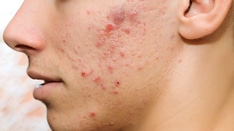
Acne vulgaris is a common chronic skin disease involving blockage and/or inflammation of pilosebaceous units (hair follicles and their accompanying sebaceous gland). Acne can present as noninflammatory lesions, inflammatory lesions, or a mixture of both, affecting mostly the face but also the back and chest. [1] See the image below.
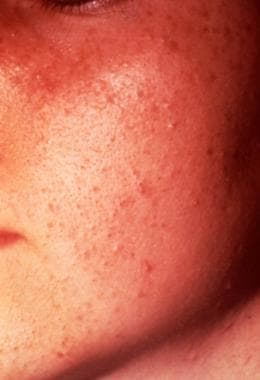
Acne develops from the following four factors: (1) follicular epidermal hyperproliferation with subsequent plugging of the follicle, (2) excess sebum production, (3) the presence and activity of the commensal bacteria Cutibacterium acnes (formerly Propionibacterium acnes), and (4) inflammation. [2] In addition, genetics is also a key factor in the pathophysiology of acne. [3]
Signs and symptoms
Acne vulgaris is characterized by noninflammatory, open or closed comedones and by inflammatory papules, pustules, and nodules. Acne vulgaris typically affects the areas of skin with the densest population of sebaceous follicles (eg, face, upper chest, back). Local symptoms of acne vulgaris may include pain, tenderness, or erythema.
Systemic symptoms are most often absent in acne vulgaris. In rare but severe cases, acne vulgaris could lead to acne conglobata, with highly inflammatory nodulocystic acne and interconnected abscesses. Acne fulminans is even more severe than acne conglobata, with systemic symptoms such as fever, joint pain, and general malaise. Additionally, acne vulgaris may have a psychological impact on any patient, regardless of the severity or the grade of the disease. [4, 5, 6]
See Clinical Presentation for more detail.
Diagnosis
Examination in patients with acne vulgaris includes the following features:
-
Comedonal acne: Presence of open and closed comedones but usually no inflammatory papules or nodules
-
Mild acne: Presence of comedones and a few papulopustules
-
Moderate acne: Presence of comedones, inflammatory papules, and pustules; a greater number of lesions are present than in milder inflammatory acne
-
Nodulocystic acne: Presence of comedones, inflammatory lesions, and large nodules greater than 5 mm in diameter; scarring is often evident
Laboratory tests
Acne vulgaris is a clinical diagnosis. However, laboratory testing may be indicated in the following situations:
-
Polycystic ovarian syndrome (PCOS): Consider PCOS in female patients with oligomenorrhea, hirsutism and/or acanthosis nigricans in addition to acne. These patients should be evaluated with total and free testosterone, dehydroepiandrosterone sulfate (DHEAS), androstenedione, luteinizing hormone, and follicle-stimulating hormone values, as well as a lipid panel, glucose value, and insulin level.
-
Cases refractory to long-term antibiotic treatment or when improvement with antibiotics is not maintained: Culture skin lesions to rule out gram-negative folliculitis.
See Workup for more detail.
Management
Treatment of acne vulgaris should be directed toward the known pathogenic factors, including follicular hyperproliferation, excess sebum, C acnes (formerly P acnes), and inflammation. The most appropriate treatment is based on the grade and severity of the acne.
Pharmacotherapy
The following medications are used in the treatment of Cutibacterium (formerly Propionibacterium) acne vulgaris:
-
Acne products (eg, erythromycin and benzoyl peroxide, clindamycin and tretinoin, clindamycin and benzoyl peroxide, azelaic acid, benzoyl peroxide, topical dapsone)
-
Retinoidlike agents (eg, topical tretinoin, adapalene, tazarotene, isotretinoin)
-
Antibiotics (eg, tetracycline, minocycline, doxycycline, sarecycline, trimethoprim/sulfamethoxazole, clindamycin, topical clindamycin, topical erythromycin, daptomycin, minocycline topical foam)
-
Selective aldosterone antagonists (eg, spironolactone)
-
Androgen receptor inhibitors (eg, clascoterone topical)
-
Estrogen/progestin combination oral contraceptive pills (eg, ethinyl estradiol, drospirenone, and levomefolate; ethinyl estradiol and norethindrone; ethinyl estradiol and norgestimate; ethinyl estradiol and drospirenone)
When a topical or systemic antibiotic is used, it should be used in conjunction with benzoyl peroxide to reduce the emergence of resistance.
Nonpharmacotherapy
Diet therapy, such as a low-glycemic diet and avoidance of “junk foods,” has been suggested as a nonpharmacologic measure to manage acne vulgaris. Skim milk has been found to have a positive association with acne.
Procedures
Procedural treatments for acne vulgaris include the following:
-
Manual extraction of comedones
-
Intralesional steroid injections
-
Superficial peels that use glycolic or salicylic acid
-
Light and laser therapy
See Treatment, Guidelines, and Medication for more detail.

Background
Acne vulgaris is characterized by noninflammatory, open or closed comedones and by inflammatory papules, pustules, and nodules. Acne vulgaris typically affects the areas of skin with the densest population of sebaceous follicles; these areas include the face, the upper part of the chest, and the back.
Acne vulgaris is the most common skin disease in the United States; it affects an estimated 80% of Americans at some time during their lives. [7] Twenty percent have severe acne, which can result in permanent physical and mental scarring.
Medscape Drugs & Diseases articles on acne include Acne Conglobata,Acne Fulminans,Acne Keloidalis Nuchae, and Acneiform Eruptions. Also see the Medscape Acne Resource Center.
Pathophysiology
The pathogenesis of acne vulgaris is multifactorial. The key factor is genetics. [3] Acne develops as a result of an interplay of the following four factors [2] :
-
Release of inflammatory mediators into the skin
-
Follicular hyperkeratinization with subsequent plugging of the follicle
-
Cutibacterium acnes (formerly Propionibacterium acnes) follicular colonization
-
Excess sebum production
Research has shown that inflammatory responses actually occur before hyperkeratinization. Cytokines produced by CD4+ T cells and macrophages activate local endothelial cells to up-regulate inflammatory mediators such as vascular cell adhesion molecule-1 (VCAM-1), intercellular adhesion molecule-1 (ICAM-1), and human leukocyte antigen (HLA)–DR in the vessels around the pilosebaceous follicle. [8]
Follicular hyperkeratinization involves increased keratinocyte proliferation and decreased desquamation, leading to sebum- and keratin-filled microcomedones. [9]
C acnes (formerly P acnes) is an anaerobic organism present in acne lesions. The presence of C acnes (formerly P acnes) promotes inflammation through a variety of mechanisms. C acnes (formerly P acnes) stimulates inflammation by producing proinflammatory mediators that diffuse through the follicle wall. Studies have shown that C acnes (formerly P acnes) activates the toll-like receptor 2 on monocytes and neutrophils. [10] Activation of the toll-like receptor 2 then leads to the production of multiple proinflammatory cytokines, including interleukins 12 and 8 and tumor necrosis factor. Hypersensitivity to C acnes (formerly P acnes) may also explain why some individuals develop inflammatory acne vulgaris while others do not. [11]
Excess sebum is another key factor in the development of acne vulgaris. Sebum production and excretion are regulated by a number of different hormones and mediators. In particular, androgen hormones promote sebum production and release. [12] The degree of comedonal acne in prepubertal girls correlates with circulating levels of the adrenal androgen dehydroepiandrosterone sulfate (DHEAS). [13, 14]
Numerous other mediators and receptors, including growth hormone and insulinlike growth factor, as well as peroxisome proliferator-activated receptors also regulate the sebaceous gland and may contribute to the development of acne. [15, 16] Furthermore, the sebaceous gland acts a neuroendocrine-inflammatory organ that is activated via corticotrophin-releasing hormones in response to stress and normal functions. [17]
Etiology
The main underlying cause of acne is a genetic predisposition. In addition, other aggravating factors are recognized.
Cosmetic agents and hair pomades may worsen acne. [18]
Medications that can promote acne development include steroids, lithium, some antiepileptics, and iodides. [19]
Congenital adrenal hyperplasia, polycystic ovary syndrome, and other endocrine disorders associated with excess androgens may trigger the development of acne vulgaris. Even pregnancy may cause a flare-up. [20]
Mechanical occlusion with headbands, shoulder pads, back packs, or under-wire bras can be aggravating factors. [21]
Excessive sunlight may either improve or flare acne. In any case, the ultraviolet exposure ages the skin.
Epidemiology
United States
Acne is the most common skin condition in the United States, affecting up to 50 million Americans annually. [22] Acne vulgaris affects 80% of Americans at some time during their lives. [7] Twenty percent have severe acne, which can result in permanent physical and mental scarring.
International
Persons of some races are affected more than others. Cystic acne is prevalent in the Mediterranean region from Spain to Iran. [23]
Race
Acne is common in North American whites. African Americans have a higher prevalence of pomade acne, likely stemming from the use of hair pomades. Ethnicities with darker skin are also more prone to postinflammatory hyperpigmentation. [18]
Sex
During adolescence, acne vulgaris is more common in males than in females. In adulthood, acne vulgaris is more common in women than in men. [22, 24]
Age
Acne or acneform lesions, such as in neonatal cephalic pustulosis, may be present in the first few weeks and months of life, when a newborn is still under the influence of maternal hormones and when the androgen-producing portion of the adrenal gland is disproportionately large. [25] This neonatal acne tends to resolve spontaneously. However, some neonates may require therapy (eg, topical retinoids). [25]
Adolescent acne usually begins with the onset of puberty, when the gonads begin to produce and release more androgen hormone. It affects many adolescents and young adults. Approximately 85% of people between the ages of 12 and 24 years experience at least minor acne. [22]
Acne is not limited to adolescence. It can occur at any stage of life and may continue into one’s 30s and 40s. Acne occurring in adults is increasing, affecting up to 12-15% of women. [22] By age 45 years, 5% of both men and women still have acne. [26]
Prognosis
Acne may cause long-lasting and detrimental psychosocial and physical effects. It is associated with depression and anxiety, regardless of disease severity, although the psychological effects usually improve with treatment. Furthermore, acne may cause permanent scarring that is difficult to correct. [27]
A 2017 Swedish study has added further statistically significant evidence that teenage acne may be a risk factor for the later development of early prostate cancer. [28, 29, 30] Researchers suggest that C acnes (formerly P acnes) may be an associated link.
In male patients, acne generally clears by early adulthood. Five percent of men still have acne at age 25 years. Adult acne is more common in females. Twelve percent of women still have acne at age 25 years. Five percent of women still have acne at age 45 years. [26]
The overall prognosis for patients with acne is good.
Patient Education
Patients should be instructed on their morning and evening treatment programs. Retinoid dermatitis may develop at approximately day 10 of therapy. Patients must be informed of this in advance so they will not consider this exfoliation an allergy. By skipping a day or 2 and restarting the program slowly, the skin can adapt to this irritation.
Prescriptions should be accompanied by a discussion of the potential adverse effects.
For patient education resources, see the Skin Conditions and Beauty Center as well as the patient education article Acne. Also see the Medscape Acne Resource Center.
-
Acne, grade I; multiple open comedones.
-
Acne, grade II; closed comedones.
-
Acne, grade III; papulopustules.
-
Acne, grade IV; multiple open comedones, closed comedones, and papulopustules, plus cysts.
-
Acne with reactive hyperpigmentation; before treatment.
-
Acne with reactive hyperpigmentation; after treatment.