Practice Essentials
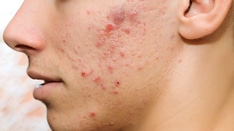
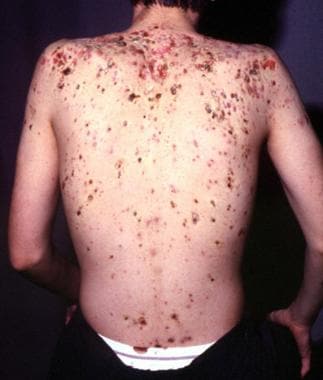
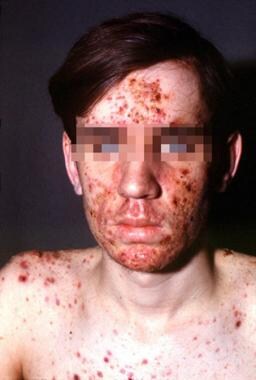
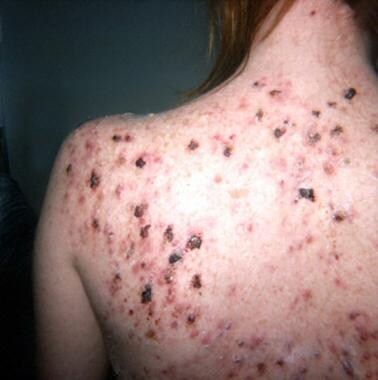
Acne conglobata (AC) is an uncommon and unusually severe form of acne characterized by burrowing and interconnecting abscesses and irregular scars (both keloidal and atrophic), often producing pronounced disfigurement. The comedones often occur in a group of 2 or 3, and cysts contain foul-smelling seropurulent material that returns after drainage. The nodules are usually found on the chest, the shoulders, the back, the buttocks, the upper arms, the thighs, and the face. [1] Acne conglobata may develop as a result of a sudden deterioration of existing active papular or pustular acne, or it may occur as the recrudescence of acne that has been quiescent for many years. See the images below.
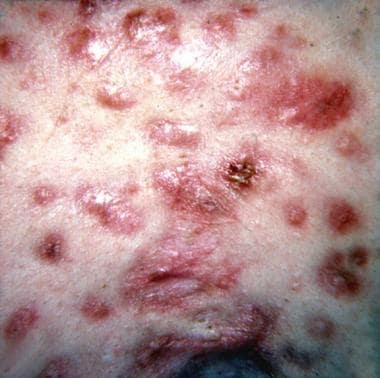 A close-up view of nodules and pustules on the back. Courtesy of Emanuel G. Kuflik.
Pyogenic arthritis, pyoderma gangrenosum, and acne conglobata are clinically distinct inflammatory disorders that may be seen rarely in the same patient in a syndrome known as PAPA Syndrome. It was originally reported in a 3-generation kindred with autosomal dominant transmission The PAPA syndrome is related to the triad of pyoderma gangrenosum, acne conglobata, and suppurative hidradenitis, known as the PASH syndrome. [2] The simultaneous presence of pyoderma gangrenosum, acne conglobata, suppurative hidradenitis, and seronegative spondyloarthritis has been suggested as a new linkage with the designation being PASS syndrome. [3] Micali and Lacarrubba adroitly observed that secondary comedones in acne conglobata may correlate with double-ended pseudocomedones in hidradenitis suppurativa. [4] In one series of 1094 pediatric patients with hidradenitis suppurativa, 503 (45.9%) had acne conglobate. [5]
Acne conglobata may also be associated with the SAPHO syndrome, which consists of synovitis, acne conglobata, pustulosis, hyperostosis, and osteitis. SAPHO syndrome is characterized by distinctive osteoarticular manifestations and a spectrum of neutrophilic dermatoses, including palmoplantar pustulosis. [6] It should be considered in patients with osteoarticular pain, particularly involving the anterior chest wall and/or spine, and neutrophilic skin lesions.
Other acne-related Medscape articles include Acne Fulminans, Acne Keloidalis Nuchae, Acne Vulgaris, and Acneiform Eruptions.
Prognosis
Acne conglobata can produce pronounced disfigurement. Severe scarring produces psychological impairment; individuals with acne conglobata are often ostracized, or they may feel excluded. Acne conglobata has also been responsible for anxiety and depression in many patients.
Complications
This inflammatory form of acne may be associated with necrotizing scleritis, a potentially sight‐threatening subtype of anterior scleritis sometimes seen with underlying inflammatory disorders. [7]
Medical care
The therapy of choice for acne conglobata (AC) includes isotretinoin 0.5-1 mg/kg for 4-6 months.
Simultaneous use of systemic steroids, such as prednisone 1 mg/kg/d for 2-4 weeks, may also prove beneficial, particularly if systemic symptoms are evident.

Pathophysiology
The primary causes of acne conglobata remain unknown. Chromosomal defects in the XYY karyotype may be responsible for severe forms of acne conglobata. In contrast, the XXY karyotype of Klinefelter syndrome is believed to exclude severe acne; however, 1 patient with the unusual combination of Klinefelter syndrome and acne conglobata has been reported. [8]
The association of this disease with specific human leukocyte antigen (HLA) phenotypes has not been proven. The HLA-A and HLA-B phenotypes were evaluated in 65 patients with acne conglobata, in whom antigen frequencies were found to be normal. Other patients with acne conglobata and hidradenitis suppurativa were studied; 4 of 6 patients had HLA-B7 cross-reacting antigens (ie, HLA-B7, HLA-Bw22, HLA-B27, HLA-Bw40, HLA-Bw42), and all had HLA-DRw4. [9]
PAPA syndrome has been mapped to a locus on the long arm of chromosome 15 (maximum 2-point logarithm of odds score 5.83; recombination fraction [straight theta] 0 at locus D15S206). [10] Assuming complete penetrance, haplotype analysis of recombination events defined an interval of 10 centimorgans between loci D15S1023 and D15S979. This finding suggests that these clinically distinct disorders may share a genetic etiology.
Etiology
The primary cause of acne conglobata remains unknown.
Changes in reactivity to Cutibacterium acnes (formerly Propionibacterium acnes) may play an important role in the etiology of the disease.
Exposure to halogenated aromatic hydrocarbons (eg, dioxins) or ingestion of halogens (eg, thyroid medication, hypnotic agents) may trigger acne conglobata in an individual who is predisposed.
Other factors that can provoke acne conglobata include androgens (eg, androgen-producing tumors) and anabolic steroids.
Acne conglobata and acne fulminans may appear after cessation of testosterone therapy or as a reaction to other medications. [11]
Epidemiology
Acne conglobata is an uncommon disease, and the disease affects males more frequently than females.
The onset of acne conglobata usually occurs in young adults aged 18-30 years, but infants may develop this condition as well.
-
Nodules on the back. Courtesy of Emanuel G. Kuflik.
-
Nodules on the face. Courtesy of Emanuel G. Kuflik.
-
A closer view of nodules and pustules on the back. Courtesy of Emanuel G. Kuflik.
-
A close-up view of nodules and pustules on the forehead. Courtesy of Emanuel G. Kuflik.
-
Nodules and pustules on the back. Courtesy of Emanuel G. Kuflik.
-
A close-up view of nodules and pustules on the back. Courtesy of Emanuel G. Kuflik.