Background
Delusions of parasitosis (DoP) manifest in the patient's firm belief that he or she has pruritus due to an infestation with insects. Patients may present with clothing lint, pieces of skin, or other debris contained in plastic wrap, on adhesive tape, or in matchboxes. They typically state that these contain the parasites; however, these collections have no insects or parasites. This presentation is called the matchbox sign, or what the authors term the "Saran-wrap sign."
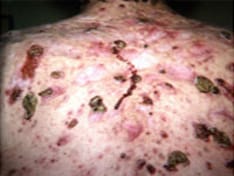
The patients have no obvious cognitive impairment, and abnormal organic factors are absent. True infestations and primary systemic diseases that cause pruritus are not involved. Primary skin lesions are not present. Physical examination may reveal no lesions, but only linear erosions with crusts, prurigo nodularis, and/or ulcers.
The classification of delusions of parasitosis is complicated. It is considered primarily a monosymptomatic hypochondriacal psychosis and has been associated with schizophrenia, obsessional states, bipolar disorder, depression, and anxiety disorders. Delusions of parasitosis occur primarily in white middle-aged or older women, although the condition has been reported in all age groups and in men.
Savely et al [1] introduced the term Morgellon disease to describe a condition characterized by fibers attached to the skin. The entity appears to be little more than a new designation for delusions of parasitosis. Koblenzer [2] and Waddell and Burke [3] have discussed the utility of the term, with Murase et al [4] finding the term useful for building a therapeutic alliance with patients with delusions of parasitosis. The Centers for Disease Control and Prevention is currently investigating Morgellon disease. [5]
William Harvey [6] of the Morgellons Research Foundation Medical Advisory Board states the following:
"All patients with Morgellons carry elevated laboratory proinflammatory markers, elevated insulin levels, and verifiable serologic evidence of 3 bacterial pathogens. They also show easily found physical markers such as peripheral neuropathy, delayed capillary refill, abnormal Romberg’s sign, decreased body temperature, and tachycardia. Most importantly they will improve, and most recover on antibiotics directed at the above pathogens."
The author of this article has not found reliable data to back up William Harvey's claims, but they are included here to comprehensively address this issue. [7]
Walling and Swick [8] suggest abandoning 3 the diagnostic terms trichotillomania, delusions of parasitosis, and neurotic excoriation, which they believe have become barriers to treatment. Instead, they suggest using the alternative patient-centered nomenclature of neuromechanical alopecia, pseudoparasitic dysesthesia, and (simply) excoriation.
It is important to note that many patients with psychopathology complain of delusions of parasitosis, but the coexistence of delusions of parasitosis and another condition, the author thinks, is independent of pure delusions of parasitosis without other symptoms. [9, 10]
One study of 47 patients reported that those noting bugs appeared to be more likely to be diagnosed with of delusional disorder or to have a medical diagnosis, as opposed to those noting fibers, who were more likely deemed to possess a somatoform disorder. Patients referred to a medical setting for delusions of parasitosis were 300 times more likely to require a physician to engage the hospital's legal counsel versus other patients in the same clinical setting. [11]
European researchers reported a series of 148 delusions of parasitosis patients. None of the patients possessed genuine infestation, as was shown by thorough examinations. Thirty-five percent of the patients believed themselves to be parasite infested. Most patients in this series noted a significant number of other living or inanimate (17%) pathogenic agents. Seventy-one (48%) of the 148 patients presented to doctors with “proof” of their infestations. These specimens were, for the most part, skin bits or hair and rarely insects. Only a few of these insects were anthropophilic or of human pathogenicity. No insects could be linked to the clinical presentations. [12]
Two comprehensive reviews in 2013 reiterated the necessity for clinicians to establish a therapeutic alliance with patients due to the challenges of treating a condition that a clinician might think is psychological in nature while the patient is convinced it is real and physical. [13, 14]
To help the patient a strong theraputic alliance must be established with the patient. [15]

Pathophysiology
The cause of delusions of parasitosis is unknown. It appears related to neurochemical pathology. This concept is underlined by its induction by psychoactive agents (eg, amphetamines, cocaine, and methylphenidate) and its coincidence with depression, schizophrenia, social isolation, and sensory impairment. Some reports have linked delusions of parasitosis to hyperthyroidism, which was deemed a secondary type of delusions of parasitosis, because it resolved with pimozide therapy and thyroid medications.
Epidemiology
Frequency
The exact prevalence of delusions of parasitosis is unknown.
Mortality/Morbidity
The literature includes one report of suicide in a 40-year-old man with delusions of parasitosis. [16]
Race-, sex-, and age-related demographics
Delusions of parasitosis appear to be more common in whites than in people of other races.
Delusions of parasitosis occur primarily in white middle-aged or older women, although the condition has been reported in all age groups and in men. The female-to-male ratio is approximately 2:1. More specifically, this ratio is 1:1 in people younger than 50 years and 3:1 in those older than 50 years. [17, 18]
Prognosis
Many patients with delusions of parasitosis refuse treatment and are lost to follow-up. For those patients who can be convinced to undertake treatment, the prognosis for a remission of the delusions is good.
Patient Education
Patients must be reassured that they are not alone and that the physician will listen to them and sincerely desires to help them to get better. While one should not say anything to confirm the delusion, it is usually not helpful to forcefully confront patients with delusions of parasitosis.
Statements such as the following might be helpful: "I know you feel strongly that there are parasites here, and I'm sure that you itch severely, but I cannot prove that parasites are or have been the cause of your problem." [19]