Continually Updated Clinical Reference
 
 
  All Sources     eMedicine     Medscape     Drug Reference     MEDLINE
 
eMedicine - Tinea Versicolor : Article by

Quick Find
Authors & Editors
Introduction
Clinical
Differentials
Workup
Treatment
Medication
Follow-up
References

Related Articles
Erythrasma

Pityriasis Alba

Psoriasis, Guttate

Seborrheic Dermatitis

Tinea Corporis

Vitiligo


Patient Education
Click here for patient education.


Author: Craig G Burkhart, MD, MPH, Clinical Professor, Department of Medicine, Clinical Assistant Professor, Department of Dermatology, Section of Dermatology, Medical College of Ohio at Toledo, Ohio University School of Medicine

Craig G Burkhart is a member of the following medical societies: American Academy of Dermatology, Ohio State Medical Association, and Phi Beta Kappa

Coauthor(s): Lorie Gottwald, MD, Chief, Division of Dermatology, Associate Professor, Department of Internal Medicine, Medical College of Ohio at Toledo; Craig Nathaniel Burkhart, MD, MS, Staff Physician, Dermatology, University of NC at Chapel Hill

Editors: Kathryn Schwarzenberger, MD, Associate Professor, Departments of Dermatology and Medicine, Medical University of South Carolina; Michael J Wells, MD, Associate Professor, Department of Dermatology, Texas Tech University Health Sciences Center; Edward F Chan, MD, Clinical Assistant Professor, Department of Dermatology, University of Pennsylvania School of Medicine; Catherine Quirk, MD, Clinical Assistant Professor, Department of Dermatology, Brown University; Dirk M Elston, MD, Director, Department of Dermatology, Geisinger Medical Center

Author and Editor Disclosure

Synonyms and related keywords: pityriasis versicolor, chromophytosis, dermatomycosis furfuracea, tinea flava, aeromia parasitica, Kleinenflechte, Hodi-Potsy, cutaneous fungal infection, hypopigmented macules, hyperpigmented macules, Malassezia furfur, M furfur, Pityrosporon orbiculare, Pityrosporon ovale, Malassezia ovalis, scaly macules, scaly papules, Cushing disease

Background

Tinea versicolor is a common, benign, superficial cutaneous fungal infection usually characterized by hypopigmented or hyperpigmented macules and patches on the chest and the back. In patients with a predisposition, the condition may chronically recur.  The fungal infection is localized to the stratum corneum.

Pathophysiology

Tinea versicolor is caused by the dimorphic, lipophilic organism, Malassezia furfur, which is cultured only in media enriched with C12- to C14-sized fatty acids. M furfur is now the accepted name for the organism. Pityrosporon orbiculare, Pityrosporon ovale, and Malassezia ovalis are synonyms for M furfur. M furfur is a member of normal human cutaneous flora, and it is found in 18% of infants and 90-100% of adults.

Eleven species of M furfur have been described, with Malassezia globosa being the usual form isolated in persons with tinea versicolor. The organism can be found on healthy skin and on skin regions demonstrating cutaneous disease. In patients with clinical disease, the organism is found in both the yeast (spore) stage and the filamentous (hyphal) form. Factors that lead to the conversion of the saprophytic yeast to the parasitic, mycelial morphologic form include a genetic predisposition; warm, humid environments; immunosuppression; malnutrition; and Cushing disease. Human peptide cathelicidin LL-37 plays a role in skin defense against this organism.

Even though M furfur is a component of the normal flora, it can also be an opportunistic pathogen. The organism is considered to be a factor in other cutaneous diseases, including Pityrosporum folliculitis, confluent and reticulate papillomatosis, seborrheic dermatitis, and some forms of atopic dermatitis.

Frequency

United States

Tinea versicolor occurs more frequently in areas with higher temperatures and higher relative humidities. The national prevalence of this condition is 2-8% of the population. The exact incidence in the United States is difficult to assess because many individuals who are affected may not seek medical attention.

International

Tinea versicolor occurs worldwide, with prevalences reported to be as high as 50% in the humid, hot environment of Western Samoa and as low as 1.1% in the colder temperatures of Sweden.

Mortality/Morbidity

  • Tinea versicolor is a benign skin disease that causes scaly macules or papules on the skin. As the name implies (versi means several), the condition can lead to discoloration of the skin, with colors ranging from white to red to brown. The condition is not considered to be contagious because the causative fungal pathogen is a normal inhabitant of the skin.
  • The skin of an individual who is affected may be either hypopigmented or hyperpigmented. In the case of hypopigmentation, tyrosinase inhibitors (resulting from the inhibitory action of tyrosinase of dicarboxylic acids formed through the oxidation of some unsaturated fatty acids of skin surface lipids) competitively inhibit a necessary enzyme of melanocyte pigment formation. In hyperpigmented macules in tinea versicolor, the organism induces an enlargement of melanosomes made by melanocytes at the basal layer of the epidermis.

Race

Although the alteration in skin pigmentation is more apparent in darker-skinned individuals, the incidence of tinea versicolor appears to be the same in all races.

Sex

Several studies have addressed the frequency of tinea versicolor based on sex, and no dominance of either sex is apparent.

Age

In the United States, the disease is most common in persons aged 15-24 years, when the sebaceous glands are more active. Its occurrence before puberty or after age 65 years is uncommon. In more tropical countries, age frequency varies; most cases involve people aged 10-19 years who live in warmer, humid countries, such as Liberia and India.


History

  • Most individuals with tinea versicolor complain of cosmetically disturbing, abnormal pigmentation.
    • The involved skin regions are usually the trunk, the back, the abdomen, and the proximal extremities. The face, the scalp, and the genitalia are less commonly involved.
    • The color of each lesion varies from almost white to reddish brown or fawn colored.
    • A fine, dustlike scale covers the lesions.
  • Patients often complain that the involved skin lesions fail to tan in the summer.
  • Occasionally, a patient also complains of mild pruritus.

Physical

Tinea versicolor can present in 3 forms.

  • Form 1
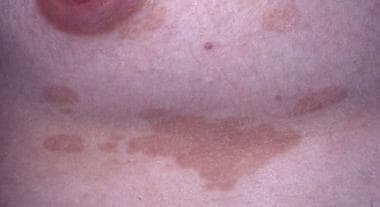
    • The most common appearance of the disease is as numerous, well-marginated, finely scaly, oval-to-round macules scattered over the trunk and/or the chest, with occasional extension to the lower part of the abdomen, the neck, and the proximal extremities.
    • The macules tend to coalesce, forming irregularly shaped patches of pigmentary alteration. As the name versicolor implies, the disease characteristically reveals a variance in skin hue. The involved areas can be either darker or lighter than the surrounding skin.
    • The condition is more noticeable during the summer months when the discrepancy in color from the normal skin becomes more apparent.
    • Light scraping of the involved skin with a scalpel blade characteristically yields a copious amount of keratin.
  • Form 2
    • An inverse form of tinea versicolor also exists in which the condition has an entirely different distribution, affecting the flexural regions, the face, or isolated areas of the extremities. This form of tinea versicolor is more often seen in hosts who are immunocompromised.
    • This form of the disease can be confused with candidiasis, seborrheic dermatitis, psoriasis, erythrasma, and dermatophyte infections.
  • Form 3
    • The third form of M furfur infections of the skin involves the hair follicle. This condition is typically localized to the back, the chest, and the extremities.
    • This form can be clinically difficult to differentiate from bacterial folliculitis. The presentation of Pityrosporum folliculitis is a perifollicular, erythematous papule or pustule.
    • Predisposing factors include diabetes, high humidity, steroid or antibiotic therapy, and immunosuppressant therapy. Additionally, several reports reveal that M furfur also plays a role in seborrheic dermatitis.

Causes

Most cases of tinea versicolor occur in healthy individuals with no immunologic deficiencies. Nevertheless, several factors predispose some people to develop this condition. These factors include genetic predisposition; warm, humid environments; immunosuppression; malnutrition; and Cushing disease.

The reason why this organism causes tinea versicolor in some individuals while remains as normal flora in others is not entirely known. Several factors, such as the organism's nutritional requirements and the host's immune response to the organism, are significant.

The organism is lipophilic, and lipids are essential for growth in vitro and in vivo. Furthermore, the mycelial stage can be induced in vitro by the addition of cholesterol and cholesterol esters to the appropriate medium. Because the organism more rapidly colonizes humans during puberty when skin lipids are increased more than that of adolescent levels and tinea versicolor is manifested in sebum-rich areas (eg, chest, back), individual variations in skin surface lipids are hypothesized to play a major role in disease pathogenesis. However, patients with tinea versicolor and control subjects do not demonstrate any quantitative or qualitative differences in skin surface lipids. Skin surface lipids are significant for the normal presence of M furfur on human skin, but they probably play little role in the pathogenesis of tinea versicolor.

Evidence has been accumulating to suggest that amino acids, rather than lipids, are critical for the appearance of the diseased state. In vitro, the amino acid asparagine stimulates the growth of the organism, while another amino acid, glycine, induces hyphal formation. In vivo, the amino acid levels have been shown to be increased in the uninvolved skin of patients with tinea versicolor in 2 separate studies.

Another significant causative factor is the patient's immune system. Although sensitization against M furfur antigens is routinely present in the general population (as proven by lymphocyte transformation studies), lymphocyte function on stimulation with the organism has been shown to be impaired in patients who are affected. This outcome is similar to the situation of sensitization with Candida albicans. In short, cell-mediated immunity plays some role in disease causation.


Erythrasma
Pityriasis Alba
Psoriasis, Guttate
Seborrheic Dermatitis
Tinea Corporis
Vitiligo

Other Problems to be Considered

Confluent and reticulated papillomatosis of Gougerot and Carteaud


Lab Studies

  • The clinical presentation of tinea versicolor is distinctive, and the diagnosis is often made without any laboratory documentation.
    • The ultraviolet black (Wood) light can be used to demonstrate the coppery-orange fluorescence of tinea versicolor. However, in some cases, the lesions appear darker than the unaffected skin under the Wood light, but they do not fluoresce.
    • The diagnosis is usually confirmed by potassium hydroxide (KOH) examination, which demonstrates the characteristic short, cigar-butt hyphae that are present in the diseased state. The KOH finding of spores with short mycelium has been referred to as the spaghetti and meatballs or the bacon and eggs sign of tinea versicolor. For better visualization, ink blue stain, Parker ink, methylene blue stain, or Swartz-Medrik stain can be added to the KOH preparation.
    • Special media are required for culture. Because the diagnosis is usually clinically suspected and can be confirmed with a KOH preparation, cultures are rarely obtained.
  • With blood examination, no definitive deficiencies of normal antibodies or complement are present in patients with tinea versicolor, but research continues in this area.
    • For example, although individuals who are affected reveal no specific antibody levels above those of age-matched controls, M furfur antigens do elicit a specific immunoglobulin G response in patients with seborrheic dermatitis and tinea versicolor detected by enzyme-linked immunosorbent assay and Western blotting assays.
    • M furfur does induce immunoglobulin A, immunoglobulin G, and immunoglobulin M antibodies, and it can activate complement via both the alternate pathway and the classical pathway.
    • Various studies have found defects in lymphokine production, natural killer T cells, decreased phytohemagglutinin and concanavalin A stimulation, interleukin 1, interleukin 10, and interferon gamma production by lymphocytes in patients.
    • Although these tests do not suggest an immunologic disorder, they do suggest a reduced body response to the specific fungal elements that produce tinea versicolor. Further assessment is warranted.

Histologic Findings

The organism that causes tinea versicolor is localized to the stratum corneum. M furfur can be detected by hematoxylin and eosin (H&E) alone, although periodic acid-Schiff (PAS) or methenamine silver staining are more confirmatory. On rare occurrences, the organism can approach the stratum granulosum, and it can even be found inside keratinocytes. The epidermis reveals mild hyperkeratosis and acanthosis, and a mild perivascular infiltrate is present in the dermis. An acanthosis nigricans–like epidermal change is noted in the papular variety, with dilated blood vessels observed in erythematous lesions.


Medical Care

Patients should be informed that tinea versicolor is caused by a fungus that is normally present on the skin surface and is therefore not considered contagious. The condition does not leave any permanent scar or pigmentary changes, and any skin color alterations resolve within 1-2 months after treatment has been initiated. Recurrence is common, and prophylactic therapy may help reduce the high rate of recurrence.

  • Tinea versicolor can be successfully treated with various agents. Effective topical agents include selenium sulfide, sodium sulfacetamide, ciclopiroxolamine, as well as azole and allylamine antifungals. Various regimens can be used. Selenium sulfide lotion is liberally applied to affected areas of the skin daily for 2 weeks; each application is allowed to remain on the skin for at least 10 minutes prior to being washed off. In resistant cases, overnight application can be helpful. Topical azole antifungals can be applied every night for 2 weeks. Weekly application of any of the topical agents for the following few months may help prevent recurrence. In patients with widespread disease, topical antifungal therapy can be expensive. Topical allylamines have been demonstrated to be clinically and mycologically effective.
  • Oral therapy is also effective for tinea versicolor and is often preferred by patients because it is more convenient and less time consuming. Of course, oral therapy can be used in consort with topical regimens. Ketoconazole, fluconazole, and itraconazole are the preferred oral agents. Various dosing regimens have been used. With ketoconazole, a 10-day 200-mg daily therapy and as a single-dose 400-mg treatment are popular, both with comparable results. Fluconazole has been offered as a single 150- to 300-mg weekly dose for 2-4 weeks. Itraconazole is usually given at 200 mg/d for 7 days.
  • Oral therapy does not prevent the high rate of recurrence, and treatment with oral ketoconazole or a topical agent may need to be repeated intermittently throughout the year. Because tinea versicolor is a benign condition and oral therapy is not without risk, the decision to treat with an oral agent should be made only after a complete discussion of the risks involved. In the case of oral terbinafine, some subgroups of M furfur apparently are not clinically responsive, although in vitro studies suggest fungistatic activity. Also, a regimen of 1 tablet a month of ketoconazole, fluconazole, and itraconazole has been used successfully to prophylactically prevent recurrences.

Diet

Dietary alterations have not proved successful in the treatment of tinea versicolor.


Tinea versicolor responds well to both topical and oral antimycotic therapies. Many patients prefer oral therapy because of its convenience.

Drug Category: Antifungals

Topical antifungals temporarily eradicate the condition, although treatment may need to be intermittently repeated to prevent recurrence. Oral therapy for tinea versicolor is convenient and effective, but it does not prevent recurrences. A once-monthly (for 6 mo) oral dose of fluconazole is a popular alternative.

Drug NameTerbinafine (Lamisil)
DescriptionInhibits squalene epoxidase, which decreases ergosterol synthesis, causing fungal cell death. Use medication until symptoms significantly improve. Duration of treatment should be > 1 wk but not > 4 wk.
Adult DoseApply bid 1-4 wk
Pediatric Dose<12 years: Not established
>12 years: Apply as in adults
ContraindicationsDocumented hypersensitivity
InteractionsNone reported
PregnancyB - Usually safe but benefits must outweigh the risks.
PrecautionsDiscontinue use if sensitivity or irritation occurs; for external use only; avoid contact with eyes

Drug NameClotrimazole (Mycelex, Lotrimin-AF)
DescriptionBroad-spectrum antifungal agent that inhibits yeast growth by altering cell membrane permeability, causing fungal cell death. Reevaluate diagnosis if no clinical improvement after 4 wk.
Adult DoseGently massage into affected area and surrounding skin areas bid for 2-6 wk
Pediatric DoseChildren: Not established
Adolescents: Apply as in adults
ContraindicationsDocumented hypersensitivity
InteractionsNone reported
PregnancyC - Safety for use during pregnancy has not been established.
PrecautionsFor external use only; avoid contact with eyes; if irritation or sensitivity develops, discontinue use

Drug NameKetoconazole (Nizoral)
DescriptionBoth topical and systemic agent. Imidazole broad-spectrum antifungal agent; inhibits synthesis of ergosterol, causing cellular components to leak, resulting in fungal cell death. Achieves excellent skin levels with minimal oral dosing. M furfur is eradicated by the presence of ketoconazole in outer skin layers. Tinea versicolor is extremely rare in small children; thus, do not treat children aged <10 y with oral ketoconazole for tinea versicolor.
Adult DoseTopical: Rub gently into affected area qd/bid for 2-4 wk
Oral: 400 mg PO once; alternatively, 200-mg dosing for 10 d
Pediatric DoseTopical: Apply as in adults
Oral: 3.3-6.6 mg/kg/d PO
ContraindicationsDocumented hypersensitivity; fungal meningitis
InteractionsIsoniazid may decrease bioavailability; coadministration decreases effects of either rifampin or ketoconazole; may increase effect of anticoagulants; may increase toxicity of corticosteroids and cyclosporine (cyclosporine dosage can be adjusted); may decrease theophylline levels; inhibition of cytochrome P450 3A4–mediated metabolism of coadministered medications (associated with QT prolongation; therefore, caution with concurrent use of drugs that can prolong the QT interval)
PregnancyC - Safety for use during pregnancy has not been established.
PrecautionsHepatotoxicity may occur; may reversibly decrease corticosteroid serum levels (adverse effects avoided with dose of 200-400 mg/d); administer antacid, anticholinergics, or H2 blockers at least 2 h after taking oral ketoconazole; if sensitivity or irritation develops with topical formulation, discontinue use; topical form is for external use only; avoid contact with eyes; caution in achlorhydria (reduces absorption); considered unsafe in persons with acute porphyrias (adrenal suppression, gynecomastia, hypocholesterolemia, and hypothyroidism have been cause by the administration of ketoconazole)

Drug NameCiclopirox (Loprox)
DescriptionInterferes with synthesis of DNA, RNA, and protein by inhibiting the transport of essential elements in fungal cells.
Adult DoseMassage into affected areas bid; reevaluate the diagnosis if no improvement after 4 wk
Pediatric Dose<10 years: Not established
>10 years: Apply as in adults
ContraindicationsDocumented hypersensitivity
InteractionsNone reported
PregnancyB - Usually safe but benefits must outweigh the risks.
PrecautionsAvoid contact with eyes and other internal routes

Drug NameButenafine (Mentax)
DescriptionDamages fungal cell membranes causing fungal cell growth to arrest.
Adult DoseApply qd for 4 wk
Pediatric Dose<12 years: Not established
>12 years: Apply as in adults
ContraindicationsDocumented hypersensitivity
InteractionsNone reported
PregnancyB - Usually safe but benefits must outweigh the risks.
PrecautionsUse topically (not for use in eyes, vagina, or other internal routes)

Drug NameNaftifine (Naftin)
DescriptionBroad-spectrum antifungal agent and synthetic allylamine derivative; may decrease the synthesis of ergosterol, which, in turn, inhibits fungal cell growth. If no clinical improvement after 4 wk, reevaluate the patient.
Adult DoseGently massage (cream/gel) sparingly into affected area and surrounding skin qd for 2-4 wk
Pediatric DoseApply as in adults
ContraindicationsDocumented hypersensitivity
InteractionsNone reported
PregnancyB - Usually safe but benefits must outweigh the risks.
PrecautionsDiscontinue use if sensitivity or chemical irritation occurs; for external use only; avoid contact with eyes

Drug NameEconazole (Spectazole)
DescriptionEffective in cutaneous infections. Interferes with RNA and protein synthesis and metabolism. Disrupts fungal cell wall membrane permeability, causing fungal cell death.
Adult DoseApply sparingly over affected areas qd/bid
Pediatric DoseApply as in adults
ContraindicationsDocumented hypersensitivity
InteractionsNone reported
PregnancyC - Safety for use during pregnancy has not been established.
PrecautionsIf sensitivity or irritation develops, discontinue use; for external use only; avoid contact with eyes

Drug NameOxiconazole (Oxistat)
DescriptionDamages fungal cell wall membrane by inhibiting biosynthesis of ergosterol. Membrane permeability is increased, causing nutrients to leak out and resulting in fungal cell death.
Adult DoseApply to affected area qid
Pediatric DoseApply as in adults
ContraindicationsDocumented hypersensitivity
InteractionsNone reported
PregnancyB - Usually safe but benefits must outweigh the risks.
PrecautionsIf sensitivity or chemical irritation occurs, discontinue use; for external use only; avoid contact with eyes


Further Outpatient Care

  • Tinea versicolor has a high rate of recurrence, and prophylactic treatment with topical or oral therapy on an intermittent basis is necessary to prevent recurrences in most cases.

Prognosis

  • Although tinea versicolor is recurrent for some patients and, therefore, a chronic disease, the condition remains treatable with the available remedies (see Medical Care and Medication). Thus, the prognosis is excellent.

Patient Education

  • Patients need to realize that tinea versicolor is caused by a fungus that is normally present on the skin surface; thus, it is not considered a contagious disease. Sequelae from the disease are not permanent, and any pigmentary alterations resolve entirely 1-2 months after treatment is initiated. Treatment is needed to remedy the condition and for prophylaxis to prevent recurrences.


  • Burkhart CG. Tinea versicolor. J Dermatol Allergy. 1983;6:8-12.
  • Burkhart CG, Dvorak N, Stockard H. An unusual case of tinea versicolor in an immunosuppressed patient. Cutis. 1981;27(1):56-8. [Medline].
  • Carrillo-Muñoz AJ, Giusiano G, Ezkurra PA, Quindós G. Sertaconazole: updated review of a topical antifungal agent. Expert Rev Anti Infect Ther. Jun 2005;3(3):333-42. [Medline].
  • Crespo-Erchiga V, Florencio VD. Malassezia yeasts and pityriasis versicolor. Curr Opin Infect Dis. Apr 2006;19(2):139-47. [Medline].
  • Faergemann J. Pityrosporum yeasts--what's new?. Mycoses. 1997;40 Suppl 1:29-32. [Medline].
  • Faergemann J, Gupta AK, Al Mofadi A, Abanami A, Shareaah AA, Marynissen G. Efficacy of itraconazole in the prophylactic treatment of pityriasis (tinea) versicolor. Arch Dermatol. Jan 2002;138(1):69-73. [Medline].
  • Fernandez-Nava HD, Laya-Cuadra B, Tianco EA. Comparison of single dose 400 mg versus 10-day 200 mg daily dose ketoconazole in the treatment of tinea versicolor. Int J Dermatol. Jan 1997;36(1):64-6. [Medline].
  • Gaitanis G, Velegraki A, Alexopoulos EC, Chasapi V, Tsigonia A, Katsambas A. Distribution of Malassezia species in pityriasis versicolor and seborrhoeic dermatitis in Greece. Typing of the major pityriasis versicolor isolate M. globosa. Br J Dermatol. May 2006;154(5):854-9. [Medline].
  • Güleç AT, Demirbilek M, Seçkin D, Can F, Saray Y, Sarifakioglu E, et al. Superficial fungal infections in 102 renal transplant recipients: a case-control study. J Am Acad Dermatol. Aug 2003;49(2):187-92. [Medline].
  • Gupta AK, Ryder JE, Nicol K, Cooper EA. Superficial fungal infections: an update on pityriasis versicolor, seborrheic dermatitis, tinea capitis, and onychomycosis. Clin Dermatol. Sep-Oct 2003;21(5):417-25. [Medline].
  • Gupta AK, Bluhm R, Summerbell R. Pityriasis versicolor. J Eur Acad Dermatol Venereol. Jan 2002;16(1):19-33. [Medline].
  • Gupta AK, Skinner AR. Ciclopirox for the treatment of superficial fungal infections: a review. Int J Dermatol. Sep 2003;42 Suppl 1:3-9. [Medline].
  • Gupta AK, Batra R, Bluhm R, Boekhout T, Dawson TL Jr. Skin diseases associated with Malassezia species. J Am Acad Dermatol. Nov 2004;51(5):785-98. [Medline].
  • Hickman JG. A double-blind, randomized, placebo-controlled evaluation of short-term treatment with oral itraconazole in patients with tinea versicolor. J Am Acad Dermatol. May 1996;34(5 Pt 1):785-7. [Medline].
  • Hull CA, Johnson SM. A double-blind comparative study of sodium sulfacetamide lotion 10% versus selenium sulfide lotion 2.5% in the treatment of pityriasis (tinea) versicolor. Cutis. Jun 2004;73(6):425-9. [Medline].
  • Janaki C, Sentamilselvi G, Janaki VR, Boopalraj JM. Unusual observations in the histology of Pityriasis versicolor. Mycopathologia. 1997;139(2):71-4. [Medline].
  • Karakas M, Durdu M, Memisoglu HR. Oral fluconazole in the treatment of tinea versicolor. J Dermatol. Jan 2005;32(1):19-21. [Medline].
  • Leeming JP, Sansom JE, Burton JL. Susceptibility of Malassezia furfur subgroups to terbinafine. Br J Dermatol. Nov 1997;137(5):764-7. [Medline].
  • López-García B, Lee PH, Gallo RL. Expression and potential function of cathelicidin antimicrobial peptides in dermatophytosis and tinea versicolor. J Antimicrob Chemother. May 2006;57(5):877-82. [Medline].
  • Mellen LA, Vallee J, Feldman SR, Fleischer AB Jr. Treatment of pityriasis versicolor in the United States. J Dermatolog Treat. Jun 2004;15(3):189-92. [Medline].
  • Morishita N, Sei Y, Sugita T. Molecular analysis of malassezia microflora from patients with pityriasis versicolor. Mycopathologia. Feb 2006;161(2):61-5. [Medline].
  • Okuda C, Ito M, Naka W, Nishikawa T, Tanuma H, Kume H, et al. Pityriasis versicolor with a unique clinical appearance. Med Mycol. Oct 1998;36(5):331-4. [Medline].
  • Partap R, Kaur I, Chakrabarti A, Kumar B. Single-dose fluconazole versus itraconazole in pityriasis versicolor. Dermatology. 2004;208(1):55-9. [Medline].
  • Rincón S, Celis A, Sopó L, Motta A, Cepero de García MC. Malassezia yeast species isolated from patients with dermatologic lesions. Biomedica. Jun 2005;25(2):189-95. [Medline].
  • Schwartz RA. Superficial fungal infections. Lancet. Sep 25-Oct 1 2004;364(9440):1173-82. [Medline].
  • Silva H, Gibbs D, Arguedas J. A comparison of fluconazole with ketoconazole, itraconazole, and clotrimazole in the treatment of patients with pityriasis versicolor. Curr Ther Res. 1998;59:203-14.
  • Silva V, Di Tilia C, Fischman O. Skin colonization by Malassezia furfur in healthy children up to 15 years old. Mycopathologia. 1995-1996;132(3):143-5. [Medline].
  • Silva V, Fischman O, de Camargo ZP. Humoral immune response to Malassezia furfur in patients with pityriasis versicolor and seborrheic dermatitis. Mycopathologia. 1997;139(2):79-85. [Medline].
  • Silva-Lizama E. Tinea versicolor. Int J Dermatol. Sep 1995;34(9):611-7. [Medline].
  • Sohnle PG, Collins-Lech C. Activation of complement by Pityrosporum orbiculare. J Invest Dermatol. Feb 1983;80(2):93-7. [Medline].
  • Vander Straten MR, Hossain MA, Ghannoum MA. Cutaneous infections dermatophytosis, onychomycosis, and tinea versicolor. Infect Dis Clin North Am. Mar 2003;17(1):87-112. [Medline].
  • Vermeer BJ, Staats CC. The efficacy of a topical application of terbinafine 1% solution in subjects with pityriasis versicolor: a placebo-controlled study. Dermatology. 1997;194 Suppl 1:22-4. [Medline].

Tinea Versicolor excerpt

Article Last Updated: Nov 13, 2006