Continually Updated Clinical Reference
 
 
  All Sources     eMedicine     Medscape     Drug Reference     MEDLINE
 
eMedicine - Pitted Keratolysis : Article by

Quick Find
Authors & Editors
Introduction
Clinical
Differentials
Workup
Treatment
Medication
Follow-up
Miscellaneous
Multimedia
References

Related Articles
Tinea Pedis


Patient Education
Click here for patient education.


Author: Joseph C English III, MD, Clinical Vice-Chairman for Quality and Innovation, Associate Professor of Dermatology, Department of Dermatology, University of Pittsburgh

Joseph C English, III, is a member of the following medical societies: American Academy of Dermatology and American Medical Association

Editors: James W Patterson, MD Director of Dermatopathology, Professor of Pathology and Dermatology, Departments of Pathology and Dermatology, University of Virginia Medical Center; David F Butler, MD, Professor of Dermatology, Texas A&M University College of Medicine; Chair, Department of Dermatology, Director, Dermatology Residency Training Program, Scott and White Clinic; Edward F Chan, MD, Clinical Assistant Professor, Department of Dermatology, University of Pennsylvania School of Medicine; Catherine Quirk, MD, Clinical Assistant Professor, Department of Dermatology, Brown University; Dirk M Elston, MD, Director, Department of Dermatology, Geisinger Medical Center

Author and Editor Disclosure

Synonyms and related keywords: keratoma plantare sulcatum, keratolysis plantare sulcatum, Micrococcus sedentarius, M sedentarius, Kytococcus sedentarius, K sedentarius, Dermatophilus congolensis, D congolensis, Corynebacterium species, Actinomyces species

Background

Pitted keratolysis is a skin disorder characterized by crateriform pitting that primarily affects the pressure-bearing aspects of the plantar surface of the feet and, occasionally, the palms of the hand as collarettes of scale. The manifestations are due to a superficial cutaneous bacterial infection.

Pitted keratolysis has gone through several name changes. It was described initially in the early 1900s as keratoma plantare sulcatum, a manifestation of yaws. It was identified in the 1930s as a unique separate clinical entity, and the name was changed to keratolysis plantare sulcatum. The current name, pitted keratolysis, describes the clinical presentation well.

Pathophysiology

Pitted keratolysis is caused by a cutaneous infection with Micrococcus sedentarius1 (now renamed to Kytococcus sedentarius), Dermatophilus congolensis,2 or species of Corynebacterium and Actinomyces. Under appropriate conditions (ie, prolonged occlusion, hyperhidrosis, increased skin surface pH), these bacteria proliferate and produce proteinases that destroy the stratum corneum, creating pits.3 K sedentarius has been found to produce 2 keratin-degrading enzymes. They are protease P1 (30 kd) and P2 (50 kd).4 The malodor associated with pitted keratolysis is presumed to be the production of sulfur-compound by-products, such as thiols, sulfides, and thioesters.

In 2006, foot odor without pitted skin changes was discovered to be from isovaleric acid produced by Staphylococcus epidermidis, a normal skin flora.5

Frequency

United States

Pitted keratolysis occurs worldwide. It can be seen in both tropical and temperate environments. A study of 142 homeless men in the Boston area revealed that 20.4% of 142 examined patients had pitted keratolysis.6

International

Prevalence rates have ranged from 1.5% of 4325 Japanese industrial workers to 2.25% (11 of 490 subjects randomly evaluated) in New Zealand. In the tropical military setting, where heat, humidity, and boots combine to produce a microenvironment that predisposes to this disease, prevalence rates are much higher. Of the 387 volunteer soldiers evaluated in South Vietnam, 53% had pitted keratolysis. Recently, in Britain, 25 of 184 examined athletes had pitted keratolysis. In 341 paddy field workers in costal South India, 42.5% had pitted keratolysis.7

Mortality/Morbidity

No mortality is associated with pitted keratolysis. However, the excessive foot odor from this disorder may be socially unacceptable. Pitted keratolysis may be symptomatic; producing secondary painful feet, which can limit function. In 2005, in Turkey (East region), a study of dermatologic manifestations in 88 hepatitis B surface antigen carriers compared with 84 controls demonstrated a significantly higher prevalence of oral lichen planus and pitted keratolysis. The mechanism is unknown and further studies are needed to confirm this association.8

Race

No race predilection is reported.

Sex

Theoretically, both males and females should be affected; however, most written case reports or studies have involved male patients.

Age

Pitted keratolysis can affect patients of any age.


History

The patient with pitted keratolysis may complain of malodor, hyperhidrosis, sliminess, and, occasionally, soreness or itching associated with the pits9; however, the pits normally are asymptomatic. The etiology of the tenderness in symptomatic cases of pitted keratolysis is unknown. In addition to pits, erythematous to violaceous macules to plaquelike lesions may be present.10 In military personnel, whose long-term occlusive boot wearing exacerbates disease, lesions often become denuded, leading to foot pain and disability.11

The palms of the hand also have been reported to be involved in some patients with pitted keratolysis of the feet. Here, a collarette forms around the keratolysis, rather than pits.

A triad of concurrent corynebacterial diseases (ie, erythrasma, trichomycosis axillaris, and pitted keratolysis) has been reported.12 In a 2008 study, 108 of 842 South Korean male soldiers were diagnosed with pitted keratolysis, of which 13 of 108 (13%) had the triad.13 Clinicians making a diagnosis of pitted keratolysis need to examine the patient for evidence of other corynebacterial infections.

The Medscape Exercise and Sports Medicine Resource Center may be of interest.

Physical

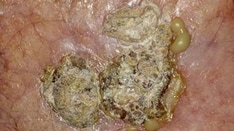
The primary lesions of pitted keratolysis are pits in the stratum corneum ranging from 0.5-7 mm, with some development of confluence, irregular erosions, or sulci (see Media File 1). A variant of markedly enlarged lesions, called crateriform pitted keratolysis, also has been described.14 This affects the entire width of the plantar surface of the foot underlying the metatarsophalangeal joints. The pits rarely are seen on non–pressure-bearing areas of the plantar surface.

Causes

See Pathophysiology.


Tinea Pedis

Other Problems to be Considered

Basal cell nevus syndrome
Keratolysis exfoliativa
Focal acral hyperkeratosis
Circumscribed acral hypokeratosis


Procedures

Skin biopsies are not performed routinely, as the diagnosis can be made easily by means of visual examination and recognition of the characteristic odor.

Histologic Findings

If a cutaneous biopsy is performed, histological evaluation of hematoxylin and eosin (H&E)–stained plantar skin reveals a crater limited to the stratum corneum (see Media File 2). The microorganisms, cocci, and filamentous forms may be seen with H&E but will be detected more easily with Gram stain, periodic acid Schiff, or methenamine silver stains. In patients with associated foot pain and with erythematous to violaceous macular lesions and pits, histological examination reveals only a mild dermal inflammatory reaction.


Medical Care

Limit the use of occlusive footwear and reduce foot friction with properly fitting footwear. Absorbent cotton socks must be changed frequently to prevent excessive foot moisture. Wool socks tend to whisk moisture away from the skin and may be helpful. In some cases, reducing any associated hyperhidrosis with the application of a roll-on antiperspirant, 20% aluminum chloride solution, may be helpful.

Many clinicians find that topical antibiotics are effective, even without the preceding steps. They are certainly easy to use and well accepted by patients. Twice daily applications of erythromycin or clindamycin are effective. Either solutions or gel formulations may be used. Topical mupirocin (Bactroban) also has been effective.15 Oral erythromycin is another option. For cases resistant to topical antibiotic treatments and/or associated with hyperhidrosis, the use of botulinum toxin injections has been effective.16

Effective treatment of pitted keratolysis clears both the lesions and odor in 3-4 weeks.


The goals of pharmacotherapy are to reduce morbidity and prevent complications.

Drug Category: Antibiotics

Empiric antimicrobial therapy must be comprehensive and should cover all likely pathogens in the context of the clinical setting.

Drug NameClindamycin (Cleocin)
DescriptionLincosamide for treatment of serious skin and soft tissue staphylococcal infections. Also effective against aerobic and anaerobic streptococci (except enterococci). Inhibits bacterial growth, possibly by blocking dissociation of peptidyl tRNA from ribosomes causing RNA-dependent protein synthesis to arrest. Many clinicians find topical antibiotics to be effective, even without other measures. They are easy to use and well accepted by patients. Either solution or gel formulations may be used.
Adult DoseApply topically bid
Pediatric DoseApply as in adults
ContraindicationsDocumented hypersensitivity
InteractionsNone reported
PregnancyB - Fetal risk not confirmed in studies in humans but has been shown in some studies in animals
PrecautionsSuperinfections may occur with prolonged or repeated antibiotic therapy

Drug NameErythromycin (E.E.S., E-Mycin, Ery-Tab)
DescriptionInhibits bacterial growth, possibly by blocking dissociation of peptidyl tRNA from ribosomes causing RNA-dependent protein synthesis to arrest. For treatment of staphylococcal and streptococcal infections.
In children, age, weight, and severity of infection determine proper dosage. When bid dosing is desired, half-total daily dose may be taken q12h. For more severe infections, double the dose.
Adult DoseTopical: Apply bid to affected area
Oral: 250 mg erythromycin stearate/base (or 400 mg ethylsuccinate) PO q6h, or 500 mg q12h (1 h ac or 2 h pc); alternatively, 333 mg PO q8h; increase to 4 g/d depending on severity of infection
Pediatric DoseTopical: Apply as in adults
Oral: 20 mg/kg PO 2 h prior to procedure, followed by 10 mg/kg 6 h after initial dose
ContraindicationsDocumented hypersensitivity; hepatic impairment
InteractionsCoadministration may increase toxicity of theophylline, digoxin, carbamazepine, and cyclosporine; may potentiate anticoagulant effects of warfarin; coadministration with lovastatin and simvastatin increases risk of rhabdomyolysis
PregnancyB - Fetal risk not confirmed in studies in humans but has been shown in some studies in animals
PrecautionsCaution in liver disease; estolate formulation may cause cholestatic jaundice; GI side effects are common (give doses pc); discontinue use if nausea, vomiting, malaise, abdominal colic, or fever occur

Drug NameMupirocin (Bactroban)
DescriptionInhibits bacterial growth by inhibiting RNA and protein synthesis.
Adult DoseApply thin film to affected area 2-5 times/d for 5-14 d
Pediatric DoseAdminister as in adults
ContraindicationsDocumented hypersensitivity
InteractionsNone reported
PregnancyB - Fetal risk not confirmed in studies in humans but has been shown in some studies in animals
PrecautionsProlonged use may result in the growth of nonsusceptible organisms


Further Outpatient Care

Instruct the patient to return to the clinic if therapy is unsuccessful. Otherwise, care proceeds on an as needed basis.

Prognosis

Pitted keratolysis is cured easily and has an excellent prognosis.

Patient Education

Educate the patient about the etiology of the disorder and regarding ways to prevent and treat pitted keratolysis. See Medical Care.


Medical/Legal Pitfalls

Failure to make the correct diagnosis is the only area in which a health care provider may find difficulty with a patient with this disorder. Patients may complain of undue mental anguish due to foot odor from pitted keratolysis, which could have resolved easily with proper identification and treatment of the disorder.


Media file 1:  Classic pitted keratolysis on the plantar surface of the foot.
Click to see larger pictureClick to see detailView Full Size Image
Media type:  Photo

Media file 2:  Histopathology reveals a crater limited to the thick stratum corneum of the epidermis.

Click to see larger pictureClick to see detailView Full Size Image
Media type:  Photo


  1. Nordstrom KM, McGinley KJ, Cappiello L, Zechman JM, Leyden JJ. Pitted keratolysis. The role of Micrococcus sedentarius. Arch Dermatol. Oct 1987;123(10):1320-5. [Medline].
  2. Woodgyer AJ, Baxter M, Rush-Munro FM, Brown J, Kaplan W. Isolation of Dermatophilus congolensis from two New Zealand cases of pitted keratolysis. Australas J Dermatol. Apr 1985;26(1):29-35. [Medline].
  3. Holland KT, Marshall J, Taylor D. The effect of dilution rate and pH on biomass and proteinase production by Micrococcus sedentarius grown in continuous culture. J Appl Bacteriol. May 1992;72(5):429-34. [Medline].
  4. Longshaw CM, Wright JD, Farrell AM, Holland KT. Kytococcus sedentarius, the organism associated with pitted keratolysis, produces two keratin-degrading enzymes. J Appl Microbiol. 2002;93(5):810-6. [Medline].
  5. Ara K, Hama M, Akiba S, Koike K, Okisaka K, Hagura T, et al. Foot odor due to microbial metabolism and its control. Can J Microbiol. Apr 2006;52(4):357-64. [Medline].
  6. Stratigos AJ, Stern R, González E, Johnson RA, O'Connell J, Dover JS. Prevalence of skin disease in a cohort of shelter-based homeless men. J Am Acad Dermatol. Aug 1999;41(2 Pt 1):197-202. [Medline].
  7. Shenoi SD, Davis SV, Rao S, Rao G, Nair S. Dermatoses among paddy field workers--a descriptive, cross-sectional pilot study. Indian J Dermatol Venereol Leprol. Jul-Aug 2005;71(4):254-8. [Medline].
  8. Dogan B. Dermatological manifestations in hepatitis B surface antigen carriers in east region of Turkey. J Eur Acad Dermatol Venereol. May 2005;19(3):323-5. [Medline].
  9. Takama H, Tamada Y, Yano K, Nitta Y, Ikeya T. Pitted keratolysis: clinical manifestations in 53 cases. Br J Dermatol. Aug 1997;137(2):282-5. [Medline].
  10. Shah AS, Kamino H, Prose NS. Painful, plaque-like, pitted keratolysis occurring in childhood. Pediatr Dermatol. Sep 1992;9(3):251-4. [Medline].
  11. Schissel DJ, Aydelotte J, Keller R. Road rash with a rotten odor. Mil Med. Jan 1999;164(1):65-7. [Medline].
  12. Shelley WB, Shelley ED. Coexistent erythrasma, trichomycosis axillaris, and pitted keratolysis: an overlooked corynebacterial triad?. J Am Acad Dermatol. Dec 1982;7(6):752-7. [Medline].
  13. Rho NK, Kim BJ. A corynebacterial triad: Prevalence of erythrasma and trichomycosis axillaris in soldiers with pitted keratolysis. J Am Acad Dermatol. Feb 2008;58(2 Suppl):S57-8. [Medline].
  14. Sehgal VN, Ramesh V. Crateriform depression--an unusual clinical expression of pitted keratolysis. Dermatologica. 1983;166(4):209-11. [Medline].
  15. Vazquez-Lopez F, Perez-Oliva N. Mupirocine ointment for symptomatic pitted keratolysis. Infection. Jan-Feb 1996;24(1):55. [Medline].
  16. Tamura BM, Cucé LC, Souza RL, Levites J. Plantar hyperhidrosis and pitted keratolysis treated with botulinum toxin injection. Dermatol Surg. Dec 2004;30(12 Pt 2):1510-4. [Medline].
  17. Eun HC, Park HB, Chun YH. Occupational pitted keratolysis. Contact Dermatitis. Feb 1985;12(2):122. [Medline].
  18. Gardner TL, Elston DM. A foot rash with a foul odor. Phys Sport Med. 1998;26:104-6.
  19. Gill KA Jr, Buckels LJ. Pitted keratolysis. Arch Dermatol. Jul 1968;98(1):7-11. [Medline].
  20. Lamberg SI. Symptomatic pitted keratolysis. Arch Dermatol. Jul 1969;100(1):10-1. [Medline].
  21. Wohlrab J, Rohrbach D, Marsch WC. Keratolysis sulcata (pitted keratolysis): clinical symptoms with different histological correlates. Br J Dermatol. Dec 2000;143(6):1348-9. [Medline].
  22. Zaias N. Pitted and ringed keratolysis. A review and update. J Am Acad Dermatol. Dec 1982;7(6):787-91. [Medline].

Pitted Keratolysis excerpt

Article Last Updated: Sep 25, 2008