Continually Updated Clinical Reference
 
 
  All Sources     eMedicine     Medscape     Drug Reference     MEDLINE
 
eMedicine - Prepatellar Bursitis : Article by

Quick Find
Authors & Editors
Introduction
Clinical
Differentials
Workup
Treatment
Medication
Follow-up
Miscellaneous
References

Related Articles
Anterior Cruciate Ligament Injury

Medial Collateral and Lateral Collateral Ligament Injury

Osteoarthritis

Pes Anserinus Bursitis

Posterior Cruciate Ligament Injury

Rheumatoid Arthritis


Patient Education
Click here for patient education.


Author: Kelly L Allen, MD, Consulting Staff, Department of Physical Medicine and Rehabilitation, Lourdes Regional Rehabilitation Center, Our Lady of Lourdes Medical Center

Coauthor(s): Guy W Fried, MD, Assistant Professor, Department of Rehabilitation Medicine, Thomas Jefferson University; Outpatient Medical Director, Medical Director of Incontinence and Respiratory Care Programs, Magee Rehabilitation Hospital

Editors: Robert E Windsor, MD, FAAPMR, FAAEM, FAAPM, President and Director, Georgia Pain Physicians, PC; Clinical Associate Professor, Department of Physical Medicine and Rehabilitation, Emory University School of Medicine; Francisco Talavera, PharmD, PhD, Senior Pharmacy Editor, eMedicine; Michael T Andary, MD, MS, Residency Program Director, Associate Professor, Department of Physical Medicine and Rehabilitation, Michigan State University College of Osteopathic Medicine; Kelly L Allen, MD, Consulting Staff, Department of Physical Medicine and Rehabilitation, Lourdes Regional Rehabilitation Center, Our Lady of Lourdes Medical Center; Consuelo T Lorenzo, MD, Consulting Staff, Department of Physical Medicine and Rehabilitation, Alegent Health Care, Immanuel Rehabilitation Center

Author and Editor Disclosure

Synonyms and related keywords: prepatellar bursitis, housemaid's knee, carpet layer's knee, beat knee

Background

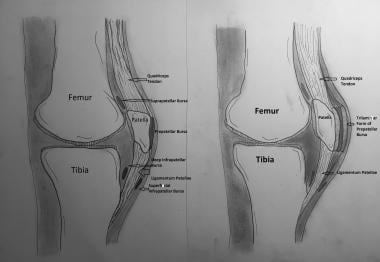
The prepatellar bursa is a superficial bursa with a thin synovial lining located between the skin and the patella. Normally, it does not communicate with the joint space and contains a minimal amount of fluid; however, inflammation of the prepatellar bursa results in marked increase of fluid within its space.

Pathophysiology

The prepatellar bursa is a flat round synovial-lined structure; its main function is to separate the patella from the patellar tendon and skin. This bursa is superficial, suggesting that it is undeveloped at birth. Within the first few months to years of life, the bursa arises from direct pressure and friction. The function of the bursa is to reduce friction and allow maximal range of motion (ROM).

Mortality/Morbidity

Mortality associated with prepatellar bursitis is rare. Morbidity usually is secondary to pain and limited function. In the case of septic prepatellar bursitis, failure to diagnose in a timely manner may lead to increased morbidity secondary to infectious etiology.

Sex

Incidence of prepatellar bursitis is greater in males than females.

Age

Prepatellar bursitis can affect all age groups; however, in the pediatric age group, it is likely to be septic and to develop in an immunocompromised host.


History

Obtaining the patient's history is important in ascertaining the diagnosis. Common findings reported by the patient with prepatellar bursitis may include the following:

  • Knee pain
  • Swelling of the knee
  • Redness of the knee
  • Difficulty with ambulation
  • Inability to kneel on the affected side
  • Relief of pain with rest
  • History of repetitive motion
  • History of occupation requiring excessive kneeling
  • History of a fall on the knee or blunt trauma to the knee (with presentation of symptoms up to 10 d after the incident)

Physical

The physician may note any of the following signs and symptoms during physical examination:

  • Tenderness of the patella to palpation
  • Fluctuant edema over the lower pole of the patella
  • Erythema of the knee
  • Crepitation of the knee
  • Decreased knee flexion secondary to pain

Causes

Any of the following causes may be associated with development of prepatellar bursitis:

  • Direct trauma (eg, a fall on the patella or direct blow to the knee)
  • Recurrent minor injuries associated with overuse (eg, repeated kneeling)
  • Septic or pyogenic process
    • Infection common from Staphylococcus aureus (usually from a break in the skin)
    • More prevalent in children
    • Can be mistaken for pyogenic arthritis
  • Crystal deposition (eg, gout, pseudogout)
  • History of inflammatory disease
  • Occupation
    • Carpet layer
    • Coal miner
    • Roofer
    • Plumber
    • Homemaker (housemaid's knee)


Anterior Cruciate Ligament Injury
Medial Collateral and Lateral Collateral Ligament Injury
Osteoarthritis
Pes Anserinus Bursitis
Posterior Cruciate Ligament Injury
Rheumatoid Arthritis

Other Problems to be Considered

Cellulitis
Other connective-tissue disorders


Lab Studies

  • Laboratory studies are not usually indicated to diagnose prepatellar bursitis; however, send aspirated fluid for analysis since this bursa commonly is a site of infection.
  • Evaluate the aspirated fluid for WBC count, protein, lactate, glucose, crystals, and Gram stain results. Typical findings include the following:
    • WBC count of 5000/µL or greater
    • Elevated protein
    • Elevated lactate
    • Decreased glucose
    • Gram-negative results in septic bursitis
    • Monosodium urate crystals found in gout
    • Calcium pyrophosphate crystals found in pseudogout
    • Cholesterol crystals found in rheumatoid bursitis

Imaging Studies

  • Plain radiographs may show soft tissue swelling; however, radiographs are necessary only if other conditions are suggested (eg, fracture and/or dislocation).
  • CT scan and MRI are reserved for cases that have been difficult to manage (eg, failure of initial treatment for septic prepatellar bursitis).

Procedures

  • Aspiration of prepatellar bursa fluid may be indicated because sepsis is common.
  • Consider injection of the prepatellar bursa with corticosteroids only when infection has been excluded.
  • Select position of maximal fullness as the site for injection.
  • Complications of injection include, but are not limited to, the following: infection, bleeding, postinjection inflammation and erythema, postinjection pain, tendon rupture, and subcutaneous atrophy.


Rehabilitation Program

Physical Therapy

After the initial period of rest, the goal of physical therapy is to regain any loss of ROM, while increasing the flexibility of the quadriceps and hamstrings. Use of therapeutic modalities can be helpful to assist stretching in this period.

Occupational Therapy

The role of the occupational therapist in this scenario is to address modifications of activities in patients diagnosed with prepatellar bursitis secondary to overuse. Emphasize patient education, avoidance of kneeling, and use of kneepads if kneeling is necessary.

Surgical Intervention

Incision and drainage of the prepatellar bursa usually is performed when symptoms of septic bursitis have not improved significantly within 36-48 hours. Surgical removal of the bursa (ie, bursectomy) may be necessary for chronic or recurrent prepatellar bursitis. Arthroscopic or endoscopic excision of the bursa has more recently been reported to have satisfactory results with less trauma than open excision.

Consultations

  • Request orthopedic consultation in recurrent and/or chronic prepatellar bursitis for bursectomy evaluation. Initiate consultation for septic prepatellar bursitis that fails to improve within 36-48 hours and requires incision and drainage.
  • Initiate infectious disease consultation within 36-48 hours in septic prepatellar bursitis that is unresponsive to treatment.


The goals of pharmacotherapy are to reduce morbidity and to prevent complications.

Drug Category: Nonsteroidal anti-inflammatory drugs

NSAIDs are the DOC for mild to moderate pain. They work by decreasing prostaglandin synthesis, thereby reducing inflammation. Ibuprofen commonly is used; however, alternatives are available, such as naproxen and ketoprofen. Use of a particular NSAID usually is secondary to physician and patient experience.

Drug NameIbuprofen (Advil, Nuprin, Motrin, Midol)
DescriptionDOC for patients with mild to moderate pain. Inhibits inflammatory reactions and pain by decreasing prostaglandin synthesis.
Adult Dose400 mg PO q4-6h, 600 mg q6h, or 800 mg q8h while symptoms persist; not to exceed 3.2 g/d
Pediatric Dose<6 years: Not established
6 months to 12 years: 4-10 mg/kg/dose PO tid/qid
>12 years: Administer as in adults
ContraindicationsDocumented hypersensitivity; peptic ulcer disease, recent GI bleeding or perforation, renal insufficiency, or high risk of bleeding
InteractionsCoadministration with aspirin increases risk of inducing serious NSAID-related side effects; probenecid may increase concentrations and, possibly, toxicity of NSAIDs; may decrease effect of hydralazine, captopril, and beta-blockers; may decrease diuretic effects of furosemide and thiazides; monitor PT closely (instruct patients to watch for signs of bleeding); may increase risk of methotrexate toxicity; phenytoin levels may be increased when administered concurrently
PregnancyB - Usually safe but benefits must outweigh the risks.
PrecautionsCategory D in third trimester of pregnancy; caution in congestive heart failure, hypertension, and decreased renal and hepatic function; caution in anticoagulation abnormalities or during anticoagulant therapy

Drug Category: Antibiotics

Use antibiotics if septic prepatellar bursitis is documented or suggested. Many antibiotics can be tailored to specific organisms. In some cases, IV antibiotics also may be required.

Drug NameCephalexin (Keflex, Biocef)
DescriptionFirst-generation cephalosporin arrests bacterial growth by inhibiting bacterial cell wall synthesis. Bactericidal activity against rapidly growing organisms. Primary activity against skin flora; used for skin infections or prophylaxis in minor procedures.
Adult Dose250 mg to 2 g IV/IM q6-12h depending on severity of infection; not to exceed 12 g/d
Pediatric Dose25-100 mg/kg/d IV/IM divided q6-8h depending on severity of infection; not to exceed 6 g/d
ContraindicationsDocumented hypersensitivity
InteractionsProbenecid prolongs effect of cefazolin; coadministration with aminoglycosides may increase renal toxicity, associated with false positive glycosuria on dipstick
PregnancyB - Usually safe but benefits must outweigh the risks.
PrecautionsAdjust dose in renal impairment; superinfections and promotion of nonsusceptible organisms may occur with prolonged use or repeated therapy

Drug Category: Corticosteroids

Corticosteroids have anti-inflammatory properties and cause profound and varied metabolic effects. In addition, these agents modify the body's immune response to diverse stimuli. Many injectable corticosteroids are available. Selection usually is physician directed.

Drug NameHydrocortisone (Solu-Cortef, Westcort)
DescriptionDecreases inflammation by suppressing migration of polymorphonuclear leukocytes and reversing increased capillary permeability.
Adult Dose25-37.5 mg intrabursal; may repeat in 1-3 wk
Pediatric DoseAdminister as in adults
ContraindicationsDocumented hypersensitivity; viral, fungal, or tubercular skin infections
InteractionsCorticosteroid clearance may decrease with estrogens; may increase digitalis toxicity secondary to hypokalemia
PregnancyC - Safety for use during pregnancy has not been established.
PrecautionsDo not use in skin with decreased circulation; can cause atrophy of groin, face, and axillae; if infection develops and is not responsive to antibiotic treatment, discontinue until infection is under control; do not use monotherapy to treat widespread plaque psoriasis


Further Inpatient Care

  • Inpatient care may be necessary in septic prepatellar bursitis, and the patient may require administration of IV antibiotics.

Further Outpatient Care

  • Conservative care usually is effective for treatment of prepatellar bursitis. Common treatment recommendations may include the following:
    • Rest
    • Ice until swelling subsides, then may use ice or heat
    • Aspiration when necessary
    • Injection (if no evidence of infection)
    • Elevation of the affected leg when possible
    • Anti-inflammatory medications
    • Antibiotics if indicated because of infection
    • Assistive device for ambulation if necessary

Deterrence

  • Avoidance of kneeling
  • Occupational modifications (use of knee pads)

Prognosis

  • Prognosis is excellent with definitive treatment.

Patient Education

  • Stress to the patient the importance of avoiding prolonged or repetitive kneeling, along with making the appropriate occupational modifications.


Medical/Legal Pitfalls

  • Failure to perform aspiration of prepatellar bursa fluid, as it is frequently septic without signs or symptoms of infection


  • Bellon EM, Sacco DC, Steiger DA, Coleman PE. Magnetic resonance imaging in "housemaid''s knee" (prepatellar bursitis). Magn Reson Imaging. 1987;5(3):175-7. [Medline].
  • Dawn B, Williams JK, Walker SE. Prepatellar bursitis: a unique presentation of tophaceous gout in an normouricemic patient. J Rheumatol. May 1997;24(5):976-8. [Medline].
  • Donahue F, Turkel D, Mnaymneh W, Ghandur-Mnaymneh L. Hemorrhagic prepatellar bursitis. Skeletal Radiol. Apr 1996;25(3):298-301. [Medline].
  • Garcia-Porrua C, Gonzalez-Gay MA, Ibanez D, Garcia-Pais MJ. The clinical spectrum of severe septic bursitis in northwestern Spain: a 10 year study. J Rheumatol. Mar 1999;26(3):663-7. [Medline].
  • Kaalund S, Breddam M, Kristensen G. Endoscopic resection of the septic prepatellar bursa. Arthroscopy. Oct 1998;14(7):757-8. [Medline].
  • Kerr DR. Prepatellar and olecranon arthroscopic bursectomy. Clin Sports Med. Jan 1993;12(1):137-42. [Medline].
  • McAfee JH, Smith DL. Olecranon and prepatellar bursitis. Diagnosis and treatment. West J Med. Nov 1988;149(5):607-10. [Medline].
  • Meys E, Michaux L, Lambert M, et al. Septic Streptococcus milleri prepatellar bursitis. Clin Rheumatol. Mar 1992;11(1):109-11. [Medline].
  • Ogilvie-Harris DJ, Gilbart M. Endoscopic bursal resection: the olecranon bursa and prepatellar bursa. Arthroscopy. Apr 2000;16(3):249-53.
  • Papadakis KA, Vartivarian SE, Vassilaki ME, Anaissie EJ. Septic prepatellar bursitis caused by Stenotrophomonas (Xanthomonas) maltophilia. Clin Infect Dis. Feb 1996;22(2):388-9. [Medline].
  • Pien FD, Ching D, Kim E. Septic bursitis: experience in a community practice. Orthopedics. Sep 1991;14(9):981-4. [Medline].
  • Roy DR, Greene WB, Gamble JG. Osteomyelitis of the patella in children. J Pediatr Orthop. May-Jun 1991;11(3):364-6. [Medline].
  • Westenfeld F, Alston WK, Winn WC. Complicated soft tissue infection with prepatellar bursitis caused by Paecilomyces lilacinus in an immunocompetent host: case report and review. J Clin Microbiol. Jun 1996;34(6):1559-62. [Medline].
  • Wilson-MacDonald J. Management and outcome of infective prepatellar bursitis. Postgrad Med J. Oct 1987;63(744):851-3. [Medline].

Prepatellar Bursitis excerpt

Article Last Updated: Jan 26, 2007