Continually Updated Clinical Reference
 
 
  All Sources     eMedicine     Medscape     Drug Reference     MEDLINE
 
eMedicine - Aortic Valve, Bicuspid : Article by

Quick Find
Authors & Editors
Introduction
Clinical
Differentials
Workup
Treatment
Medication
Follow-up
Miscellaneous
Multimedia
References

Related Articles
Coarctation of the Aorta


Patient Education
Click here for patient education.


Author: Edward J Bayne, MD, Assistant Professor, Division of Pediatric Cardiology, Emory University School of Medicine; Consulting Staff, Sibley Heart Center Cardiology, Children's Healthcare of Atlanta

Edward J Bayne is a member of the following medical societies: Alpha Omega Alpha, American Academy of Pediatrics, American College of Cardiology, American Heart Association, and American Society of Echocardiography

Editors: Paul M Seib, MD, Associate Professor of Pediatrics, University of Arkansas for Medical Sciences; Medical Director, Cardiac Catheterization Laboratory, Co-Medical Director, Cardiovascular Intensive Care Unit, Arkansas Children's Hospital; Mary L Windle, PharmD, Adjunct Assistant Professor, University of Nebraska Medical Center College of Pharmacy, Pharmacy Editor, eMedicine.com, Inc; Alvin J Chin, MD, Professor of Pediatrics, Division of Cardiology, The Children's Hospital of Philadelphia, University of Pennsylvania School of Medicine; Gilbert Herzberg, MD, Assistant Professor, Department of Pediatrics, Section of Pediatric Cardiology, New York Medical College; Steven R Neish, MD, SM, Director of Pediatric Cardiology Fellowship Program, Department of Pediatrics, Baylor College of Medicine

Author and Editor Disclosure

Synonyms and related keywords: bicuspid valve, bicuspid aortic valve, bicommissural aortic valve

Background

The bicuspid aortic valve has been recognized as a common congenital abnormality for centuries. Leonardo da Vinci was one of the first to call attention to the aortic valve with 2 leaflets. He recognized the superior engineering advantages of the normal trileaflet valve. Considering that it is a common abnormality, bicuspid aortic valve is mentioned only briefly in many pediatric and cardiology textbooks.

Definition

A congenitally bicuspid aortic valve has 2 functional leaflets. Most have 2 complete commissures. Approximately half of cases have a low raphe. Not included are stenotic or partially fused valves caused by inflammatory processes, such as rheumatic fever.

Embryology

The embryonic truncus arteriosus is divided by the spiral conotruncal septum during development. The normal right and left aortic leaflets form at the junction of the ventricular and arterial ends of the conotruncal channel. The nonseptal leaflet (posterior) cusp normally forms from additional conotruncal channel tissue. Abnormalities in this area lead to the development of a bicuspid valve, often through incomplete separation (or fusion) of valve tissue.

Bicuspid aortic valve is often observed with other left-sided obstructive lesions such as coarctation of the aorta or interrupted aortic arch, suggesting a common developmental mechanism.

Anatomy

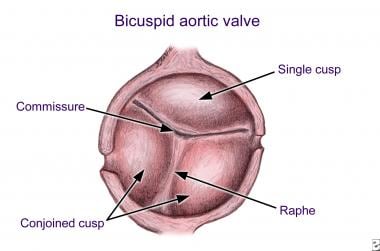
The bicuspid valve is composed of 2 leaflets or cusps, usually of unequal size. The larger leaflet is referred to as the conjoined leaflet. Two commissures (or hinge points) are present; usually neither is partially fused. The presence of a partially fused commissure, which has also been called a high raphe, probably predisposes toward eventual stenosis. At least half of all congenitally bicuspid valves have a low raphe, which never attains the plane of the attachments of the two commissures and which never extends to the free margin of the conjoined cusp. Redundancy of a conjoined leaflet may lead to prolapse and insufficiency.

Valve leaflet orientation can vary. Anteroposterior orientation of the commissures, with right (conjoined) and left leaflets, occurs in approximately 50-65% of cases. The conjunction is of tissue that would normally form the right noncoronary commissure. Horizontal (left-right) orientation of the commissures, with anterior (conjoined) and posterior leaflets is observed in 30-45% of cases. The conjunction is of tissue that would normally form the left-right commissure. For unclear reasons, conjunction of tissue normally destined to form the left noncoronary commissure is rare.

Coronary arteries may be abnormal. A left-dominant coronary system (ie, posterior descending coronary artery arising from the left coronary artery) is more commonly observed with bicuspid aortic valve. Rarely, the left coronary artery may arise anomalously from the pulmonary artery. The left main coronary artery may be up to 50% shorter in patients with a bicuspid aortic valve. Occasionally, the coronary ostium may be congenitally stenotic in association with bicuspid aortic valve.

The aortic root may be dilated. This has been attributed to poststenotic dilatation in association with aortic stenosis. However, the aortic root may be inherently abnormal (eg, it may have abnormal connective tissue with cystic medial necrosis changes indistinguishable from other disorders such as Marfan syndrome).

Pathophysiology

With degeneration of aging valves, sclerosis and calcification can occur, with changes similar to those in atherosclerotic coronary arteries. The bicuspid valve may also be completely competent, producing no regurgitant flow. However, redundancy and prolapse of cusp tissue can lead to valve regurgitation. Although bicuspid aortic valve is a common abnormality, complications may arise in as many as one third of patients over their lifetimes; this disorder, therefore, deserves close attention and medical follow-up.

Valve morphology may be predictive of problems of stenosis, insufficiency, or both. Fusion along the right or left leaflets is less commonly associated with stenosis or insufficiency in children. This arrangement is much more common in patients with coarctation of the aorta, whose valves function adequately. Fusion along the right and noncoronary leaflets is more frequently associated with pathologic changes of stenosis or insufficiency in the pediatric population.

Frequency

United States

Bicuspid aortic valves may be present in up to 1-2% of the population. Because the bicuspid valve may be entirely silent during infancy, childhood, and adolescence, these incidence figures may be underestimated and are not generally included in the overall incidence of congenital heart disease.

International

Incidence does not appear to be affected by race or geography.

Sex

The male-to-female ratio is 2:1 or greater. Sex is not a predictive variable in the natural history of bicuspid aortic valve. A recent prospective echocardiographic study in newborn infants showed a prevalence of bicuspid aortic valve in 7.1 per 1,000 male newborns versus 1.9 per 1,000 female newborns.

Age

Bicuspid aortic valve may be identified in patients of any age, from birth through the 11th decade of life. It may be only an incidental finding at autopsy. Bicuspid aortic valve may remain silent and be discovered as an incidental finding on echocardiographic examination of the heart.

  • Critical aortic stenosis and infective endocarditis may be considered relatively early sources of morbidity for patients with bicuspid aortic valve. Critical aortic stenosis may occur in infancy and may be associated with a bicuspid valve.
  • Occasionally, bicuspid aortic valve is diagnosed after a patient has developed infective endocarditis with systemic embolization.
  • Stenosis of a bicuspid aortic valve is more likely to develop in persons older than 20 years and is caused by progressive sclerosis and calcification. High levels of serum cholesterol have been associated with more rapidly progressive sclerosis of the congenitally bicuspid aortic valve.
  • Children who develop early progressive, pathologic changes in the bicuspid aortic valve are more likely to develop valve regurgitation than stenosis. Bicuspid aortic valve was identified in 167 (0.8%) of 20,946 young Italian military conscripts. Of these, 110 were found to have either mild or moderate aortic insufficiency.


History

Patients with bicuspid aortic valves may be completely asymptomatic. About 30% of individuals with a bicuspid aortic valve develop complications. If symptoms are present, they relate to the development of aortic stenosis, aortic insufficiency, or both. Occasionally, a congenitally bicuspid aortic valve may be the cause of critical aortic stenosis, with symptoms of severe congestive heart failure developing in early infancy. This critical form of stenosis is more frequently associated with a unicommissural valve. In patients in whom a bicuspid aortic valve is observed in association with other types of left heart obstruction (coarctation or interrupted aortic arch), the bicuspid valve generally functions well, and symptoms are usually caused by the associated disorder.

  • Inheritance: Although most cases of bicuspid aortic valve are sporadic, familial clusters have been identified, with incidence as high as 10-17% in first-degree relatives of probands. Increasing evidence suggests an autosomal-dominant inheritance pattern with variable penetrance, encompassing the entire spectrum of left heart obstruction (hypoplastic left heart syndrome, aortic stenosis, coarctation of the aorta).
  • Associated syndromes
    • Coarctation or interrupted aortic arch (bicuspid aortic valve is present in >50% of patients with these lesions)
    • Williams syndrome (bicuspid aortic valve associated with supravalvular aortic stenosis occurs in 11.6% of cases)
    • Patent ductus arteriosus, also associated with hand anomalies
    • Erdheim cystic medial necrosis (familial aortic dissection)
    • Turner syndrome (bicuspid aortic valve occurs in 30% of patients)

Physical

Because the bicuspid aortic valve is frequently a clinically silent condition, general examination findings are usually normal.

  • Typical features of Turner syndrome (eg, short stature in females with webbed neck and broad chest) or Williams syndrome (eg, elfin facies, mild retardation) may suggest the possibility of bicuspid aortic valve.
  • Cardiac examination findings include the following:
    • The precordium is usually normal to palpation, and no evidence of cardiomegaly is present.
    • The first heart sound is unaffected. The second heart sound splits normally with inspiration, with absent or minimal outflow gradient. With increasing aortic stenosis gradient, the splitting of the second sound is less apparent or may be absent. With severe stenosis, the second sound is split paradoxically (ie, with expiration). This splitting differs from normal splitting of the first heart sound (ie, with tricuspid and mitral valve closures) in that normal splitting is best appreciated at the lower left sternal border and is a softer lower-pitched sound than the click of a bicuspid aortic valve.
    • The most common abnormal sound heard with bicuspid aortic valve has been described as a systolic ejection click. This sound is actually a less-distinct medium-pitched sound heard well at the apex with the diaphragm of the stethoscope. It is heard in all phases of respiration just after the first heart sound, and its timing does not vary with maneuvers (eg, hand-grip, Valsalva, squatting). The ejection sound may also be heard in the aortic area (upper right sternal border), where it takes on a brighter and sharper quality.
    • In contrast, the click of pulmonary valvular stenosis is intermittent (heard best during expiration) and located closer to the left sternal border. It is a bit less distinct than the aortic valve click. The click of mitral valve prolapse may also be heard at the apex, but it is softer, occurs later, and is less distinct than the bicuspid aortic valve click. The mitral prolapse click often varies in timing with changes in position or isometric handgrip and may be followed by the murmur of mitral regurgitation. Multiple showers of clicks are common, and the sound has been likened to crinkling cellophane.
    • Minimal or mild stenosis may produce a soft and fairly harsh ejection murmur at the upper right sternal border with possible radiation into the carotids. Increasing severity of stenosis produces a longer, louder, and harsher murmur with definite radiation into the carotids and possibly into the posterior shoulder. With more severe stenosis, a thrill may be felt in the suprasternal notch.
    • In the presence of a typical opening sound or click, the high-pitched sound of subtle aortic valve insufficiency may be heard at the third left intercostal space with the diaphragm of the stethoscope. A variety of maneuvers may be helpful in auscultation, including having the patient perform an isometric handgrip, having patients lean forward in a seated position (to bring the aortic area closer to the chest wall), and having patients hold their breath in expiration (also decreases the distance between the stethoscope and the left ventricle).


Coarctation of the Aorta


Lab Studies

  • Total and high-density lipoprotein (HDL) cholesterol or fasting lipid panel should be measured in children older than 3 years.
    • Elevated low-density lipoprotein (LDL) cholesterol may accelerate sclerosis of the bicuspid aortic valve.
    • In the case of a child with bicuspid aortic valve and family history of hypercholesterolemia or early coronary artery disease, baseline cholesterol may be helpful in recommending dietary modification.

Imaging Studies

  • Chest radiography may show mild prominence of the ascending aorta in the posteroanterior projection along the superior right heart border. Left ventricular enlargement implies progressive aortic valve insufficiency. Chest radiography is generally not helpful as a screening tool for bicuspid aortic valve.
  • Two-dimensional echocardiography provides accurate confirmation of a bicuspid aortic valve.
    • Imaging can show the bicuspid aortic valve in multiple planes. Most important information is obtained from the parasternal long- and short-axis views.
    • The long-axis view shows the typical systolic doming due to limited valve opening. An approximation of valve orifice diameter can be obtained at peak systole. This view is also important for sizing the sinus of Valsalva, sinotubular junction, and ascending aorta.
    • The short-axis view is used to examine commissures, leaflet morphology, mobility, and the presence or absence of a low raphe. The diameter or area of the valve opening is generally overestimated in this view because the true orifice usually lies above this plane. The bicuspid valve typically looks like a fish's mouth on opening.
    • Doppler measurements of peak and mean systolic velocities and gradients can be recorded from the apical 5-chamber, the suprasternal, or the high right parasternal views. Doppler signal should be lined up as closely as possible and parallel to the jet to provide accurate estimates of flow velocities. Estimates of flow velocity from the apical view can sometimes be improved by moving the transducer more medially toward the sternum.
    • Parasternal long- and short-axis views can also be used for color Doppler studies, which evaluate for aortic insufficiency. The severity of aortic valve insufficiency can be assessed by several methods. One of the simplest and most reliable is to measure the insufficiency jet diameter at the aortic valve annulus and compare this diameter to the annulus diameter.
    • False-positive diagnosis of bicuspid aortic valve may arise from incomplete demonstration of all 3-valve closure lines. The typical normal (trileaflet) aortic valve shows a rotated Mercedes sign on closure. The bicuspid valve may not be recognized if a high raphe is observed with valve closure.
  • Angiography
    • The bicuspid aortic valve is viewed best in the anteroposterior 30-degree right anterior oblique (RAO) projection. Injection is into the left ventricle and also into the aortic root.
    • Angiography is not the primary diagnostic method to diagnose a bicuspid aortic valve.
    • Typical finding is systolic doming of the valve margins due to incomplete opening.
    • Aortic insufficiency can be looked for on the aortic root injection.
  • Magnetic resonance imaging: MRI is generally not helpful for the diagnosis of bicuspid aortic valve alone, but it may be helpful for complete assessment of the thoracic aorta, particularly in cases of coarctation, Turner syndrome, or Williams syndrome.
  • Transesophageal echocardiography may be necessary to define valve commissures and vegetations in adolescents or young adults in whom bicuspid aortic valve is suspected on clinical grounds (particularly those with symptoms or findings that suggest infective endocarditis).

Other Tests

  • Electrocardiography
    • ECG findings generally are normal for an isolated bicuspid aortic valve without stenosis or insufficiency.
    • Progression of stenosis or insufficiency leads to left atrial enlargement and left ventricular hypertrophy.
  • Testing in family members
    • Two-dimensional echocardiography is recommended as a screening tool for the offspring and first-degree relatives (especially males) of patients identified as having a bicuspid aortic valve


Medical Care

No specific medical care is required for individuals with bicuspid aortic valve, unless they have progressive deterioration or infection. Serial follow-up evaluations are important for early recognition of potential complications (valve insufficency, valve stenosis, progressive aortic root dilation) and the prevention of possible bacterial endocarditis.

Surgical Care

Surgery specifically for bicuspid aortic valve is not necessary unless progressive complications ensue (valve insufficiency, valve stenosis, progressive aortic root dilation, possible bacterial endocarditis).

  • The patient with known bicuspid aortic valve requires antibiotic prophylaxis for invasive dental or noncardiac surgical procedures.
  • For noncardiac procedures, preoperative cardiac evaluation may be appropriate, particularly for patients with aortic stenosis or insufficiency. The patient with simple, uncomplicated bicuspid aortic valve should not require special anesthetic precautions, other than bacterial endocarditis prophylaxis, when appropriate.

Diet

Because hypercholesterolemia and other coronary artery disease risk factors may accelerate the sclerosis and deterioration of a congenitally bicuspid aortic valve, a heart-healthy diet is recommended for all patients, not only those with recognized risk factors. This diet should limit fat calories to no more than 30% of total calories. Calories from saturated fats should be limited to no more than 10% of total.

Activity

Patients with normally functioning bicuspid aortic valves (ie, no stenosis or insufficiency) do not require activity restrictions. They may participate in organized competitive sports activities.

  • Patients who develop valve insufficiency or stenosis from a congenitally bicuspid aortic valve may require restrictions from strenuous competitive sports.
  • Patients with aortic valve insufficiency should avoid strenuous isometric activity, such as weight lifting, rope climbing, and pull-ups.


Patients with bicuspid aortic valve are at increased risk for infective endocarditis. Prophylactic antibiotics are required for dental or surgical procedures as recommended by the American Heart Association. A single dose of antibiotic is generally administered approximately 1 hour before an invasive procedure (ie, one that has the potential to produce bacteremia). Follow-up doses are not usually required. For more information, see Antibiotic Prophylactic Regimens for Endocarditis.

Drug Category: Antibiotics, prophylactic

Antibiotic prophylaxis is provided to patients before performing procedures that may cause bacteremia.

Drug NameAmoxicillin (Amoxil, Trimox)
DescriptionInterferes with synthesis of cell wall mucopeptides during active multiplication, resulting in bactericidal activity against susceptible bacteria. Used as prophylaxis in minor procedures.
Adult Dose2 g PO 1 h before the procedure
Alternatively, 3 g PO 1 h before the procedure, followed by 1.5 g 6 h after the initial dose
Pediatric Dose50 mg/kg PO 1 h before the procedure; not to exceed 2 g/dose
ContraindicationsDocumented hypersensitivity
InteractionsReduces the efficacy of PO contraceptives
PregnancyB - Usually safe but benefits must outweigh the risks.
PrecautionsAdjust dose in renal impairment

Drug NameAmpicillin (Marcillin, Omnipen)
DescriptionFor prophylaxis in patients undergoing dental, oral, or respiratory tract procedures. Coadministered with gentamicin for prophylaxis in GI or GU procedures.
Adult Dose2 g IV/IM 30 min before procedure
High-risk patients: 2 g ampicillin IV/IM plus 1.5 mg/kg gentamicin IV 30 min before procedure, followed 6 h later by 1 g ampicillin IV/IM or 1 g amoxicillin PO
Pediatric Dose50 mg/kg IV/IM 30 min before procedure; not to exceed 2 g/dose
High-risk patients: 50 mg/kg ampicillin IV/IM plus 1.5 mg/kg gentamicin IV 30 min before procedure, followed 6 h later by 25 mg/kg ampicillin IV/IM or 25 mg/kg amoxicillin PO
ContraindicationsDocumented hypersensitivity
InteractionsProbenecid and disulfiram elevate levels; allopurinol decreases ampicillin effects and has additive effects on ampicillin rash; may decrease effects of PO contraceptives
PregnancyB - Usually safe but benefits must outweigh the risks.
PrecautionsAdjust dose in renal failure; evaluate rash and differentiate from hypersensitivity reaction

Drug NameClindamycin (Cleocin)
DescriptionUsed in penicillin-allergic patients undergoing dental, oral, or respiratory tract procedures. Useful for treatment against streptococcal and most staphylococcal infections.
Adult Dose600 mg PO/IV 1 h before procedure and 150 mg PO/IV 6 h after first dose
Pediatric Dose20 mg/kg PO 1h before procedure
20 mg/kg IV 30 min before procedure; not to exceed 600 mg/dose
ContraindicationsDocumented hypersensitivity; regional enteritis; ulcerative colitis; hepatic impairment; antibiotic-associated colitis
InteractionsIncreases duration of neuromuscular blockade induced by tubocurarine and pancuronium; erythromycin may antagonize effects of clindamycin; antidiarrheals may delay absorption of clindamycin
PregnancyB - Usually safe but benefits must outweigh the risks.
PrecautionsAdjust dose in severe hepatic dysfunction; no adjustment necessary in renal insufficiency; associated with severe and possibly fatal colitis

Drug NameGentamicin (Garamycin)
DescriptionAminoglycoside antibiotic for gram-negative coverage. Used in combination with both an agent against gram-positive organisms and one that covers anaerobes. Used in conjunction with ampicillin or vancomycin for prophylaxis in GI or GU procedures.
Adult Dose1.5 mg/kg IV; not to exceed 120 mg/dose; administer with 2 g ampicillin IV 30 min before procedure; not to exceed 80 mg
Pediatric Dose1.5 mg/kg IV; not to exceed 120 mg/dose; administer with 50 mg/kg ampicillin IV (not to exceed 2 g/dose) 30 min before procedure
ContraindicationsDocumented hypersensitivity; non–dialysis-dependent renal insufficiency
InteractionsCoadministration with other aminoglycosides, cephalosporins, penicillins, and amphotericin B may increase nephrotoxicity; aminoglycosides enhance effects of neuromuscular blocking agents, thus prolonged respiratory depression may occur; coadministration with loop diuretics may increase auditory toxicity of aminoglycosides; possible irreversible hearing loss of varying degrees may occur (monitor regularly)
PregnancyC - Safety for use during pregnancy has not been established.
PrecautionsNarrow therapeutic index (not intended for long-term therapy); caution in non–dialysis-dependent renal failure, myasthenia gravis, hypocalcemia, and conditions that depress neuromuscular transmission; adjust dose in renal impairment

Drug NameVancomycin (Vancocin)
DescriptionPotent antibiotic directed against gram-positive organisms and active against Enterococcus species. Useful in the treatment of septicemia and skin structure infections. Indicated for patients who cannot receive, or who have not responded to penicillins and cephalosporins or who have infections with resistant staphylococci. Use CrCl to adjust dose in renal impairment. Used in conjunction with gentamicin for prophylaxis in penicillin-allergic patients undergoing GI or GU procedures.
Adult DoseDental, oral, or upper respiratory tract surgery: 1 g IV infused over 1 h, 1 h before procedure
GI/GU procedures: 1 g IV plus 1.5 mg/kg gentamicin infused over 1 h, 1 h prior to surgery
Pediatric DoseDental, oral, or upper respiratory tract surgery: 20 mg/kg, infused over 1 h, 1 h before procedure; not to exceed 1 g/dose
ContraindicationsDocumented hypersensitivity
InteractionsErythema, histaminelike flushing, and anaphylactic reactions may occur when administered with anesthetic agents; when taken concurrently with aminoglycosides, risk of nephrotoxicity may increase above that with aminoglycoside monotherapy; effects in neuromuscular blockade may be enhanced when coadministered with nondepolarizing muscle relaxants
PregnancyC - Safety for use during pregnancy has not been established.
PrecautionsCaution in renal failure and neutropenia; red man syndrome is caused by too-rapid IV infusion (dose administered over a few min) but rarely happens when dose is administered as a 2-h administration or as PO or IP administration; red man syndrome is not an allergic reaction

Drug NameCefazolin (Ancef)
DescriptionFirst generation semisynthetic cephalosporin that arrests bacterial cell wall synthesis, inhibiting bacterial growth. Primarily active against skin flora, including Staphylococcus aureus.
Adult Dose1 g IV/IM within 30 min before procedure
Pediatric Dose25 mg/kg IV/IM within 30 min before procedure; not to exceed 1 g/dose
ContraindicationsDocumented hypersensitivity
InteractionsProbenecid prolongs effect of cefazolin; coadministration with aminoglycosides may increase renal toxicity; may yield false-positive urine-dip test result for glucose
PregnancyB - Usually safe but benefits must outweigh the risks.
PrecautionsAdjust dose in renal impairment; superinfections and promotion of nonsusceptible organisms may occur with prolonged use or repeated therapy

Drug NameCephalexin (Keflex)
DescriptionFirst-generation cephalosporin arrests bacterial growth by inhibiting bacterial cell wall synthesis. Bactericidal activity against rapidly growing organisms. Primary activity against skin flora and used for skin infections or prophylaxis in minor procedures.
Adult Dose2 g PO 1 h before procedure
Pediatric Dose50 mg/kg PO 1 h before procedure; not to exceed 2 g/dose
ContraindicationsDocumented hypersensitivity
InteractionsCoadministration with aminoglycosides increases nephrotoxic potential
PregnancyB - Usually safe but benefits must outweigh the risks.
PrecautionsAdjust dose in renal impairment

Drug NameCefadroxil (Duricef)
DescriptionFirst-generation cephalosporin arrests bacterial growth by inhibiting bacterial cell wall synthesis. Bactericidal activity against rapidly growing organisms. Primary activity against skin flora and used for skin infections or prophylaxis in minor procedures.
Adult Dose2 g PO 1h before procedure
Pediatric Dose50 mg/kg PO 1h before procedure; not to exceed 2 g/dose
ContraindicationsDocumented hypersensitivity
InteractionsCoadministration with furosemide or aminoglycosides may increase nephrotoxicity; probenecid prolongs effects
PregnancyB - Usually safe but benefits must outweigh the risks.
PrecautionsAdjust dose in renal impairment; superinfections and promotion of nonsusceptible organisms may occur with prolonged use or repeated therapy

Drug NameAzithromycin (Zithromax)
DescriptionInhibits bacterial growth, possibly by blocking dissociation of peptidyl tRNA from ribosomes, causing RNA-dependent protein synthesis to arrest.
Adult Dose500 mg PO 1 h before procedure
Pediatric Dose15 mg/kg PO 1 h before procedure; not to exceed 500 mg/dose
ContraindicationsDocumented hypersensitivity; hepatic impairment; administration with pimozide
InteractionsMay increase toxicity of theophylline, warfarin, and digoxin; effects are reduced with coadministration of aluminum or magnesium antacids; nephrotoxicity and neurotoxicity may occur when coadministered with cyclosporine
PregnancyB - Usually safe but benefits must outweigh the risks.
PrecautionsBacterial or fungal overgrowth may result with prolonged antibiotic use; may increase hepatic enzymes and cholestatic jaundice; caution in patients with impaired hepatic function, prolonged QT intervals, or pneumonia; caution in hospitalized, geriatric, or debilitated patients

Drug NameClarithromycin (Biaxin)
DescriptionInhibits bacterial growth, possibly by blocking dissociation of peptidyl tRNA from ribosomes, causing RNA-dependent protein synthesis to arrest.
Adult Dose500 mg PO 1 h before procedure
Pediatric Dose15 mg/kg PO 1 h before procedure; not to exceed 500 mg/dose
ContraindicationsDocumented hypersensitivity; coadministration of pimozide
InteractionsToxicity increases with coadministration of fluconazole, astemizole, and pimozide; clarithromycin effects decrease and GI adverse effects may increase with coadministration of rifabutin or rifampin; may increase toxicity of anticoagulants, cyclosporine, tacrolimus, digoxin, omeprazole, carbamazepine, ergot alkaloids, triazolam, and HMG CoA-reductase inhibitors; cardiac arrhythmias may occur with coadministration of cisapride; plasma levels of certain benzodiazepines may increase, prolonging CNS depression; arrhythmias and increase in QTc intervals occur with disopyramide; coadministration with omeprazole may increase plasma levels of both agents
PregnancyC - Safety for use during pregnancy has not been established.
PrecautionsCoadministration with ranitidine or bismuth citrate is not recommended with CrCl <25 mL/min; administer half dose or increase dosing interval if CrCl <30 mL/min; diarrhea may be sign of pseudomembranous colitis; superinfections may occur with prolonged or repeated antibiotic therapies


Complications

  • Overall complications: Overall complication rates are variable. In general, bicuspid aortic valve may be a common reason for acceleration of the normal aging process (eg, valve sclerosis, calcification). Four specific complications are related to the congenitally bicuspid aortic valve.
  • Aortic stenosis
    • Sclerosis of the bicuspid aortic valve generally begins in the second decade of life, and calcification becomes more concerning during and after the fourth decade of life. The presence of coronary risk factors (eg, smoking, hypercholesterolemia) may accelerate these processes.
    • Approximately 50% of adults with severe aortic stenosis have a congenitally bicuspid valve.
    • Historically, rheumatic fever was the most common cause of aortic stenosis. With significantly decreasing incidence of rheumatic fever in developed nations, bicuspid aortic valve is the most common cause of aortic stenosis in adults and is probably the most common etiology of valve insufficiency as well. Acute rheumatic fever and its recurrences are still a major problem in developing countries, and in these areas, long-term effects of rheumatic fever still are more significant than bicuspid valve in the etiology of aortic stenosis and insufficiency. Rheumatic aortic valve damage can be confirmed only at surgery or autopsy by the presence of Aschoff bodies.
  • Aortic insufficiency
    • Most cases of severe aortic insufficiency are related, either directly or indirectly, to a congenitally bicuspid valve.
    • A number of factors may contribute to development of aortic valve insufficiency. These include cusp prolapse, erosion of irregular commissure lines, aortic root dilatation (particularly at the sinotubular junction or supra-aortic ridge), infective endocarditis, and systemic hypertension (particularly with coarctation).
  • Bacterial (eg, infective) endocarditis
    • The risk of developing infective endocarditis on a bicuspid aortic valve is 10-30% over a lifetime.
    • Bicuspid aortic valve is the second most common congenital etiology for infective endocarditis in infants and children; and overall, approximately 25% of endocarditis infections develop on a bicuspid valve.
  • Aortic root dissection
    • Findings on histologic studies of the aortic root in individuals with bicuspid aortic valve are controversial. Enlargement of the root is often attributed to poststenotic dilatation. However, the root may dilate without significant valve stenosis, and abnormal histology consistent with cystic medial necrosis has been identified in a number of studies.
    • The risk of aortic root dissection is much higher for individuals with Marfan syndrome (approximately 40%) than for those with bicuspid aortic valve (approximately 5%). However, because bicuspid aortic valve is more prevalent in the general population, this disorder is more commonly associated with aortic root dissection.

Prognosis

  • Overall prognosis for the individual with bicuspid aortic valve is good. Reviews and reports in the past have emphasized the fairly benign course for patients with bicuspid valves. However, more recent reports on the natural history of these valves suggest a number of more serious problems and an acceleration of normal valvular wear and tear. These problems may not develop until adulthood. Routine and regular follow-up for the child or adolescent with bicuspid aortic valve is recommended.

Patient Education

  • Patient and family education should emphasize the fairly benign course for the child with bicuspid aortic valve.
  • Older children and adolescents should begin to be made aware of the accelerated aging processes (ie, progressive stenosis), with particular attention to coronary risk factors.
  • The importance of bicuspid aortic valve as a potential substrate for infective endocarditis should be emphasized. Good oral and dental hygiene, with appropriate antibiotic prophylaxis for procedures, is important.
  • Most young individuals with bicuspid aortic valve should not require restrictions in physical activity or sports participation, unless they have stenosis or insufficiency.


Medical/Legal Pitfalls

  • The bicuspid aortic valve may not be recognized as a source for emboli in cases of unexplained fever and focal central nervous system deficits.

Special Concerns

  • Pregnancy in women with bicuspid aortic valve should pose no special concerns unless complications of progressive aortic stenosis or aortic root dilation occur.


Media file 1:  Bicuspid aortic valve with unequal cusp size. Note eccentric commissure and raphe.
Click to see larger pictureClick to see detailView Full Size Image
Media type:  Image

Media file 2:  Parasternal long-axis echocardiogram showing doming of a bicuspid aortic valve.
Click to see larger pictureClick to see detailView Full Size Image
Media type:  Image

Media file 3:  Parasternal short-axis echocardiographic view in diastole, showing bicuspid aortic valve with nearly equal cusp size and right-left orientation of the commissure. Note the 2 color signals showing minimal aortic insufficiency.
Click to see larger pictureClick to see detailView Full Size Image
Media type:  Image

Media file 4:  Two-dimensional echocardiogram of typical bicuspid aortic valve in diastole and systole. Valve margins are thin and pliable and open widely, creating the fishmouth appearance.
Click to see larger pictureClick to see detailView Full Size Image
Media type:  Image

Media file 5:  Long- and short-axis transthoracic echocardiograms showing a bicuspid aortic valve. In diastole, hammocking (prolapse) of the valve cusps occurs. The short-axis view shows the irregular sclerotic margins. This type of bicuspid valve is the most commonly replaced, typically because of insufficiency.
Click to see larger pictureClick to see detailView Full Size Image
Media type:  Image

Media file 6:  Basilar oblique transesophageal image showing congenitally bicuspid aortic valve with vegetation (due to Streptococcus viridans endocarditis).

Click to see larger pictureClick to see detailView Full Size Image
Media type:  Image


  • Arai AE, Epstein FH, Bove KE, Wolff SD. Visualization of aortic valve leaflets using black blood MRI. J Magn Reson Imaging. Nov 1999;10(5):771-7. [Medline].
  • Beppu S, Suzuki S, Matsuda H, et al. Rapidity of progression of aortic stenosis in patients with congenital bicuspid aortic valves. Am J Cardiol. Feb 1 1993;71(4):322-7. [Medline].
  • Brandenburg RO Jr, Tajik AJ, Edwards WD, et al. Accuracy of 2-dimensional echocardiographic diagnosis of congenitally bicuspid aortic valve: echocardiographic-anatomic correlation in 115 patients. Am J Cardiol. May 15 1983;51(9):1469-73. [Medline].
  • Brook MM. Pediatric bacterial endocarditis. Treatment and prophylaxis. Pediatr Clin North Am. Apr 1999;46(2):275-87. [Medline].
  • Cheitlin MD, Fenoglio JJ Jr, McAllister HA Jr, et al. Congenital aortic stenosis secondary to dysplasia of congenital bicuspid aortic valves without commissural fusion. Am J Cardiol. Jul 1978;42(1):102-7. [Medline].
  • Cripe L, Andelfinger G, Martin LJ, et al. Bicuspid aortic valve is heritable. J Am Coll Cardiol. Jul 7 2004;44(1):138-43. [Medline].
  • Dajani AS, Taubert KA, Wilson W, et al. Prevention of bacterial endocarditis. Recommendations by the American Heart Association. JAMA. Jun 11 1997;277(22):1794-801. [Medline].
  • Dawson-Falk KL, Wright AM, Bakker B, et al. Cardiovascular evaluation in Turner syndrome: utility of MR imaging [published erratum appears in Australas Radiol 1992 Nov;36(4):359]. Australas Radiol. Aug 1992;36(3):204-9. [Medline].
  • Duran AC, Frescura C, Sans-Coma V, et al. Bicuspid aortic valves in hearts with other congenital heart disease. J Heart Valve Dis. Nov 1995;4(6):581-90. [Medline].
  • Freedom RM, Mawson JB, Yoo SJ. Left ventricular outflow tract obstruction. In: Congenital heart disease: Textbook of angiocardiography. Armonk, NY:. Futura Publishing Company, Inc;1997:787-847.
  • Garg V, Muth AN, Ransom JF, et al. Mutations in NOTCH1 cause aortic valve disease. Nature. Sep 8 2005;437(7056):270-4. [Medline].
  • Kitchiner D, Jackson M, Walsh K, et al. The progression of mild congenital aortic valve stenosis from childhood into adult life. Int J Cardiol. Dec 31 1993;42(3):217-23. [Medline].
  • Lamas CC, Eykyn SJ. Bicuspid aortic valve--A silent danger: analysis of 50 cases of infective endocarditis. Clin Infect Dis. Feb 2000;30(2):336-41. [Medline].
  • McKusick VA. Online Mendelian Inheritance in Man, OMIM. Bicuspid aortic valve. Baltimore, Md:. Johns Hopkins University;7/2/1998:109730. [Full Text].
  • Nistri S, Basso C, Marzari C, et al. Frequency of bicuspid aortic valve in young male conscripts by echocardiogram. Am J Cardiol. Sep 1 2005;96(5):718-21. [Medline].
  • Parai JL, Masters RG, Walley VM, et al. Aortic medial changes associated with bicuspid aortic valve: myth or reality?. Can J Cardiol. Nov 1999;15(11):1233-8. [Medline].
  • Roberts WC. Morphologic aspects of cardiac valve dysfunction. Am Heart J. Jun 1992;123(6):1610-32. [Medline].
  • Roberts WC. The congenitally bicuspid aortic valve. A study of 85 autopsy cases. Am J Cardiol. Jul 1970;26(1):72-83. [Medline].
  • Sabet HY, Edwards WD, Tazelaar HD, Daly RC. Congenitally bicuspid aortic valves: a surgical pathology study of 542 cases (1991 through 1996) and a literature review of 2,715 additional cases. Mayo Clin Proc. Jan 1999;74(1):14-26. [Medline].
  • Sadee AS, Becker AE, Verheul HA, et al. Aortic valve regurgitation and the congenitally bicuspid aortic valve: a clinico-pathological correlation. Br Heart J. Jun 1992;67(6):439-41. [Medline].
  • Titus JL, Edwards JE. The aortic root and valve development, anatomy, and congenital anomalies. In: Emery RW, Arom KV, eds. The Aortic Valve. Philadelphia, Pa:. Hanley & Belfus, Inc;1991:1-8.
  • Tutar E, Ekici F, Atalay S, Nacar N. The prevalence of bicuspid aortic valve in newborns by echocardiographic screening. Am Heart J. Sep 2005;150(3):513-5. [Medline].
  • Waller BF, Carter JB, Williams HJ Jr, et al. Bicuspid aortic valve. Comparison of congenital and acquired types. Circulation. Nov 1973;48(5):1140-50. [Medline].
  • Ward C. Clinical significance of the bicuspid aortic valve. Heart. Jan 2000;83(1):81-5. [Medline].
  • Wessels MW, Berger RM, Frohn-Mulder IM, et al. Autosomal dominant inheritance of left ventricular outflow tract obstruction. Am J Med Genet A. Apr 15 2005;134(2):171-9. [Medline].
  • Zuberbuhler JR. Aortic stenosis. In: Clinical Diagnosis in Pediatric Cardiology. London, England:. Churchill Livingstone;1981:75-82.
  • de Sa M, Moshkovitz Y, Butany J, David TE. Histologic abnormalities of the ascending aorta and pulmonary trunk in patients with bicuspid aortic valve disease: clinical relevance to the ross procedure. J Thorac Cardiovasc Surg. Oct 1999;118(4):588-94. [Medline].

Aortic Valve, Bicuspid excerpt

Article Last Updated: Jun 22, 2006