| Patient Education |
|
Click here for patient education.
|
|
You are in: eMedicine Specialties >
Ophthalmology > RETINA
Macular Hole
Article Last Updated: May 31, 2006
AUTHOR AND EDITOR INFORMATION
Section 1 of 11
Author: Bradley M Hughes, MD, Assistant Professor, Department of Ophthalmology, Retina and Vitreous Service, University of Arkansas for Medical Sciences
Bradley M Hughes is a member of the following medical societies: Alpha Omega Alpha and American Academy of Ophthalmology
Coauthor(s):
Neal H Atebara, MD, Clinical Assistant Professor, Department of Surgery, Division of Ophthalmology, University of Hawaii School of Medicine;
John H Drouilhet, MD, FACS, Clinical Associate Professor, Department of Surgery, Section of Ophthalmology, University of Hawaii, John A Burns School of Medicine
Editors: Brian A Phillpotts, MD, Former Vitreo-Retinal Service Director, Former Program Director, Clinical Assistant Professor, Department of Ophthalmology, Howard University College of Medicine; Simon K Law, MD, PharmD, Assistant Professor of Ophthalmology, Jules Stein Eye Institute; Chief of Section of Ophthalmology Surgical Services, Department of Veterans Affairs Healthcare Center, West Los Angeles; Steve Charles, MD, Director of Charles Retina Institute; Clinical Professor, Department of Ophthalmology, University of Tennessee College of Medicine; Lance L Brown, OD, MD, Ophthalmologist, Affiliated With Freeman Hospital and St John's Hospital, Regional Eye Center, Joplin, Missouri; Hampton Roy Sr, MD, Associate Clinical Professor, Department of Ophthalmology, University of Arkansas for Medical Sciences
Author and Editor Disclosure
Synonyms and related keywords:
macula, retinal tear, retinal defect, retinal detachment, RD, ocular trauma, cystoid macular edema, CME, decreased vision
Background
A macular hole is a tear or a defect of the foveal retina involving its full thickness from the internal limiting membrane (ILM) to the outer segment of the photoreceptor layer. Until recently, it was believed to be an infrequent ocular condition that was invariably untreatable. Advances in the field of vitreoretinal surgery, especially in the last decade, have sparked renewed interest in this disease paving the way for an increased awareness and understanding of its pathogenesis, natural course and, more importantly, management.
In 1869, Knapp first reported the case of a macular hole in a patient who sustained blunt trauma to the eye. Subsequent case reports and series pointed to antecedent episodes of ocular trauma such that the two were customarily linked to each other. However, throughout this century, ophthalmologists increasingly have recognized this condition in atraumatic settings such that it has now come to be known as idiopathic full-thickness macular holes. In fact, case series as far back as the 1970s reported that more than 80% of macular holes are idiopathic and that only less than 10% have associated history of trauma to the eye.
Pathophysiology
The current understanding of the pathogenesis of idiopathic macular holes is based mostly on the correlation between clinical observation with known histopathology of this condition. Several theories exist about how an idiopathic macular hole is produced. See Causes.
Frequency
United States
Overall prevalence is approximately 3.3 cases in 1000 in those persons older than 55 years. Peak incidence of idiopathic macular hole development is in the seventh decade of life, and women typically are affected more than men. Reasons for this, at best, are speculative at this point. Some epidemiologic risk factors have been reported by other studies such as cardiovascular disease, hypertension, and a history of hysterectomy. However, none of these have been proven to have any significant association with macular hole formation.
Mortality/Morbidity
Macular holes are divided into several stages, which will be discussed in greater detail later in this article. The natural history of a macular hole varies depending on the stage. It has been reported that around 50% of stage 0 and stage 1 macular holes do no progress and may resolve both in the anatomic changes and the symptoms produced. Stage 2 holes progress and worsen in most cases to stage 3 or stage 4, resulting in a decline in vision. Best estimates of the incidence of development of an idiopathic full-thickness macular hole in the fellow eye are approximately 12%. In rare instances (0-10%), a full-thickness macular hole may spontaneously close with resultant good vision.
Sex
Women typically are affected more than men.
Age
Peak incidence is in the seventh decade of life.
History
Macular holes produce a variety of symptoms in the patient.
- Initially, the patient may notice blurred vision in their central vision or metamorphopsia.
- Patients may characterize these symptoms as being mild and only apparent when reading or driving.
- Because the initial changes may be mild and gradual, it may be some time before the patient discovers that something is wrong with their vision. Macular holes may only be discovered when patients cover one eye and notice blurred vision and metamorphopsia in the opposite eye.
- Rarely, some patients may describe the exact moment at which the hole developed, but more commonly, they describe the onset as slow and gradual if at all noticeable.
- Later, a larger macular hole may produce a central defect, or scotoma, in the central vision of the patient.
- Some patients may be asymptomatic, and the hole is diagnosed only on routine ophthalmologic examination.
Physical
- The visual acuity of the patient varies according to the size, location, and the stage of the macular hole. Patients with small, eccentric holes may retain excellent visual acuity in the range of 20/25 to 20/40. In addition, a macular hole that is not full thickness can have very good visual acuity in the range of 20/30 to 20/50. However, once a macular hole is well developed or full thickness, the usual range of visual acuity is from 20/80 to 20/400 averaging at 20/200.
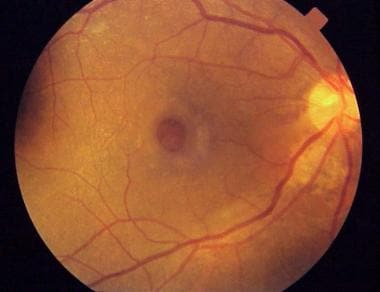
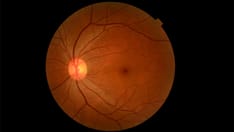
- A full-thickness macular hole visualized with direct ophthalmoscopy is characterized by a well-defined round or oval lesion in the macula with yellow-white deposits at the base. These yellow dots probably represent lipofuscin-laden macrophages or nodular proliferations of the underlying pigment epithelium with associated eosinophilic material.
- With biomicroscopic (slit lamp) examination preferably with an examination contact lens, a round excavation with well-defined borders interrupting the beam of the slit lamp can be observed.
- In most patients, an overlying semitranslucent tissue, representing the pseudo-operculum, can be seen suspended over the hole. There is often a surrounding cuff of subretinal fluid.
- Cystic changes of the retina also may be evident at the margins of the hole. The retinal pigment epithelium is usually intact and normal in acute stages but may undergo chronic changes, such as atrophy and hyperplasia, with time.
- Fine crinkling of the inner retinal surface caused by an epiretinal membrane may be present and sometimes may even distort the appearance of the hole.
- The most useful diagnostic tests for ophthalmologists to distinguish full-thickness macular holes from other lesions are the Watzke-Allen and the laser aiming beam tests.
- The Watzke-Allen test is performed at the slit lamp using a macular lens and placing a narrow vertical slit beam through the fovea. A positive test is elicited when patients detect a break in the bar of light that they perceive. This reaction is due to the fact that there is a lack of retinal material in the area of the hole, thus producing a central defect or scotoma. Narrowing or distortion of the bar of light is not diagnostic of full-thickness macular holes and should be interpreted with caution.
- The laser aiming beam test also is performed similarly, but this time a small 50-µm spot size laser aiming beam is placed within the lesion. A positive test is obtained when the patient fails to detect the aiming beam when it is placed within the lesion but is able to detect it once it is placed onto normal retina.
- In addition, some slit lamps are equipped with a setting to project a small test object, often a star, onto the fovea. Again, the patient is asked whether they perceive the test object.
Causes
- Trauma
- In the latter part of the 19th century, trauma was believed to be the primary cause of macular hole formation.
- One mechanism that was proposed was that contrecoup forces from the trauma led to an immediate rupture or laceration of the macular retina. Another theory was that posttraumatic cystic degeneration from reactive vasoconstriction and vasodilatation in time led to macular hole formation. The latter theory served as the basis for the atraumatic theories that subsequently were proposed.
- Vascular/cystoid degeneration theory
- The early part of this century saw the first histopathologic descriptions of macular holes by Coats, Fuchs, and Kuhnt. Based on findings of intraretinal cystic changes adjacent to the holes, Coats suggested that macular holes could likewise be caused by atraumatic mechanisms.
- The most popular of these theories was the vascular/cystoid theory wherein it was proposed that aging changes in the retinal vasculature led to cystoid degeneration of the macular retina. Coalescence of these cysts along with the progressive thinning of the retina eventually leads to macular hole formation. This theory was the basis for a myriad of interesting pharmacologic therapies including anxiolytics, vasodilating agents, hormones, nicotinic acid, and even retrobulbar atropine injections.
- Vitreous theory
- More recently, great emphasis has been placed on the role of the vitreous in the pathogenesis of macular holes. In 1924, Lister described anteroposterior vitreous traction bands originating from the vitreous base, which he believed to cause macular distortion, traction retinal detachments, macular cystoid degeneration, and subsequently, macular hole formation. Later histologic findings of vitreomacular attachment plaques, attachments of vitreous traction fibers on macular hole opercula, and direct attachments of vitreous fibers to the macula from the base appear to support this theory. Indirect support also came from the clinical finding that eyes with posterior vitreous detachment were relatively protected against macular hole formation. However, several investigators could not reconcile this theory of contracting vitreous bands with clinical observations of relatively clear vitreous in most cases.
- In 1988, Gass and Johnson described a classification scheme for idiopathic macular holes and their precursor lesions incorporating their ideas of the pathogenesis of these lesions. They observed that attached vitreous appears to move freely without significant anteroposterior traction despite the presence of firm vitreomacular attachments from the base. They proposed that focal shrinkage of the prefoveal vitreous cortex causes tangential traction on the foveal area leading to foveal detachment and, subsequently, macular hole formation. A very strong argument for this theory is the finding that the detached edge of a macular hole is rarely, if at all, elevated above the parafoveal retina indicating that the traction is not directed anteroposteriorly but rather tangentially.
- Recently, Gass updated his biomicroscopic classification and anatomic interpretation of macular hole formation.
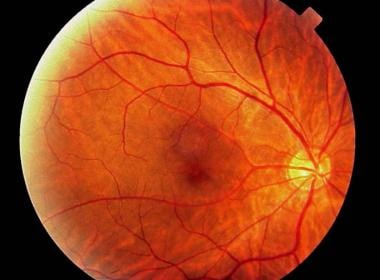
- The first stage (1a) is a yellow spot 100-200 µm in diameter, resulting from a foveolar detachment secondary to spontaneous tangential traction by the prefoveolar vitreous cortex. The yellow spot is presumed to be intraretinal xanthophyll pigment, which has become more visible because of the foveolar detachment. This is not a pathognomonic sign of macular holes as it also can be seen in some cases of central serous chorioretinopathy, cystoid macular edema (CME), and solar maculopathy.
- The foveal retina elevates to the level of the perifovea, elongating the foveal retina around the umbo. In stage 1b (occult hole), the yellow spot is transformed into a donut-shaped yellow ring of approximately 200-300 µm in size centered on the foveola. This finding appears to be specific for macular hole formation. Vision in stage 1 lesions typically is in the 20/25 to 20/70 range associated with some degree of metamorphopsia.
- Eventually, the centrifugal forces exerted on the fovea lead to the dehiscence of the deeper retinal layers at the umbo. The overlying ILM and prefoveolar vitreous condensation may remain intact and thereby preclude detection. The center of the yellow ring may appear reddish, and the yellow ring itself develops serrated or irregular edges.
- The first evidence of a full-thickness macular hole is defined as stage 2 ( <400 µm). At this stage, the hole may become evident in 2 ways. More often, it appears as an eccentric hole caused by the separation of the prefoveolar cortex from one edge of the occult hole. Rarely, the prefoveolar cortex separates from the center of the macular hole. Spontaneous vitreofoveolar separation occurs creating a semitransparent opacity, the pseudo-operculum, which often is larger than the underlying occult macular hole. Pseudo-opercula have been found not to harbor any retinal receptors and mainly are made up of vitreous condensation and reactive glial proliferation. At this stage, the yellow ring disappears because of the relief of prefoveolar traction on the edge of the occult macular hole.
- These stage 2 holes generally progress to stage 3 holes, which is defined as holes larger that 400 µm associated with partial vitreomacular separation. Stage 3 holes may evolve to stage 4 holes with complete separation of the vitreous from the entire macula and optic disc.
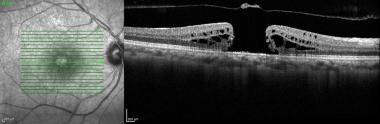
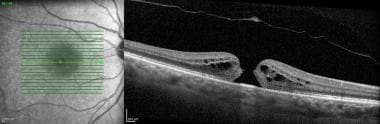
- Newer developments in retinal imaging technology, such as optical coherence tomography (OCT), which allows high resolution cross-sectional imaging of the retina, has added even more information in the study of the vitreoretinal interface and the evolution of macular holes.
- Using OCT, investigators have shown that in many cases of macular hole formation, there appears to be a separation of the posterior hyaloid with remaining focal attachments to the foveal area. This can cause traction on the fovea and has led to the theory of stage 0 macular holes to possibly explain the early changes in the evolution of a macular hole formation.
- Stage 0 macular holes are described where the fibers of the posterior hyaloid are still inserted on the foveal border and cause oblique traction. At this stage, there is a 40-50% chance of spontaneous resolution.
- One would think that the visual decline caused by macular holes would be related to the size of the retinal defect. Although this might be true to some extent, other factors also are involved in the causation of poor vision in these cases. Idiopathic macular holes may range in size from as small as 100 µm to more than 800 µm, averaging at around 500 µm in diameter. Based on optical and physical principles alone, the size of these full-thickness defects is not enough to produce the dip in visual acuity experienced by patients.
- Studies have shown that a full-thickness macular hole one-half disc diameter in size (750 µm) centered on foveal fixation would produce a visual acuity of 20/60. For a macular hole alone to produce the 20/200 vision experienced by most patients, a 3000-µm full-thickness defect should be present. This discrepancy could be explained by the fact that these holes have been found to be surrounded by a cuff of subretinal fluid and underlying photoreceptor atrophy. This localized detachment and associated receptor atrophy occupy a much larger area than the hole itself, thereby explaining the heightened visual decline that is usually found.
Epimacular Membrane
Imaging Studies
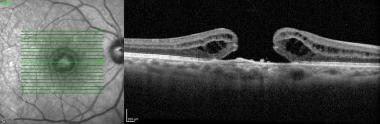
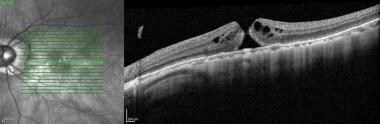
- New technologies, such as ocular coherence tomography (OCT), allow high-resolution cross-sectional imaging of the retina. OCT allows the physician to detect the presence of a macular hole as well as changes in the surrounding retina.
- OCT can distinguish lamellar holes and cystic lesions of the macula from macular holes.
- Also, the status of the vitreomacular interface can be evaluated. This allows the clinician to evaluate the earliest of the stages of a macular hole as well as evaluate for other vision-limiting conditions associated with macular holes, such as a surrounding cuff of subretinal fluid.
- Fluorescein angiography (FA) may be a useful test in differentiating macular holes from masquerading lesions, such as CME and choroidal neovascularization (CNV).
- Full-thickness stage 3 holes typically produce a window defect early in the angiogram and do not expand with time. The arteriovenous phase of the angiogram best demonstrates a granular hyperfluorescent window associated with the overlying pigment layer changes.
- No leakage or accumulation of dye is observed as opposed to other lesions.
- In CME, a gradual accumulation of dye occurs in the cystoid spaces, eventually demonstrating a petaloid appearance late in the angiogram.
- B-scan ultrasonography may be helpful in elucidating the relationship of the macula to the vitreous; therefore, it may be helpful in staging the disease but is not sensitive to distinguish a true macular hole from masquerading lesions.
Other Tests
- Amsler grid abnormalities, although sensitive for macular lesions, are not specific for macular holes. Plotting of small central scotomas caused by full-thickness macular holes using the Amsler grid is difficult because of the poor fixation in the affected eye. However, bowing of the lines and micropsia frequently are appreciated. This could be attributable to the surrounding area of retinal edema and intraretinal cysts, which could be seen in macular holes as well as other lesions like CNV.
Surgical Care
The potential for better vision as well as the 12% chance that the fellow eye will develop another macular hole has prompted ophthalmologists to seek for a viable treatment for this condition. Historically, therapy for macular holes has evolved from pharmacologic interventions, such as anxiolytics and vasodilators to an assortment of surgical techniques such as cerclage, scleral buckles, direct photocoagulation of the hole edges, and intraocular gas tamponade without the aid of vitrectomy. In 1982, Machemer and Gonvers were the first to recommend vitrectomy, intravitreal gas, and prone positioning for retinal detachments secondary to macular holes.
Carrying this one step further, Kelly and Wendell suggested that vision might be stabilized or even improved if it were possible to surgically relieve tangential traction on the macula, reduce the cystic changes, and reattach the cuff of detached retina surrounding the macular hole. They proposed that by performing this surgery, they could flatten the retina and possibly reduce the adjacent cystic retinal changes and neurosensory macular detachment.
In 1991, Kelly and Wendell reported on vitrectomy, removal of cortical vitreous and epiretinal membranes, and strict facedown gas tamponade as treatment of full-thickness macular holes. The overall results of their initial report were a 58% anatomic success rate and visual improvement of 2 or more lines in 42% of eyes. A succeeding report showed a 73% anatomic success rate and 55% of patients improving 2 or more lines of visual acuity. Present anatomic success rates range from 82-100% depending on the series.
A prospective, randomized, and controlled series by the Vitrectomy for Treatment of Macular Hole Study Group for stage 2, 3, and 4 holes showed that vision was improved in surgically treated eyes compared with observed eyes. However, more frequent adverse effects were observed in the surgically treated eyes compared to the control eyes, with the most common adverse effects being macular retinal pigment epithelium changes and cataractogenesis.
- Some aspects of the surgery may vary but the basic technique is the same. The anterior and middle vitreous is removed via a standard 3-port pars plana vitrectomy. The critical step appears to be the removal of the perimacular traction. Factors contributing to this traction, such as the posterior hyaloid, the ILM and coexisting epimacular membranes, should be addressed. The traction exerted by the posterior hyaloid on the macula should be relieved by either removing just the perimacular vitreous or combining it with the induction of a complete posterior vitreous detachment. Various surgical techniques have been described to accomplish this task but moderate suction with a soft-tipped silicon cannula appears to be the safest and the easiest technique. A fish-strike sign or bending of the silicon cannula is a sign that the posterior hyaloid has been engaged. Then, it may be pulled carefully and removed with the vitrectomy cutter.
- The removal of ILM is now widely recognized to be a contributing factor in the success of macular hole surgeries. ILM peeling may be accomplished via a "rhexis" not unlike that of a capsulorrhexis in lens surgeries. Very fine forceps such as those designed by Eckardt may be used to peel the ILM from the underlying retina. Care should be taken not to include the deeper layers in the forceps' grasp, which may further damage the surrounding retinal tissues. Currently, many surgeons use indocyanine green dye to stain the ILM making it easier to visualize and manipulate. Another recent innovation in the peeling of ILM is the development of the Diamond Dusted Membrane Scraper, which is used to gently scrape the ILM from the underlying tissues.
- Epiretinal membranes, if present, also should be removed. Techniques in completing this procedure vary from surgeon to surgeon. Some use sharp dissection with a bent microvitreoretinal blade, others may choose to use blunt dissection with a fine membrane pick. Still, others may use the same instruments that they used for the ILM peeling, namely, forceps and scrapers.
- After careful indirect ophthalmoscopic examination of the peripheral retina for tears, a total air-fluid exchange is performed to desiccate the vitreous cavity. At this point, the tendency of the retinal edges to stick to the retinal pigment epithelium usually predicts the anatomic success of the procedure. A nonexpansile concentration of a long-acting gas is exchanged for air. Studies have shown that a longer period of internal tamponade equated to a higher success rate. There is now a preference for 12% perfluoropropane (C3F8) gas concentrations over 20% sulfur hexafluoride (SF6) gas concentrations as this creates a longer action nonexpansile gas volume.
- The amount of time that the patient is required to stay facedown is a subject of argument among retinal surgeons. Strict facedown positioning to position the bubble against the hole is completed for a period ranging from 1-4 weeks. Silicone oil tamponade has been advocated for patients who cannot tolerate facedown positioning or those who are expecting to travel by air within the immediate postoperative period. Reports have shown that this type of tamponade results in respectable anatomic success rates of 80% but invariably necessitates a second procedure to remove the oil.
- The use of pharmacologic adjuncts such a transforming growth factor-b (TGF-b) and autologous serum to facilitate hole closure has not been proven to have any added benefit as compared to controls such that their use has not gained much popularity.
Further Outpatient Care
- Because complications, such as cataracts and retinal detachment, can follow treatment for macular holes, regular examinations are necessary.
Complications
- Surgical complications include retinal detachments, iatrogenic retinal tears, enlargement of the hole, macular light toxicity, postoperative pressure spikes, and cataractogenesis.
- The almost universal development of nuclear sclerotic cataracts may preclude visual improvement in postvitrectomized eyes seemingly defeating the purpose of the original surgery. Some facilities have advocated simultaneous lens removal with the vitrectomy procedure. However, the authors feel that this may be too radical a procedure since these cataracts are managed easily with a second procedure later on in the future.
- Postoperative pressure spikes usually can be treated pharmacologically but may sometimes require an anterior chamber or vitreous tap.
Prognosis
- Of individuals with stage 2 macular holes, 34-96% have a decline in vision. Many are in the range of 20/80 to 20/400.
Patient Education
- Older individuals should be educated on the necessity of a yearly eye examination since early symptoms of a macular hole can easily go undetected by the patient.
Medical/Legal Pitfalls
- Informed consent for surgery
- It must be emphasized to the patient who is contemplating on undergoing surgery for macular holes that although great strides have been made in the field of macular hole surgery, the procedure is still not 100% successful.
- Surgeons should indicate their overall success rate, both anatomic and visual, when explaining the procedure to the patient.
- It also should be noted that successful macular hole closure does not guarantee complete visual rehabilitation and that a 2-line improvement is usually the measure of success of the surgery.
- It should be emphasized that a great part of the surgery's success is dependent on the postoperative positioning that is required of the patient and that a good majority of the failures stem from incomplete and inconsistent postoperative positioning.
The authors and editors of eMedicine gratefully acknowledge the contributions of previous author, Sherman O Valero, MD, to the development and writing of this article.
| Media file 1:
Full-thickness macular hole showing a surrounding cuff of subretinal fluid. |
 | View Full Size Image | |
Media type: Photo
|
| Media file 2:
Full-thickness macular hole with typical yellowish granular deposits on the retinal pigment epithelium. |
 | View Full Size Image | |
Media type: Photo
|
| Media file 3:
Fluorescein angiogram showing a central window defect. |
 | View Full Size Image | |
Media type: Photo
|
| Media file 4:
Preoperative fundus photograph of a macular hole. |
 | View Full Size Image | |
Media type: Photo
|
| Media file 5:
Fundus photograph of the same patient as in Image 4 at 6 months postoperatively. Note the increased media opacity caused by cataractous changes of the lens. |
 | View Full Size Image | |
Media type: Photo
|
| Media file 6:
Fundus photograph of a stage 1a macular hole with characteristic yellow spot at the center of the fovea. |
 | View Full Size Image | |
Media type: Photo
|
- Chan A, Duker JS, Schuman JS, et al. Stage 0 macular holes: observations by optical coherence tomography. Ophthalmology. Nov 2004;111(11):2027-32. [Medline].
- Federman JL, Gouras P, Schubert H, Slusher MM, et al. Macular disorders. In: Podos SM, Yanoff M, eds. Retina and Vitreous: Textbook of Ophthalmology. Vol 9. 1994:15-17.
- Gass JD. Idiopathic senile macular hole. Its early stages and pathogenesis. Arch Ophthalmol. May 1988;106(5):629-39. [Medline].
- Gonvers M, Machemer R. A new approach to treating retinal detachment with macular hole. Am J Ophthalmol. Oct 1982;94(4):468-72. [Medline].
- Guyer DR, Gragoudas ES. Idiopathic macular holes. In: Albert DN, Jakobiec FA, eds. Principles and Practice of Ophthalmology. 1994: 883-888.
- Ho AC. Macular hole. Retina Vitreous Macula. Vol 2. 1999: 217-229.
- Ho AC, Guyer DR, Fine SL. Macular hole. Surv Ophthalmol. Mar-Apr 1998;42(5):393-416. [Medline].
- Johnson RN, Gass JD. Idiopathic macular holes. Observations, stages of formation, and implications for surgical intervention. Ophthalmology. Jul 1988;95(7):917-24. [Medline].
- Judson PH, Yannuzzi LA. Macular hole. In: Ryan SJ, ed. Retina. Vol 2. 1994:1169-1185.
- Kelly NE, Wendel RT. Vitreous surgery for idiopathic macular holes. Results of a pilot study. Arch Ophthalmol. May 1991;109(5):654-9. [Medline].
- Lister W. Holes in the retina and their clinical significance. Br J Ophthalmol. 1924;8:1-20.
- Madreperla SA, McCuen BW II. Macular Hole: Pathogenesis, Diagnosis and Treatment. 1999.
- der Bustros S. The Vitrectomy for Prevention of Macular Hole Study Group: Vitrectomy for prevention of macular holes; results of a randomized multicenter clinical trial. Ophthalmology. 1994;101:1055-1059.
Macular Hole excerpt Article Last Updated: May 31, 2006
|