You are in: eMedicine Specialties >
Neurology > Neuro-vascular Diseases
Arteriovenous Malformations
Article Last Updated: May 31, 2006
AUTHOR AND EDITOR INFORMATION
Section 1 of 9
Author: H Christian Schumacher, MD, Postdoctoral Residency Fellow, Doris and Stanley Tananbaum Stroke Center, Columbia University Presbyterian Medical Center
H Christian Schumacher is a member of the following medical societies: American Academy of Neurology, American Heart Association, and American Medical Association
Coauthor(s):
Randolph S Marshall, MD, Co-Director, Levine Cerebral Localization Lab, Associate Professor, Department of Neurology, Division of Cerebrovascular Diseases, Columbia University Presbyterian Medical Center
Editors: Edward Hogan, MD, Professor, Department of Neurology, Medical College of Georgia; Emeritus Professor and Chair, Department of Neurology, Medical University of South Carolina; Francisco Talavera, PharmD, PhD, Senior Pharmacy Editor, eMedicine; Howard S Kirshner, MD, Professor of Neurology, Psychiatry and Hearing and Speech Sciences, Vice Chairman, Department of Neurology, Vanderbilt University School of Medicine; Director, Vanderbilt Stroke Center; Program Director, Stroke Service, Vanderbilt Stallworth Rehabilitation Hospital; Consulting Staff, Department of Neurology, Nashville Veterans Affairs Medical Center; Matthew J Baker, MD, Consulting Staff, Collier Neurologic Specialists, Naples Community Hospital; Helmi L Lutsep, MD, Associate Professor, Department of Neurology, Oregon Health and Science University; Associate Director, Oregon Stroke Center
Author and Editor Disclosure
Synonyms and related keywords:
cerebrovascular malformation, vascular malformation, AVM, cerebral AVM, stroke, cerebral hemorrhage, intracranial hemorrhage, arteriovenous malformations, cerebral arteriovenous malformations, AVMs, hemorrhagic stroke
Background
Hemorrhage from cerebral arteriovenous malformations (AVMs) represents 2% of all hemorrhagic strokes. A clear understanding of the diagnostic and treatment algorithms involved with AVM management is imperative, because AVMs are a cause of hemorrhage in young adults.
Pathophysiology
AVMs are congenital lesions composed of a complex tangle of arteries and veins connected by one or more fistulae. The vascular conglomerate is called the nidus. The nidus has no capillary bed, and the feeding arteries drain directly to the draining veins. The arteries have a deficient muscularis layer. The draining veins often are dilated owing to the high velocity of blood flow through the fistulae. How the abnormal vessels appear or exactly when the process begins is unknown. Deranged production of vasoactive proteins is under investigation as the angiogenetic link to pathophysiology.
AVMs produce neurological dysfunction through 3 main mechanisms. First, hemorrhage may occur in the subarachnoid space, the intraventricular space or, most commonly, the brain parenchyma. Second, in the absence of hemorrhage, seizures may occur as a consequence of AVM: approximately 15-40% of patients present with seizure disorder. Finally, but rarely, a progressive neurological deficit may occur in 6-12% of patients over a few months to several years. These slowly progressive neurological deficits are thought to relate to siphoning of blood flow away from adjacent brain tissue (the "steal phenomenon"), a concept that has been recently challenged. Neurological deficits may be explained alternatively by the mass effect of an enlarging AVM or venous hypertension in the draining veins.
Frequency
United States
The detection rate in the general population based on prospective data from the New York Islands AVM Study is approximately 1.34 per 100,000 person-years. The prevalence of cerebral AVM in the United States is not known. Given the low threshold for MRI neuroimaging, many patients' conditions are now discovered before they experience a brain hemorrhage.
International
Reported detection rates range between 0.89 and 1.24 per 100,000 person-years according to reports from Australia, Sweden, and Scotland. The prevalence of cerebral AVMs in Scotland has been estimated to be 18 per 100,000 person-years.
Mortality/Morbidity
Although 300,000 persons in the United States may harbor AVMs, only 12% of AVMs are estimated to become symptomatic. Death occurs in 10-15% of patients who have hemorrhage, and morbidity of various degrees occurs in approximately 50%.
- Hemorrhage: In population-based studies, 38-70% of brain AVMs present initially with hemorrhages. The overall risk of intracranial hemorrhage in patients with known AVM is 2-4% per year. Patients presenting with a hemorrhage are at increased risk for rebleeding, particularly during the first year after the initial hemorrhage (recurrent hemorrhage rate within 12 months after initial hemorrhage: patients with hemorrhagic presentation 7-33%; patients with nonhemorrhagic presentation 0-3%). Hemorrhage rates progressively converge with time for both patients groups after 1 year. Clinical and angiographic features associated with the risk for hemorrhagic presentation are male gender, small AVM size, location in the basal ganglia or posterior fossa, deep venous drainage, single or only few draining veins, high pressure in the feeding arteries as measured during angiography, and intranidal and flow-related feeding artery aneurysms.
Although the initial presentation of a cerebral hemorrhage may be indistinguishablefrom those of other causes of hemorrhage, the neurological deficit in AVM-related hemorrhage tends to be less severe compared with a non–AVM-related hemorrhage. Recovery of AVM-related hemorrhage tends to be better, partly because of the relatively younger age of patients with AVM and partly because of functional cerebral reorganization in patients with cerebral AVMs. - Seizures and epilepsy: Seizures unrelated to hemorrhage occur as the presenting symptom in 15-40% of patients with brain AVM. These may be focal or become secondarily generalized. Satisfactory treatment of seizures is usually possible with standard anticonvulsants. Presentation with seizures is associated with young age, large AVM size, lobar location (especially temporal lobe), and feeders mainly from the middle cerebral artery. Patients with brain ruptured AVM, especially if it is of cortical or subarachnoid location, are at increased risk to develop seizures and epilepsy similar to patients with this type of hemorrhages of other causes unrelated to brain AVM.
- Headache and migraine: In the general population, headache due to a brain AVM is an extremely uncommon cause. Headache unrelated to hemorrhage occurs in 4-14% of patients with AVM and may be the presenting symptom. The headache may be typical for migraine or may be present with a less specific complaint of more generalized head pain.
Race
No racial predilection has been identified.
Sex
Both sexes are affected equally.
Age
- Despite the presumed congenital origin of AVMs, the clinical presentation most commonly occurs in young adults.
- AVM hemorrhage or seizure as an incident event may occur in young children or adults older than 40 years; however, childhood migraine is common.
- A history of subtle learning disorder is elicited in 66% of adults with AVMs. This suggests early effects that are largely subclinical and do not come to medical attention.
History
- AVMs tend to be clinically silent until the presenting event occurs. Therefore, the diagnosis usually is made at the time of the first seizure or hemorrhage.
- A history of minor learning disability is present in as many as two thirds of patients; such dysfunction is rarely apparent in adult life.
- A history of headaches is present in as many as half of patients with cerebral AVM. The headaches subsequently may take the form of classic migraine or more generalized headache.
- If seizures have occurred, a careful seizure history should be obtained. Seizures are simple, partial, or secondarily generalized.
- The effectiveness of anticonvulsant therapy should be observed carefully and monitored before and during treatment.
Physical
- Abnormal physical findings are rare in the absence of hemorrhage in patients with cerebral AVMs.
- Detailed neuropsychological testing may disclose subtle right or left hemisphere dysfunction.
- If parenchymal hemorrhage is present, the physical findings are indistinguishable from those due to intracranial hemorrhage of other causes.
- Intraventricular hemorrhage generally produces a less severe neurological deficit than hemorrhage into other areas of the brain.
- In the rare patients in whom focal neurological deficits are present, the deficit may reflect the location of the AVM.
Causes
- No genetic, demographic, or environmental risk factors for cerebral AVM have been identified clearly.
- Families with cerebral AVMs are rare, and such pedigrees have been too small to enable linkage studies. From the few family cases reported, the inheritance appears to be autosomal dominant.
- In a small minority of cases, cerebral AVMs are associated with other inherited disorders, such as the Osler-Weber-Rendu syndrome (ie, hereditary hemorrhagic telangiectasia), Sturge-Weber disease, neurofibromatosis, and von Hippel-Lindau syndrome.
Amyloid Angiopathy
Anterior Circulation Stroke
Cardioembolic Stroke
Cavernous Sinus Syndromes
Cerebral Aneurysms
Cerebral Venous Thrombosis
Chronic Paroxysmal Hemicrania
Cluster Headache
Dissection Syndromes
Fibromuscular Dysplasia
Headache: Pediatric Perspective
Intracranial Hemorrhage
Migraine Headache
Migraine Headache: Neuro-Ophthalmic Perspective
Migraine Headache: Pediatric Perspective
Migraine Variants
Moyamoya Disease
Posterior Cerebral Artery Stroke
Subarachnoid Hemorrhage
Vein of Galen Malformation
Other Problems to be Considered
Arteriovenous fistula (traumatic)
Cavernous hemangioma
Dural arteriovenous fistulas
Venous malformation
Neuroimaging of vascular malformations and hematomas of the brain
Imaging Studies
- High-quality imaging studies are the key to diagnosis of AVMs.
- CT scan
- CT scanning easily identifies an intracerebral hemorrhage, raising suspicion of AVM in a younger person or a patient without clear risk factors for hemorrhage.
- CT scan can identify only large AVMs.
- MRI
- MRI is essential for initial diagnosis of AVMs.
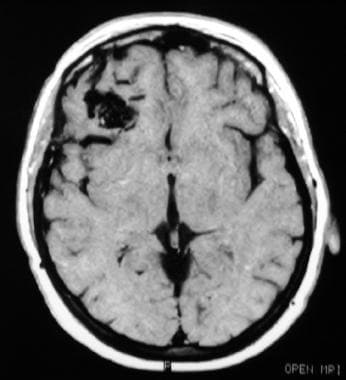
- AVMs appear as irregular or globoid masses anywhere within the hemispheres or brain stem (see Images 1-3).
- AVMs may be cortical, subcortical, or in deep gray or white matter.
- Small, round, low-signal spots within or around the mass on T1, T2, or fluid-attenuated inversion recovery (FLAIR) sequences are the "flow voids" of feeding arteries, intranidal aneurysms, or draining veins.
- If hemorrhage has occurred, the mass of blood may obscure other diagnostic features, requiring angiogram or follow-up MRI.
- Low signal of extracellular hemosiderin may be seen around or within the AVM mass, indicating prior symptomatic or asymptomatic hemorrhage.
- Larger aneurysms within the AVM or on feeding arteries may be identified occasionally.
- Magnetic resonance angiography (MRA) may identify AVMs greater than 1 cm in size (see Image 4) but is inadequate to delineate the morphology of feeding arteries and draining veins; small aneurysms can be missed easily.
- Cerebral angiography
- Angiogram is required for hemodynamic assessment, which is essential for planning treatment (see Image 5).
- The morphology of the AVM determines the treatment algorithm. Important features include feeding arteries, venous drainage pattern, and arterial and venous aneurysms.
- Ten to fifty-eight percent of patients with AVM have aneurysms located in vessels remote from the AVM, in arteries feeding the AVM, or within the nidus of the AVM itself.
- Intranidal aneurysms may have a higher risk of rupture than those outside the bounds of the AVM.
- Other important angiographic features may include kinking or ectasia of draining veins, which can cause venous congestion, thrombosis, or rupture; and stenosis of feeding arteries due to angiopathy caused by high-velocity, turbulent flow into the fistula.
- Special expertise is required to perform superselective catheterization into AVM feeding arteries, which allows both pressure measurements and superselective anesthetic injections to map neurological function in and around the AVM (see Superselective angiography in Procedures).
- Functional MRI
- Use of functional MRI (fMRI) is becoming more common to map brain function during treatment planning for AVMs.
- Localization of language, memory, vision, motor, or sensory function may be obtained to help identify "eloquent" brain regions in and around the AVM prior to treatment by embolization, radiation, or surgery.
Procedures
- Superselective angiography
- Superselective angiography is performed with standard cerebral angiography, with access via a femoral artery puncture.
- A special, flexible, directable catheter is threaded up into one of the main cerebral arteries (carotid or vertebral), then into sequentially smaller branch arteries, until the catheter tip is near or within the AVM nidus.
- Pressure measurements can be obtained via a coaxial catheter. Higher feeding pressures increase the risk of subsequent hemorrhage.
- Sodium amytal, an anesthetic agent, can be injected to produce temporary anesthesia of the area perfused by the artery. In this so-called "superselective Wada testing," language, memory, visual-spatial, sensory, and motor function can be tested during 5 minutes of anesthetic effect to determine whether "eloquent" function originates in that region, which would therefore be at risk for neurological deficits should that brain area be injured during embolization or surgery. Arteries directly feeding the AVM or "en passage" vessels that feed the AVM but continue past the AVM to feed normal brain tissue can be studied.
Medical Care
Treatment planning for AVMs depends on risk of subsequent hemorrhage, which is determined by the demographic, historical, and angiographic features of the individual patient as discussed above. Prior hemorrhage, smaller AVM size, deep venous drainage, and relatively high arterial feeding pressures make subsequent hemorrhage more likely.
No randomized clinical trial comparing invasive treatment (staged embolization followed by either neurosurgical resection or radiosurgery) versus medical management alone of patients with a known brain AVM is available. There is little disagreement that patients with an AVM-related hemorrhage need treatment to avoid subsequent hemorrhages given the high recurrent hemorrhage rates. However, until recently, most patients with a diagnosis of an unruptured brain AVM were also considered candidates for invasive treatment to prevent a devastating hemorrhage. This concept has been challenged because of the low annual hemorrhage rates in patients who did not present with a brain hemorrhage.
To answer this question, the NIH-sponsored, multicenter Unruptured Brain Arteriovenous Malformations Trial (ARUBA) is conducted in the United States, Canada, Europe, and Australia. A total of 800 patients will be randomly assigned in 90 centers to invasive therapy (endovascular, surgical, and/or radiation therapy) versus medical management alone. Patients will be followed for a minimum of 5 years and a maximum of 7.5 years (mean, 6.25 y) from randomization. Final study results will not be available until 2012.
Until the ARUBA study results are available, treatment is recommended for the younger patient with one or more of the high-risk features for a AVM rupture, whereas an older individual or a patient with no high-risk features may be best treated by managing the medical aspects of the illness alone. In such patients, anticonvulsants for seizure control and appropriate analgesia for headaches may be the only treatment recommendations necessary.
- Anticonvulsants
- Standard anticonvulsant therapy, pursuant to the type of seizure, is generally sufficient to bring seizures under control.
- In many patients, seizures are well controlled with phenytoin, carbamazepine, valproic acid, or lamotrigine. Please see the article Complex Partial Seizures.
- Headache management
- Headache of acute onset without localizing neurological signs may be the presenting sign of a hemorrhage, either intraventricular or subarachnoidal, and need immediate assessment by neuroimaging.
- For AVM-associated headaches that are not associated with an intracranial hemorrhage, standard analgesia for headache may be used, either nonspecific or migraine specific. Serotonin agonists are not specifically contraindicated, unless focal neurological symptoms appear as a part of the migraine. Please see the article Migraine Headache.
Surgical Care
Invasive treatment of AVMs may include endovascular embolization, surgical resection, and focal beam radiation, alone or in any combination. The surgical treatment risk has traditionally been estimated by the Spetzler-Martin grade. This grading system assigns 1 point to AVMs smaller than 3 cm in largest diameter, 2 points to AVMs between 3 and 6 cm in largest diameter, and 3 points for AVMs larger than 6 cm. A further point is added if the AVM is located in functionally critical brain (eg, language, motor, sensory, or visual cortex), and another point if the AVM has a deep venous drainage.
The current American Heart Association multidisciplinary management guidelines for the treatment of brain AVMs recommend the following approach:
- Surgical extirpation is strongly suggested as the primary treatment for Spetzler-Martin grade I and II if surgically accessible with low risk.
- Radiation therapy alone is recommended for Spetzler-Martin grade I or II if the AVM is less than 3 cm in size and surgery has an increased surgical risk based on location and vascular anatomy.
- Brain AVM of Spetzler-Martin grades III can often be treated by a multimodal approach with embolization followed by surgical extirpation. If the lesion has a high surgical risk based on location and vascular anatomy, radiation therapy may be performed after embolization.
- AVMs of Spetzler-Martin grade IV and V are often not amenable to surgical treatment alone because of the high procedural risk. These AVMs can be approached by a combined multimodal approach of a combination of embolization, radiosurgery, and/or surgery.
- In general, embolization should only be performed if the goal is complete AVM eradication with other treatment modalities. The only exception is palliative embolization in patients with an AVM of Spetzler-Martin grade IV or V with venous outflow obstruction or true steal phenomenon in order to reduce arterial inflow to control edema or to reduce the amount of shunt, respectively.
- Surgical resection
- Surgical resection is the mainstay of definitive treatment and is most effective with more easily accessible lesions of smaller size.
- AVMs may be approached with craniotomy over the cerebral convexity, via the skull base, or via the ventricular system.
- Arterial feeders and draining veins are isolated and ligated, then the nidus is resected. Arterial aneurysms may be clipped surgically as well.
- Postsurgical angiography is done routinely to ensure that no residual AVM exists; however, cases of reappearance of AVMs, years after a negative postresection angiogram, have been reported.
- Endovascular embolization
- Superselective endovascular treatment includes delivery of thrombosing agents such as quick-acting acrylate glue (N-butyl cyanoacrylate [NBCA]), thrombus-inducing coils, Onyx liquid embolic fluid, or small balloons into the AVM nidus.
- The goal of embolization is to block the high-velocity shunting of blood from the high-pressure arterial system into the venous system. Serial embolization sessions may whittle the AVM down to a fraction of its original size; the reduced AVM size and the presence of embolic material within the AVM make surgery and radiosurgery safer and more accurate. Embolization may be embarked upon to produce relief of neurological symptoms caused by a large lesion, even if the goal of treatment is not complete obliteration. In most cases, embolization alone is not sufficient to completely obliterate the AVM. However, isolated case series have reported 11-40% of AVM obliteration with only endovascular embolization.
- Radiosurgery
- Radiosurgery is an option to treat AVMs that are approximately 3 cm in diameter or less. Proton beam, linear accelerator, or gamma knife methods are used to deliver a high dose of radiation to the AVM, while minimizing the effects to surrounding brain tissue; a single dose generally is given. Proton beam irradiation sometimes is attempted with larger lesions. Radiotherapy is thought to work by inducing thrombosis. This approach is appealing because of its apparent noninvasiveness.
- MRI often shows high signal in surrounding brain white matter following treatment; actual mass effect from edema can be seen when larger territories are covered. Radiosurgery may take 1-3 years to achieve thrombosis of an AVM, thus the patient remains at risk for hemorrhage from AVM during the treatment period.
Consultations
Treatment of AVMs is best achieved with a multispecialty team comprising a neurologist, neuropsychologist, neurosurgeon, interventional neuroradiologist, and neuroanesthesiologist.
Activity
- No particular activity restrictions are placed on patients with AVMs, besides the usual postsurgical care.
- AVM patients with seizures should follow the same protocols as patients with epilepsy without AVM.
Further Inpatient Care
- The algorithm for surgical treatment is highly individual and is based on the angiographic characteristics of the AVM.
- The most common treatment scenario is one or more endovascular embolization sessions during separate hospitalizations, followed by surgical resection or radiosurgery.
- When hemorrhages occur as the presenting event, a longer hospitalization may be required, with supportive care during recovery from the brain hemorrhage.
Further Outpatient Care
- Seizure and/or headache medications usually are managed by the neurologist or referring physician.
- Follow-up neuropsychological assessments may be helpful if subtle cognitive impairments are noted.
- Patients who have suffered hemorrhage may need inpatient or outpatient rehabilitation like other patients with stroke.
Complications
- The most dreaded complication of the AVMs' natural history is intracerebral hemorrhage (see Prognosis). Treatment decisions are based on the natural history-risk of first or subsequent hemorrhage versus the risk-benefit ratio of treatment.
- Surgical complications
- Surgical complications may include persistent neurological deficits associated with hemorrhage and stroke.
- Surgical outcome risk correlates with score on the Spetzler-Martin scale; higher scores, seen with large-sized AVMs, deep venous drainage, and location of the AVM in eloquent brain regions, increase the surgical risk.
- A recent meta-analysis reports a morbidity of 8.6% and mortality of 3.3% after mostly surgical treatment in a series of 2452 patients. The surgical risk for morbidity and mortality for Spetzler-Martin grade of less or equal to 3 has been reported to be 2-6.3% and 0-2%, respectively. The surgical risk for morbidity and mortality for Spetzler-Martin grade IV and V has been reported to be 9-39% and 0-9%, respectively.
- Complications of endovascular embolization
- Complications of endovascular embolization include persistent neurological deficits related to inadvertent embolization of arteries supplying normal brain tissue or obliteration of the venous outflow leading to intracerebral hemorrhages. The procedure carries an associated risk for morbidity and mortality in the range of 9-22% and 0-9%, respectively.
- No long-term outcome studies are yet available; however, as endovascular techniques continue to improve, complication rates are likely to diminish.
- Complications of radiosurgery
- The potential for late effects from radiation, such as accelerated atherosclerosis in surrounding blood vessels, does exist.
Prognosis
- With an overall risk of intracerebral hemorrhage of 2-4% per year, angiographic assessment is recommended to further define prognosis for patients with AVM.
- Those with superficial, moderate-sized AVMs have a good long-term prognosis and may not have any additional benefit with interventional treatment.
- Lifetime risk of hemorrhage may be substantial for young patients with AVM.
- Prognosis after AVM hemorrhage is generally better than that after intracerebral hemorrhage from other causes. Better prognosis may be due to the relatively younger age of patients and a greater potential for reorganization of brain function. More accurate prognosis awaits the results of currently active, long-term, population-based outcome studies.
Patient Education
- For excellent patient education resources, visit eMedicine's Stroke Center. Also, see eMedicine's patient education article Stroke.
| Media file 1:
Axial T2 MRI showing an arteriovenous malformation, with hemorrhage, in the territory of the left posterior cerebral artery. |
 | View Full Size Image | |
Media type: MRI
|
| Media file 2:
T1 axial MRI showing a small subcortical arteriovenous malformation in the right frontal lobe. |
 | View Full Size Image | |
Media type: MRI
|
| Media file 3:
T2 coronal MRI showing an arteriovenous malformation in the left medial temporal lobe. See Image 4 for magnetic resonance angiography of the same patient. |
 | View Full Size Image | |
Media type: MRI
|
| Media file 4:
Magnetic resonance angiography showing a left medial temporal arteriovenous malformation corresponding to the MRI shown in Image 3. |
 | View Full Size Image | |
Media type: MRI
|
| Media file 5:
Angiogram (anteroposterior view) showing an arteriovenous malformation in the deep left middle cerebral artery territory measuring approximately 3 cm in diameter, with a deep draining vein (arrow). |

 | View Full Size Image | |
Media type: X-RAY
|
- ARUBA Investigators. Unruptured brain arteriovenous malformation trial. [The Internet Stroke Center]. Feb 2006;[Full Text].
- ARUBA Study. Unruptured brain arteriovenous malformation trial. [ARUBA Study Site]. Feb 2006;[Full Text].
- Al-Shahi R, Bhattacharya JJ, Currie DG. Prospective, population-based detection of intracranial vascular malformations in adults: the Scottish Intracranial Vascular Malformation Study (SIVMS). Stroke. May 2003;34(5):1163-9. [Medline].
- ApSimon HT, Reef H, Phadke RV. A population-based study of brain arteriovenous malformation: long-term treatment outcomes. Stroke. Dec 2002;33(12):2794-800. [Medline].
- Castel JP, Kantor G. [Postoperative morbidity and mortality after microsurgical exclusion of cerebral arteriovenous malformations. Current data and analysis of recent literature]. Neurochirurgie. May 2001;47(2-3 Pt 2):369-83. [Medline].
- Flickinger JC, Kondziolka D, Lunsford LD. A multi-institutional analysis of complication outcomes after arteriovenous malformation radiosurgery. Int J Radiat Oncol Biol Phys. Apr 1 1999;44(1):67-74. [Medline].
- Halim AX, Johnston SC, Singh V. Longitudinal risk of intracranial hemorrhage in patients with arteriovenous malformation of the brain within a defined population. Stroke. Jul 2004;35(7):1697-702. [Medline].
- Hartmann A, Mast H, Mohr JP, et al. Determinants of staged endovascular and surgical treatment outcome of brain arteriovenous malformations. Stroke. Nov 2005;36(11):2431-5. [Medline]. [Full Text].
- Hillman J. Population-based analysis of arteriovenous malformation treatment. J Neurosurg. Oct 2001;95(4):633-7. [Medline].
- Hofmeister C, Stapf C, Hartmann A, et al. Demographic, morphological, and clinical characteristics of 1289 patients with brain arteriovenous malformation. Stroke. Jun 2000;31(6):1307-10. [Medline]. [Full Text].
- Maruyama K, Kawahara N, Shin M. The risk of hemorrhage after radiosurgery for cerebral arteriovenous malformations. N Engl J Med. Jan 13 2005;352(2):146-53. [Medline].
- Mast H, Young WL, Koennecke HC. Risk of spontaneous haemorrhage after diagnosis of cerebral arteriovenous malformation. Lancet. Oct 11 1997;350(9084):1065-8. [Medline].
- Nataf F, Ghossoub M, Schlienger M. Bleeding after radiosurgery for cerebral arteriovenous malformations. Neurosurgery. Aug 2004;55(2):298-305; discussion 305-6. [Medline].
- Ogilvy CS, Stieg PE, Awad I. AHA Scientific Statement: Recommendations for the management of intracranial arteriovenous malformations: a statement for healthcare professionals from a special writing group of the Stroke Council, American Stroke Association. Stroke. Jun 2001;32(6):1458-71. [Medline].
- Stapf C, Mast H, Sciacca RR. The New York Islands AVM Study: design, study progress, and initial results. Stroke. May 2003;34(5):e29-33. [Medline].
Arteriovenous Malformations excerpt Article Last Updated: May 31, 2006
|