Practice Essentials
Lysergic acid diethylamide (LSD), a hallucinogen that is also known as an entactogen (“to touch within” [1] ), is one of the most potent psychoactive compounds known (said to be more than 3000 times more potent than mescaline). Doses as small as 1-1.5 mcg/kg can produce psychoactive effects; an oral dose of 25 µg is capable of producing potential deleterious psychedelic effects. [2, 3]
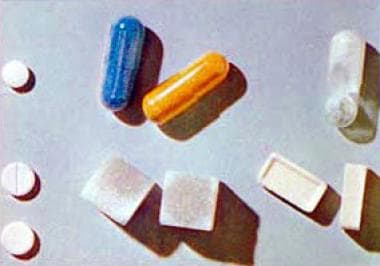
The drug is odorless, colorless, and slightly bitter tasting. It is usually taken by mouth and is rapidly absorbed by the gastrointestinal (GI) tract. The image below depicts LSD in several different pill forms.
While LSD usage reached epidemic proportions in the 1960s, subsequent constraints on the manufacture and distribution of the drug have led to a reduction in rates of abuse. LSD is classified as a Schedule I drug by the US Food and Drug Administration, meaning it is considered a narcotic drug with no known acceptable medical use that has a high potential for abuse, and the possession of any amount of LSD is illegal.
There has also been a concerted effort to educate the public that the psychedelic experiences are a potential health hazard. Nevertheless, LSD continues to be used. Pockets of continued abuse have been documented across the country. [4]
Severe LSD toxicity can lead to respiratory arrest, coma, emesis, hyperthermia, autonomic instability, and bleeding disorders. In some cases, the patient's altered perceptions can result in behavioral toxicity, in which an individual fails to appreciate dangers in the environment and may be injured.
Signs and symptoms
Psychomimetic symptoms
Adverse effects of LSD use can include the following:
-
Panic reaction - May be triggered by an unexpected stressful setting
-
Amplification of unconscious fears
-
Self aggression
-
Suicidal or homicidal ideation
-
Fear of going insane or of the inability to return to normal
-
Perception of rapid aging of self or others
-
Profound depression
Somatic symptoms
Somatic symptoms of LSD toxicity, which are usually due to sympathomimetic effects, include the following:
-
Mydriasis
-
Hypertension
-
Tachycardia
-
Flushing
-
Sweating
-
Loss of appetite
-
Nausea
-
Diarrhea
-
Dry mouth
-
Drowsiness
-
Sleeplessness
-
Weakness
-
Paresthesias
-
Tremors
-
Hyperactive reflexes
-
Piloerection
-
Mild pyrexia
-
Seizures - Rare; typically with doses above 10 mcg/kg
Massive overdoses can lead to the following [1, 2] :
-
Respiratory arrest
-
Intracranial hemorrhage
-
Cardiac arrhythmias
-
Coma - Very rare
-
Emesis
-
Hyperthermia
-
Autonomic instability
-
Coagulopathies
-
Rhabdomyolysis
-
Seizures
LSD has been found to be responsible for triggering serotonin syndrome in patients already using precipitating drug combinations (serotonin precursors or agonists, serotonin-release stimulators, selective serotonin reuptake inhibitors [SSRIs], nonselective serotonin-reuptake inhibitors, nonspecific inhibitors of 5-HT metabolism). [5]
HPPD and flashbacks
In hallucinogen persisting perception disorder (HPPD), patients who are not intoxicated experience symptoms (flashbacks) that initially arose during LSD use. HPPD can last from months to years. According to the American Psychiatric Association's Diagnostic and Statistical Manual of Mental Disorders, 5th Edition (DSM-5), all of the following criteria must be met for a diagnosis of HPPD [6] :
-
Re-experiencing, after the use of a hallucinogen, of one or more of the perceptual symptoms that were experienced while intoxicated with the hallucinogen
-
The symptoms cause clinically significant distress or impairment in social, occupational, or other important areas of functioning
-
The symptoms are not due to a general medical condition and are not better accounted for by another mental disorder
Perceptual symptoms include the following [6] :
-
Geometric hallucinations
-
Perception of movement in peripheral visual fields
-
Flashes of color
-
Intensified colors
-
Trails of images of moving objects
-
Postitive afterimages
-
Halos around objects
-
Macropsia and micropsia
See Presentation for more detail.
Diagnosis
Although LSD toxicity is diagnosed primarily by way of history and physical examination, LSD can be detected by radioimmunoassay. levels from 1.5-5.5 ng/mL may be found within 24 hours after the patient has taken a 300-mcg dose of the drug. However, high-performance liquid chromatography or gas chromatography is required for confirmation.
Diagnostic testing should be directed at identification of complications or exclusion of comorbidities. Coagulation, total creatine phosphokinase, or serum electrolyte studies may be indicated in patients with seizures, coma, or a neuroleptic malignant syndrome–like presentation to identify coagulopathy or rhabdomyolysis or to exclude other diagnoses.
See Workup for more detail.
Management
The basic tenet of caring for patients who have ingested hallucinogens such as LSD is reassurance in a calm, stress-free environment that is safe for both patient and healthcare professionals. Rarely, patients need to be either sedated or physically restrained. Benzodiazepines can safely be given to treat agitation. [1, 2] Butyrophenones such as haloperidol may be required, although there is a small theoretic risk of lowering the seizure threshold. [1]
Massive ingestions of LSD should be treated with supportive care, including respiratory support and endotracheal intubation if needed. The following should be treated symptomatically:
-
Hypertension
-
Tachycardia
-
Hyperthermia
-
Hypotension - Should be treated initially with fluids and subsequently with pressors if required
See Treatment and Medication for more detail.

Background
The prototype of the hallucinogen class, LSD was first developed in 1938, when the Swiss biochemist Albert Hofmann synthesized it from lysergic acid while researching the medical effects of ergot-derived synthetic molecules. However, the hallucinogenic properties of LSD were not discovered until 1943, when Hofmann unintentionally ingested the substance and experienced an “extremely stimulated experience." [7]
Hailed as a wonder drug in the field of psychoanalysis during the 1950s and 1960s, LSD was used in schizophrenia research to produce “experimental psychosis” (through alteration of neurotransmitter systems) and in so-called psycholytic and psychedelic therapies. [8] Multiple reports suggested beneficial effects from the use of LSD in the treatment of depression, obsessive-compulsive disorder, alcoholism, and sexual dysfunction. [9, 10] For over a decade, it was also used to treat children with autism.
In the 1960s, however, large numbers of people began using LSD as part of a counterculture movement. Most prominently, the American psychologist, writer, and futurist Timothy Leary helped popularize LSD and other hallucinogens by proclaiming their alleged therapeutic and spiritual benefits. Because of the resulting public health concerns, the drug was banned for recreational purposes by federal law in 1966. [11] In addition, LSD research and use in psychotherapy ended. Recently, however, studies of LSD as a psychotherapeutic tool have resumed, principally in Europe. [10, 12, 13]
Currently, LSD is known for its use as a “club drug,” together with gamma-hydroxybutyric acid (GHB); 3,4 methylenedioxymethamphetamine (MDMA), also referred to as ecstasy; and ketamine. Other hallucinogens include mescaline, psilocybin, and ibogaine, which all possess a structural similarity to serotonin. (See DDx.)
In addtion, a trend toward microdosing of psychedelic drugs—primarily LDS and psilocybin—has emerged. This practice consists of the use of tiny repeated doses (typically 1/10th of a full dose; eg, 7-20 µg) to facilitate a range of supposed benefits. Uses of microdosing include self-treatment of disorders such as depression, attention deficit hyperactivity disorder (ADHD), or cluster headaches, or self-optimization (eg, for enhancing performance and creativity; this is reportedly popular among high-tech professionals in Silicon Valley). [14, 15, 16]
Psychoactive effects
LSD causes changes in thought, mood, and perception, with minimal effects on memory and orientation. The drug primarily produces so-called pseudohallucinations, which are illusions derived from the misinterpretation of actual experiences. These include synesthesias, in which the transposition of certain sensory modes occurs, creating an experience known as sensory crossover . For example, the perception of a sound evoked by a visual image or the impression of hearing colors or feeling sounds would be considered a synesthesia. True hallucinations occur as well; visual hallucinations are the most common.
Exposure to LSD causes pleasant and unpleasant emotions, but the overall effects are unpredictable and vary with the ingested amount, the user’s personality and mood, individual expectations, and surroundings. Users are typically aware that visual, auditory, and olfactorial perceptions are distorted and unreal; however, acute adverse drug effects can include panic reactions, psychoses, and major depression. [17]
In persons who are on the edge of mental illness (eg, with a predisposition to schizophrenia), exposure to LSD can trigger psychotic episodes. One case report describes a young man under the influence of LSD and alcohol who amputated his testicles. [18]
Synthesis and preparation
LSD can be synthesized from easily obtainable chemicals or from naturally occurring substances. Ergotamine alkaloids produced from a fungus that grows on rye and other grains contain lysergic acid. Lysergic acid amide (LSA), a Schedule III substance, is found in the seeds of morning glories and Hawaiian baby woodrose. LSD is produced as a crystalline powder and then mixed with various binding agents.
Potency
According to the US Drug Enforcement Administration (DEA), the strength of samples obtained from illicit sources ranges from 20-80 mcg of LSD per dose. Although LSD possesses a wide margin of safety, single doses obtained over recent years were significantly less potent than those available during the 1960s and 1970s, when a dose contained 100-200 mcg or more of LSD.
Use and availability
Most LSD manufactured in the United States is intended for illegal use. Primary motivations given for the use of LSD are experimentation, a desire to feel good, and a perceived enhancement of social interactions. It is also inexpensive. Typically, a dose costs less than $15. [2] Although small amounts of the drug are used for research purposes, it has no known medical applications. (See Epidemiology.)
Most commonly, 20 to 80 µg of this colorless, tasteless, odorless, and water-soluble substance is ingested via a small square of dried "blotter" paper that has been saturated with a solution of the compound. With this method, the LDS is sprayed onto the small squares of decorative paper, creating the product known as blotter acid.The blotter paper is often imprinted with fanciful designs or cartoons (ie, trademarks for the manufacturer). Other forms of LSD administration include "microdots" (tiny tablets), "windowpane" (gelatin sheets), and liquid LSD. [2] See the image below.

Most illegal laboratories making LSD are found on the West Coast. The drug is sold under more than 80 street names, including "A", acid, Adams, back breaker, battery acid, beast, blotter, blue chairs, blue cheers, blue mist, brown dot, buttons, California triple dip, cube, dose, dot, Elvis, flat blues, gelatin, green wedge, hawk, looney toons, Lucy in the sky with diamonds, M and Ms, mellow yellow, mescal, microdot, mighty Quinn, mind detergent, Owsley acid, Owsley blue dot, pane, pearly gates, pink wedge, pink Owsley, purple Owsley, Sandoz's, strawberries, sugar cube, sunshine, Superman, uncle, vacation, wedding bells, window pane, and Zen.
Pathophysiology and Etiology
Most hallucinogens belong to 1 of the following 2 structurally distinct classes:
-
Indoles and tryptamines - Eg, LSD, psilocybin, and N,N-dimethyltryptamine (DMT)
-
Phenylethylamines - Mescaline and MDMA
The most common route of exposure to LSD is oral; the drug is absorbed rapidly from the GI tract. Dermal absorption has not been well documented. LSD can be aerosolized and is absorbed by the lungs if the particle diameter is 5 micrometers or less.
Disruption of the serotonin system
Because of their structural similarity to serotonin and their intrinsic potency, hallucinogens disrupt the balanced functioning of the serotonin system. [3, 7] Hallucinogens have a high affinity for serotonin (5-HT) receptors, at which LSD exhibits agonist and antagonist properties. [19]
The 5-HT2A receptor plays a major role in the modulation of sensory signals and is predominantly found in pyramidal neurons of the prefrontal cerebral cortex, where hallucinogens have effects on cognition, mood, perception, and emotions ranging from fear to euphoria. These receptors are also thought to be responsible for the pathology and therapy of schizophrenia. Serotonin receptors found in the locus coeruleus are important for sensory modulation and are responsible for the sympathomimetic effects of the drug (hypertension, tachycardia, dizziness, loss of appetite, dry mouth, sweating, nausea, numbness, tremor).
Affinities to other serotonin receptors differ between the 2 hallucinogen classes, which makes attributing specific effects to a single 5-HT receptor subtype impossible. LSD also stimulates dopamine D2 receptors. [20] This leads to a biphasic pharmacologic pattern of early serotoninlike effects (15-30 min after administration) and late mediated dopaminelike effects (60-90 min after administration). The relationship between the dopaminergic and serotonergic systems is not fully understood. [21, 22]
After oral administration, the early drug effects of LSD appear after 30-60 minutes. More profound psychoactive effects peak at 2-4 hours and some effects may last as long as 12 hours. [2] A typical dose to obtain the desired effects ranges from 50-200 mcg. LSD is rapidly metabolized in the liver by N-demethylation, N-deethylation, and aromatic hydroxylation after oral ingestion. The LSD metabolites N-demethyl-LSD (nor-LSD), lysergic acid ethylamide (LAE), iso-LAE, mono-oxylated LSD, and hydroxylated LSD are excreted in the urine. The elimination half-life of LSD is 3-5 hours.
Although LSD does not cause physical or psychological addiction, users quickly develop a high degree of short-lived tolerance (tachyphylaxis), which is due to down-regulation of 5-HT2A receptors. Long-term effects of chronic use can result in persistent psychosis and hallucinogen persisting perception disorder (HPPD), so called “flashbacks." LSD remains one of the most potent mood-altering and perception-altering drugs. [17]
Epidemiology
In 2021, the American Association of Poison Control Centers' (AAPCC) National Poison Data System (NPDS) reported 491 single exposures to LSD, with 67 major outcomes and four deaths. [23] A review of data from the National Survey on Drug Use and Health indicated that LSD use in the US increased 200% from 2002-2018, with higher likelihood of use noted in four groups: those with higher levels of education, those who were not married or never been married, those with severe comorbid mental health disorders, and those with criminal justice involvement. [24]
The overall prevalence of LSD use among adolescents and young adults ages 15 to 34 years in Europe is estimated to be 1.0% or less, although higher prevalence has been reported in Finland (2.0%) and Estonia (1.7%). [25]
While LSD is included in national drug trending reports, the accuracy of these for actual LSD use is complicated by novel non-lysergamide hallucinogenic compounds being marketed as LSD. For example, a new class of designer research chemicals includes highly potent hallucinogenic serotonin agonists. Of these, 25I-NBOMe and 25C-NBOMe are the most common type called "Bomb" or "N-Bomb" and are sold on blotter paper. The drug is taken via the buccal or sublingual route, just like LSD. NBOMes are commonly misrepresented as LSD because of their similar routes of administration and effects. [26]
A survey of 682 adults (aged 18–25 years) in 2015 entering electronic dance music (EDM) events at nightclubs and festivals in New York City found 2.9% of respondents reported lifetime use of LSD. In addition, LSD use significantly increased the risk of novel psychoactive substance (NPS) use (adjusted odds ratio = 4.64, P = 0.004). [26] Another study of self-reported NPS use in a US nationally representative sample found that 73.7% of NPS users reported lifetime LSD use. [27]
In the United States, LSD is used predominantly by whites. [28] While use by Blacks and Hispanics is less common, it has been reported in surveys of urban populations, being especially used in clubs and raves. [26]
Males use LSD more frequently than do females. The typical LSD user is a risk-taking, white male in high school or college. However, a survey of women attending university-based ambulatory reproductive health clinics revealed that 13% had used LSD in the past. [29] There was also an association between LSD and high-risk sexual behavior.
The 2021 AAPCC-NPDS reported that 60% of reported exposures to LSD were in adolescents aged 13-19 years. [23] According to the Monitoring the Future study, in 2022, 0.6% of US 8th graders, 1.3% of 10th graders, and 2.5% of 12th graders reported using LSD during the past year. [30]
Prognosis
The long-term prognosis for persons who use LSD is good provided that they stop using it, and most users voluntarily decrease or stop the use of the drug over time. LSD is not considered an addictive drug, because it does not produce compulsive drug-seeking behavior; however, LSD does produce a physiologic tolerance, requiring subsequent increased doses to achieve the same effect.
For those who use LSD chronically, there is the enhanced risk for schizophreniform psychosis and derangements in memory function, problem solving, and abstract thinking. Long-term complications from LSD use may include prolonged psychotic reactions, severe depression, or an exacerbation/unmasking of a preexisting psychiatric illness. LSD potentially may exacerbate comorbid conditions in elderly patients.
In 2021, AAPCC reported 4 deaths related to LSD exposure. [23] Because of its large index of toxicity, patients must have access to unusually concentrated forms of LSD if they are to overdose. The lethal dose of LSD has been estimated to be 14,000 mcg. However, only a few cases of massive ingestions have been reported. For example, eight individuals who believed they had cocaine accidentally insufflated an extremely high dose of LSD. Their plasma LSD levels were reported as between 1000 and 7000 μg/100 ml. These individuals all became comatose, with hyperthermia, vomiting, light gastric bleeding, and respiratory problems. With hospital treatment, however, all were reported to have survived without apparent residual effects. [31]
The patient's altered perceptions can lead to behavioral toxicity, in which the patient does not appreciate the dangers in the environment and may be injured. Users may believe that they are invincible or possess superpowers and may do things they would not normally consider, such as believing they can fly, jumping from buildings, or incurring severe ocular damage by prolonged staring at the sun. [31] Extreme agitation brought on by disturbing hallucinations has been known to lead to suicide or to unintentional death, as users have tried to flee from these drug-induced illusions.
Despite early reports of LSD-related fetal malformations, inadequate evidence exists to establish causality.
Hallucinogen persisting perception disorder (HPPD) has an estimated prevalence of 4.2%. With HPPD, individuals who are not intoxicated experience symptoms (flashbacks) that initially arose during the use of LSD. Flashbacks tend to occur during times of psychological stress and can last for minutes to hours. HPPD may last several months; however, some patients report these experiences for as long as 5 years, with many of these individuals having an underlying psychiatric illness. [32]
Patient Education
Counsel patients on the potential dangers of LSD use, including driving automobiles while intoxicated or combining LSD ingestion with ethanol, marijuana, or other illicit drugs. Because the metabolism of LSD is not fully understood, HIV-positive patients on highly active antiretroviral therapy should be counseled to not use LSD, due to the possibility of adverse drug-drug interactions."Mind Over Matter," an educational tool, is designed to encourage young people in grades 5-9 to learn about the effects of drug abuse on the body and brain (see National Institute on Drug Abuse, Mind Over Matter).
For patient education information, see Substance Abuse.
-
Assorted lysergic acid diethylamide (LSD) blotter papers.
-
Lysergic acid diethylamide (LSD) in assorted pill forms.