Overview
Emergency departments (EDs) and emergency medical services (EMS) are responsible for managing potential chemical disasters, whether they result from industrial accidents or terrorist activities. In recognition of this responsibility, The Joint Commission (TCJ) and the Occupational Safety and Health Administration (OSHA) require EDs to prepare for hazardous material incidents. [1]
In treating patients with chemical exposures, decontamination is of primary importance provided the patient does not require immediate life-saving interventions. [2] Any plan must include contingencies for contamination sources within the hospital and for ED evacuation. The determination of a workable hazardous materials plan requires careful thought and often professional input from medical toxicologists, hazardous materials teams, and industrial hygiene and safety officers. Using a patient decontamination plan implemented without specific adaptation to the hospital and without practice can result in undesirable outcomes.
Legal requirements apply to hospital-based decontamination. All "first responders" for hazardous materials incidents must meet OSHA requirements (29 CFR 1910.120[q]) for both staff training and response to hazardous materials, because they likely will be presented with a chemically exposed patient who has not been decontaminated. Under these regulations, emergency personnel who may decontaminate victims exposed to a hazardous substance should be trained at a minimum to the first-responder operational level. For response to an unknown hazard, OSHA regulations require Level B protection, which includes a positive-pressure self-contained breathing apparatus and splash-protective chemical-resistant clothing. For hospital-based first receivers, however, certain criteria allow for the use of Level C personal protective equipment (PPE) in personnel performing initial triage and decontamination at the hospital. [3]
For more information, see Medscape’s Disaster Preparedness and Aftermath Resource Center.

Purpose of Chemical Decontamination
Chemical decontamination has 2 primary goals. First, decontamination helps prevent further harm to the patient from the chemical exposure. Methods of patient decontamination include chemical dilution and chemical inactivation. Second, decontamination helps protect healthcare providers and maintains the viability of the ED and hospital as a treatment center. Mismanagement may result in illness in healthcare providers and contamination of the ED; severe ED contamination may necessitate departmental closure, which is potentially catastrophic in a mass casualty incident.
Decontamination is time consuming and requires resources. Nerve agents and substances causing injury to the skin and tissue are easily soluble in, and penetrate many different types of material, which renders decontamination more difficult. If chemical warfare (CW) agents have penetrated sufficiently deep, then toxic gases can be released from the material for long periods. By adding substances that increase the viscosity of a CW agent, its persistence time and adhesive ability can be increased. These thickened agents will thus be more difficult to decontaminate with liquid decontaminants since they adhere to the material and are difficult to dissolve.
The need for decontamination can only be established by means of detection. If detection is not possible, then decontamination must be performed solely on suspicion of contamination.
Recognizing a Chemical Contamination
Before chemical decontamination can occur, chemical contamination must be recognized. The most important tool for assessing a patient for chemical exposure is a careful history. Continue to consider chemical exposures in the differential diagnosis for any mass casualty incident in which multiple ill persons with similar clinical complaints (point-source exposure) seek treatment at about the same time or in persons who are exposed to common ventilation systems or unusual patterns of death or illness.
Personal Protective Equipment
Personal protective equipment (PPE) is the clothing and respiratory gear designed to protect the health care provider while he or she is caring for the contaminated patient (see CBRNE - Personal Protective Equipment). The minimum protective equipment required by OSHA regulations for healthcare providers caring for patients contaminated with an unknown substance include chemical-resistant suits that guard against splash exposures and positive-pressure full-faced respirators. Using this equipment requires specialized training; therefore, train appropriate personnel in the use of this equipment before they need to use it. [4]
PPE is divided into 4 levels under the OSHA HAZWOPER classification scheme. Level A PPE is required in the area of chemical release if exposure risk is unknown and potential exposure via splash and vapor is present. A Level A suit is fully encapsulated and chemically resistant to both liquid and vapor exposures. Since this suit is fully encapsulated, it requires a self-contained breathing apparatus. The level of protection typically provided to those involved in the decontamination procedure is a Level B suit. This suit requires a full-faced positive-pressure respirator, is chemically resistant, and provides protection against splash exposures. Use level C protection when the chemical hazard is known, the concentration does not exceed immediate danger to life and health (IDLH) levels, and ambient air oxygen levels are at or above 18% of atmospheric levels. Per guidelines outlined in the OSHA Best Practices for Hospital-based First Receivers guildelines. [3] Level C protection may be used by hospital-based personnel performing decontamination and triage functions under certain conditiona. Level C involves chemical-resistant clothing and air-purifying respirators to filter airborne contaminants (see the image below).
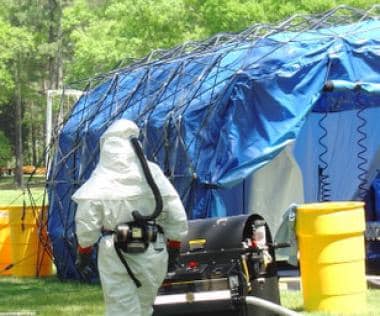 Battery powered air-purifying hood respirator and decontamination shelter. Image courtesy of A. J. Anderson, MD
For excellent patient education resources, visit eMedicineHealth's First Aid and Injuries Center. Also, see eMedicineHealth's patient education articles Personal Protective Equipment and Chemical Warfare.
Patient Decontamination
If it is suspected that skin has been exposed to liquid agents, then it should be decontaminated immediately (within a minute to avoid any effects). All experience confirms that the most important factor is time; the means used in decontamination are of minor importance. Good results can be obtained with such widely differing means as talcum powder, flour, soap and water, or special decontaminants. [5, 6]
If clothes have been exposed to contamination, then extreme care must be taken when undressing to avoid transferring CW agents to the skin. There may be particular problems when caring for injured persons since it may be necessary to remove their clothes by cutting them off. This must be performed in such a way that the patient is not further injured through skin contact with CW agents. During subsequent treatment, ensuring that the entire patient is decontaminated is essential to avoid the risk of exposing the medical staff to the CW agents.
ED staff has the following 3 primary goals in treating a patient who has been exposed to a hazardous material and may be contaminated or who has not undergone adequate decontamination before arrival at the hospital: (1) isolate the chemical contamination; (2) appropriately decontaminate and treat the patient(s) while protecting hospital staff, other patients, and visitors; and (3) reestablish normal service as quickly as possible.
Health care providers caring for the patient should put on the appropriate PPE prior to coming into contact with contaminated patients. In most instances, this is level B PPE.
Ideally, decontamination occurs outside the hospital by Fire and Emergency Services first responders. If this does not occur, prepare a decontamination area for the patient. If possible, the ideal location is outdoors.
If indoor decontamination is necessary, a decontamination room is the next ideal location. Indoor decontamination only should occur in cases in which a controlled indoor environment may be maintained safely.
Control volatilization of the chemical to prevent displacement of ambient room oxygen, to prevent combustion, and to prevent levels of the chemical from reaching air concentrations deemed immediately dangerous to life or health for that specific hazard. In order to monitor this hazard effectively, the hospital requires testing equipment capable of identifying the chemical, its ambient air concentration, and ambient room oxygen concentrations.
If such a room is not available, try to isolate the patient in a single large room after removing nonessential and nondisposable equipment. Ideally, this room should be away from other patient care areas. Maintain ventilation to the area in which the patient is located, but be wary of further contaminating the hospital with recycled ventilation.
Establish a secure zone with yellow tape and permit only appropriately protected individuals to enter as needed. Include in the secure zone any area the patient may contaminate while entering the ED.
Upon arrival of the patient, determine whether the patient requires any immediate life-saving interventions. If these are required, stabilize the patient before or during decontamination.
General principles
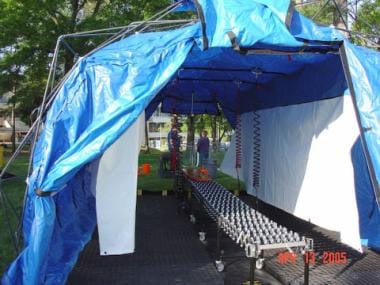
The hot zone, or immediate isolation zone, is the area of immediate contamination. Entry into a hot zone requires special training, equipment, and procedures. It is imperative that the hot zone be isolated immediately and entry restricted to avoid additional unnecessary casualties. Chemical agents are especially likely to spread downwind, creating an at-risk area, protective action zone, which is potentially amenable to evacuation. Notably, dispersion dynamics are such that "downwind" is rarely a straight line and is more likely to be an expanding plume. Gases spread differently in the atmosphere during day and night. Meteorologic conditions, population concentrations, communication capabilities, the specific agent and amount released, and evacuation routes must be identified and are factors in decisions to either evacuate or shelter in place. See the images below.
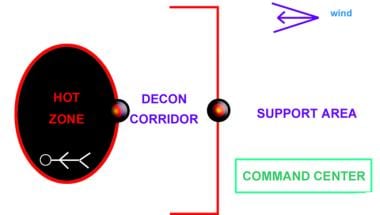
The hot zone must be approached from an upwind direction, an area that is also a potential evacuation and treatment area. The general indicators of a chemical attack include immediate casualties of similar presentation; a suspicious site characterized by a dispersal device; unexplained gaseous clouds, vapors, or odors; or an absence of animal, bird, or insect life.
Alternatively, there may be intelligence based on reports, remote detection, or point use chemical detectors. Victims must be identified, decontaminated, and evacuated, and general and specific therapy administered as rapidly and efficiently as possible. Considerations include triage and prioritization, communication with a central command center, and identification of all potential sources of important resources such as medications, monitors, and life-support equipment. For example, local supplies of drugs, such as atropine, amyl nitrite, and thiosulfate, will be exhausted rapidly in a mass casualty scenario, so alternative supplies need to be identified and efficiently procured.
Casualties will also be individuals who sustained secondary trauma during exposure to chemical agents, falls and blunt trauma, motor vehicle injuries, burns, or aggravation of preexisting comorbidities such as chronic lung disease and myocardial ischemia. These patients will need to be treated according to established medical principles, including the ABCDs of acute care.
Treatment area
When responding to a disaster involving hazardous materials and weapons of mass destruction, it is critical that the treatment area be at least 300 yards upwind of the contaminated area.
Having the patient perform as much of the decontamination as possible is preferable to decrease the amount of cross-contamination.
Remove the patient's clothes and jewelry and place them in plastic bags.
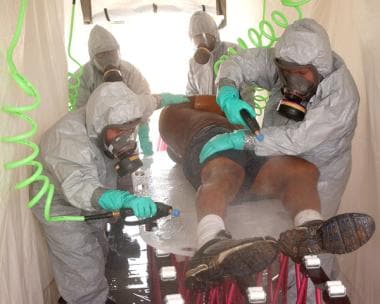
Wash the patient from head to toe with soap and water. Avoid vigorous scrubbing to prevent skin breakdown. See the image below.
Decontaminate open wounds by irrigation with saline or water for an additional 5-10 minutes.
Try to avoid contaminating unexposed skin on the patient. Use surgical drapes if necessary.
Flush exposed areas with soap and water for 10-15 minutes with gentle sponging.
Irrigate exposed eyes with saline for 10-15 minutes, except in alkali exposures, which require 30-60 minutes of irrigation.
Clean under fingernails with a scrub brush.
Ideally, collect runoff water in steel drums if possible.
Special considerations for the chemical warfare patient
The best universal liquid decontamination agent for chemical warfare agents (CWAs) is 0.5% hypochlorite solution. It is prepared easily by diluting household bleach to one-tenth strength (ie, 9 parts water or saline to 1 part bleach). Hypochlorite solution works through physical removal and oxidation and/or hydrolysis of the agent; water does this at a much slower rate. Hypochlorite solutions are for use on the skin and soft-tissue injuries, including open lacerations. Do not use it in penetrating abdominal wounds (leads to development of peritoneal adhesions), in the eye (leads to corneal opacities), in open chest wounds, or in open brain or spinal cord injuries (effects unknown). Irrigate these areas with copious amounts of sterile saline solution. After using hypochlorite solution on either the skin or soft-tissue wounds, subsequently irrigate these areas with sterile saline solution.
The military also has access to a universal dry decontaminant known as M291 resin, which is available as pads packaged in small individual packets. M291 resin is a dry black carbonaceous material that decontaminates by absorption and physical removal of the CWA from the victim. M291 resin is used for spot decontamination of skin exposed to CWAs.
Organization of the military treatment area in chemical warfare
A full discussion of the military medical team response to a chemical warfare attack is beyond the scope of this article. A basic understanding of the structure of the military's medical treatment facility is important for civilian health care providers, since they most likely will be working with the military in the event of a chemical warfare incident. The military medical treatment facility is divided into dirty and clean sides. The demarcation of the sides is known as the hotline. The concept of the hotline is to keep all contaminated equipment, personnel, and casualties out of the clean side until decontamination is completed.
The dirty side consists of a triage station, emergency treatment station, and decontamination area. The triage station is the single entry point into the medical treatment facility. If the patient has an emergent medical condition that requires immediate medical intervention before decontamination, the patient is sent from triage to the emergency treatment station. The emergency treatment station is equipped to handle contaminated patients with emergent medical issues and stabilize them for either decontamination at the medical treatment facility or dirty evacuation to another facility for a higher level of care. The decontamination area is divided into ambulatory and nonambulatory patient decontamination areas.
The clean side consists of part of the decontamination area and the clean treatment area. The hotline extends through the decontamination area. Patients are decontaminated on the dirty side and are brought to the hotline nude except for their PPE mask. These patients are transferred across the line to a team on the clean side of decontamination area. The clean side decontamination team then brings patients into the clean treatment area.
The clean treatment area is located 30-60 meters upwind of the dirty side. The clean side decontamination team removes the patient's mask prior to transferring the patient to the clean treatment area. In the clean treatment area, the patient can be treated definitively or transferred to another facility if needed.
Supportive Care
Saving lives always depends on ensuring the ABCs: adequate airway, ventilation, and circulation. Greater contamination or exposure more likely results in victims who require early intubation and ventilation. Conversely, adequate ventilation may be impossible because of the intense muscarinic effects of certain nerve gas exposures (copious airway secretions, bronchoconstriction). In this situation, administer atropine before initiating other measures. In some patients, large quantities of atropine may be required, rapidly depleting hospital supplies. Administering succinylcholine to assist intubation is relatively contraindicated, since nerve agents prolong the drug's paralytic effects.
Benzodiazepines are the mainstays in seizure treatment. [7] Liberal doses are required; titrate to effect. Termination of seizure activity may reflect onset of flaccid paralysis from the nerve agent rather than adequacy of antiseizure therapy. Bedside electroencephalography (EEG) may be required to assess ongoing seizure activity.
Animal data suggest that routine administration of diazepam reduces the incidence of seizures and decreases severity of pathologic brain injury following nerve agent exposure.
CWAs are a diverse group of extremely hazardous materials. [8] Emergency physicians must be familiar with the pathophysiology and various clinical presentations produced by CWAs and the principles and practices of appropriate medical management. Since deployment of CWAs also places emergency care providers at serious risk of exposure, emergency physicians must be familiar with the different levels of PPE, appropriate use, and decontamination procedures.
CWAs, as potential weapons of mass destruction with the capability of causing a catastrophic medical disaster, easily may overwhelm any health care system. Since civilian victims exposed to CWAs are likely to flee to the nearest hospital, emergency physicians provide the first line of treatment and must prepare their EDs for the treatment of persons exposed to CWAs.
Identifying the Chemical and Obtaining Expert Advice
Verification and Identification
Ideally, a hazardous materials team at the scene will be able to provide assistance regarding the specifics of the exposure and the potential treatment. A local poison control center may also be able to provide assistance. The Chemical Manufacturers Association provides 24-hour assistance in the specifics of treating a particular chemical exposure; it can be reached at (800) 424-9300. The Domestic Preparedness Chem/Bio Helpline can be reached at (410) 436-4484. Online information is available at Centers for Disease Control and Prevention.
In order to reach decisions on the level of protection required, knowing the type of agent present in the area is necessary. However, if that is not possible, then, at a minimum, level B protection should be used.
Development of detection methods today is mainly concentrated on instruments. New manual methods may be developed, but the development mainly concerns instruments for detection and monitoring. In some cases, instruments capable of both tasks are being constructed.
Several lines of development are presently being followed as regards to detection principles. The most common line of development is some form of ion mobility detector ion mobility spectroscopy (IMS). The Chemical Agent Monitor (CAM) also belongs to this group as well as detectors for warning such as the Finnish M86 and the more recent M90. Another principle used is flame photometry, flame photometric detector (FPD). A flame of hydrogen is allowed to burn the sample of air after which the color of the flame is investigated by a photometer. In this way, the presence of phosphorus and sulphur can be demonstrated. Examples of instruments using this principle are the French monitor AP2C and Israeli combined detector and monitor CHASE.
A third principle is to use enzymes, as in the manual methods for nerve agent detection. Detectors operating on this principle have been developed in the United Kingdom, the Netherlands, and the former Soviet Union, among others.
Methods for long-range monitoring using optical methods (IR) are being developed in France and the United States.
A research sector attracting great interest is the use of biologically active molecules as sensors. These biosensors are believed to have extremely great potential, and research is ongoing in several countries. The advantage of biosensors is that, at least in theory, they can be given the sensitivity and specificity desired. This is possible since the biosensor uses the same mechanisms that influence the human body when exposed to poisoning. A simple type of biosensor is the enzyme ticket.
A more general type of biosensor may also be useful in the early detection of potential threats. Instead of studying toxic substances, investigations can be made of which receptors in the body may be sensitive to, such as a toxin. These receptors could then be used in a biosensor.
Manual Detection Methods
Manual detection methods are discussed below.
Detection paper
Detection paper is based on certain dyes being soluble in CW agents. Normally, two dyes and one pH indicator are used, which are mixed with cellulose fibers in a paper without special coloring (unbleached). When a drop of CW agent is absorbed by the paper, it dissolves one of the pigments. Mustard agent dissolves a red dye and a nerve agent, a yellow. In addition, VX causes the indicator to turn to blue, which, together with the yellow, will become green/green-black.
Detection paper can thus be used to distinguish between 3 different types of CW agents. A disadvantage with the papers is that many other substances can also dissolve the pigments. Consequently, they should not be located in places where drops of solvent, fat, oil, or fuel can fall on them. Drops of water give no reaction.
Detection tubes
The detection tube for mustard agent is a glass tube containing silica gel impregnated with a substrate (DB-3). Detection air is sucked through the tube using a special pump. The reaction between the mustard agent and substrate is sped up by heating the tube such as with a cigarette lighter. A developer is then added, and the result can be read-off. If the silica gel in the tube turns blue, then the vapor in the sample contains mustard agent.
Detection tickets
Detection tickets for nerve agents are used in a similar way. The ticket consists of 2 parts: one with enzyme-impregnated paper and the other with substrate-impregnated paper. When the package is broken and the enzyme paper is wetted, the substrate part of the ticket is exposed to the test vapor by means of a pump.
Subsequently, the 2 parts are put together for 2 minutes. If the enzyme part of the ticket has turned a weak blue color, nerve agent is not present in the air. The detection limit is 0.02-0-05 mg/m3 depending on the number of strokes of the pump. The ticket can also be used without a pump (by waving it in the air), but this gives a slightly poorer sensitivity.
Note that the blue change of color requires an active enzyme—some form of cholinesterase. In the presence of nerve agents, the enzyme is inhibited and no change of color occurs. Detection tickets of this kind cannot distinguish between the different nerve agents.
Deciding to Evacuate the Emergency Department
Evacuation of the ED rarely is indicated. In most situations, isolation of the contamination is all that is required.
Consider evacuation of the ED in the following situations:
-
Toxic material spills in the ED
-
Nearby hazardous materials that are threatening the hospital
-
Patient is contaminated with a volatile toxic or flammable chemical and is decontaminated insufficiently prior to entering the ED
If symptoms start to occur outside of the isolation area or the situation requires urgent decision-making without time to identify the contaminant, consider evacuation. Odor does not predict toxicity reliably.
Recommended Equipment for Patient Decontamination - Minimum
Minimum level equipment
Staff PPE
-
Full face shield
-
Hood or hair covering
-
Gloves
-
Water-repelling gown
-
Rubber boots
Equipment list
-
Patient identification and belongings
Waterproof triage tags
Sealable plastic bags, size small and large to accommodate belongings and clothing
Paper bags
Labels
Permanent marker
-
Cleaning supplies
Mild soap
Sponges
Long-handled brushes
Buckets
-
Water sources/containment devices (use any type below)
Hoses with gentle flow, controlled nozzles with hot and cold water
Shower - Single with flex head (minimal); multiple heads (recommended)
Plastic pallets to prevent slippage (minimum of 3)
Water containment/collection system - Wading pools, barrels, and pump; built-in decontamination collection and storage systems
Patient privacy
-
Gowns and/or suits for patient to don post decontamination
-
Towels and blankets
-
Self-decontamination “trash bag” kits (optional)
-
Tents or prefabricated decontamination tents
-
Modesty screens, portable screens
-
Ropes and tarps, barrier tapes
Miscellaneous supplies
-
Duct tape
-
Scissors
-
Traffic cones
-
Megaphones
-
Plastic totes for hospital equipment
Patient education: Laminated decontamination instructions in different languages (community specific) AND interpreter services
Recommended Equipment for Patient Decontamination – Preferred and Specialized
Preferred Level Equipment
Staff PPE
-
Full face shield
-
Chemical-resistant gloves*
-
Chemical-resistant suit*
-
Waterproof chemical-resistant boots*
-
Respirator
Air-purifying respirator (APR)
PAPR with loose-fitting hood
Supplied air with loose fitting hood
-
Appropriate filter cartridge for APR or PAPR
Equipment
-
All equipment listed in minimum level PLUS
-
Ambulation assistance and transportation devices
-
Instant developer camera for evidence collection or identification of patient belongings (optional)
*Note: The use of specific types of cartridges or filters, chemical-resistant suits, gloves, and boots is determined by the contaminant to which exposure is encountered. The type of equipment obtained and utilized by the hospital should be based on the hazard vulnerability analysis and community risk.
Specialized Level Equipment
Staff PPE
-
Level A
Vapor protective suit with hood
SCBA
-
Level B
Chemical-resistant gloves*
Chemical-resistant suit with hood*
Waterproof chemical-resistant boots*
Supplied air respirator or air-purifying respirator
Equipment
-
All items listed in minimum and preferred levels PLUS
-
Chemical-resistant and waterproof litters (ie, Raven, Stokes, Morgue) or gurneys
-
Plastic (nonporous) backboard
* Note: The use of specific types of cartridges or filters, chemical-resistant suits, gloves, and boots is determined by the contaminant to which exposure is encountered. The type of equipment obtained and utilized by the hospital should be based on the hazard vulnerability analysis and community risk.
-
Zone control of the hazardous materials site.
-
Battery powered air-purifying hood respirator and decontamination shelter. Image courtesy of A. J. Anderson, MD
-
Portable decontamination shelter. Image courtesy of A. J. Anderson, MD.
-
Decontamination. Image courtesy of Wikimedia.
Tables

What would you like to print?
- Overview
- Purpose of Chemical Decontamination
- Recognizing a Chemical Contamination
- Personal Protective Equipment
- Patient Decontamination
- Supportive Care
- Identifying the Chemical and Obtaining Expert Advice
- Deciding to Evacuate the Emergency Department
- Recommended Equipment for Patient Decontamination - Minimum
- Recommended Equipment for Patient Decontamination – Preferred and Specialized
- Show All
- Media Gallery
- References