Practice Essentials
Hidradenitis suppurativa is a disorder of the terminal follicular epithelium in the apocrine gland–bearing skin. This condition is a chronic disabling disorder that relentlessly progresses, frequently causing keloids, contractures, and immobility. See the image below.
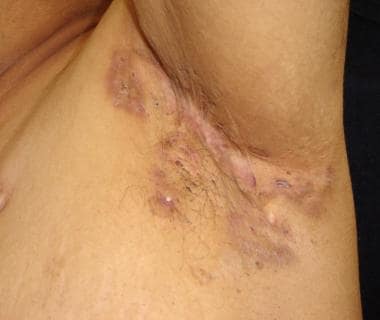 Close-up view of axillary hidradenitis suppurativa in a patient with pyoderma gangrenosum.
Signs and symptoms of hidradenitis suppurativa
Hidradenitis suppurativa usually occurs in otherwise healthy adolescents and adults. It rarely may begin before puberty. Hidradenitis suppurativa is characterized by comedolike follicular occlusion, chronic relapsing inflammation, mucopurulent discharge, and progressive scarring.
The onset of hidradenitis suppurativa is insidious, with the earliest sign being erythema. Later, the lesions become painful. Arthropathy associated with hidradenitis suppurativa may present with variable clinical features, ranging from asymmetric pauciarticular arthritis to a symmetric polyarthritis and/or polyarthralgia syndrome, as well as spondyloarthropathy. Moreover, epidemiological data also suggest an association of hidradenitis suppurativa with other diseases, including metabolic syndrome. Therefore, it is important to approach hidradenitis suppurativa as a systemic disease with an interprofessional team. [1, 2]
See Clinical Presentation for more detail.
Diagnosis of hidradenitis suppurativa
The diagnosis is primarily clinical, no pathognomonic test exists, and biopsy is rarely required, especially in well-developed lesions. [3] The consensus approach indicates that three key elements are required to diagnose hidradenitis suppurativa: typical lesions, characteristic distribution, and recurrence. Arbitrarily, two recurrences over a period of 6 months have been used as a qualifier for a diagnosis. [3] All three criteria must be present for the definitive diagnosis. [1]
Primary positive diagnostic criteria are as follows:
-
History: Recurrent painful or suppurating lesions more than twice in 6 months
-
Signs: Involvement of axilla, genitofemoral area, perineum, gluteal area and inframammary area of women; presence of nodules (inflamed or noninflamed), sinus tracts (inflamed or noninflamed), abscesses, and scarring (atrophic, meshlike, red, hypertrophic or linear)
Suspicion of the diagnosis can be strengthened by other factors that are not, however, pathognomonic. [1, 3]
Secondary positive diagnostic criteria are as follows:
-
History: Family history of hidradenitis suppurativa
-
Microbiology: A negative swab or the presence of normal skin microbiota (may be indicative of hidradenitis suppurativa)
Typical lesions, called primary lesions, include the following:
-
Painful and/or tender erythematous papules smaller than 1 cm in diameter
-
Painful and/or tender erythematous nodules larger than 1 cm in diameter
-
Painful or tender abscesses and inflamed discharging papules or nodules
-
Dermal contractures and ropelike elevation of the skin
-
Double-ended comedones
The axillae and the groin are the 2 areas most frequently affected. These regions are defined by anatomic borders and are called designated sites. Hidradenitis suppurativa is diagnosed if the patient has 1 of the following:
-
Active disease with 1 or more primary lesions in a designated site, plus a history of 3 or more discharging or painful lumps (not specified) in designated sites since age 10 years
-
Inactive disease with a history of 5 or more discharging or painful lumps (unspecified) in designated sites since age 10 years, in the absence of current primary lesions [4]
Other authors have based the diagnosis on a series of questions, as follows [5] :
-
Is there more than a single inflamed lesion?
-
Is the course chronic, with new and recurrent lesions?
-
Are the lesions bilateral?
-
Are the lesions located primarily in the milk line?
Staging
The Hurley clinical staging of hidradenitis suppurativa from 1989 is still relevant today; it has diagnostic value but is not suitable for monitoring the efficacy of interventions in clinical trials. [1] This staging is as follows:
-
First stage: Solitary/multiple, isolated abscess formation without scarring or sinus tracts
-
Second stage: Recurrent abscesses, single/multiple widely separated lesions, with sinus tract formation and cicatrization
-
Third stage: Diffuse/broad involvement or multiple interconnected sinus tracts/abscesses across the entire area
Dynamic staging Sartorius Score systems have been used for assessing differences in treatment effects. [6] Uniform outcome variables should take into account the known characteristics of hidradenitis suppurativa, including the following [6] :
-
Anatomic region involved (axilla, groin, genital, gluteal, or other inflammatory region left and/or right): 3 points per region involved
-
Number and scores of lesions (abscesses, nodules, fistulas, scars): 2 points for each nodule, 4 points for each fistula, 1 point for each scar, 1 point each for "other"
-
Longest distance between 2 relevant lesions (ie, nodules and fistulas, in each region, or size if only 1 lesion): Less than 5 cm, 2 points; less than 10 cm, 4 points; more than 10 cm, 8 points
-
Lesions clearly separated by normal skin in each region: If yes, 0 points; if no, 6 points
A six-stage physician global assessment (PGA) is defined as follows:
-
Clear: No inflammatory or noninflammatory nodules
-
Minimal: Only the presence of noninflammatory nodules
-
Mild: Fewer than five inflammatory nodules or one abscess or draining fistula and no inflammatory nodules
-
Moderate: Fewer than five inflammatory nodules or one abscess or draining fistula and one or more inflammatory nodules or 2-5 abscesses or draining fistulas and fewer than 10 inflammatory nodules
-
Severe: Two to five abscesses or draining fistulas and 10 or more inflammatory nodules
-
Very severe: More than five abscesses or draining fistulas
However, a Hurley severity grade‒relevant conservative and surgical treatment for hidradenitis suppurativa is recommended. [1, 7] In order to assess any treatment effectiveness, it is very important to standardize relevant endpoints. Defined as at least a 50% reduction in total abscess and inflammatory nodule count with no increase in abscess count and no increase in draining fistula count relative to baseline at week 12, the hidradenitis suppurativa clinical response (HiSCR) is currently the most appropriate clinical endpoint to assess treatment and effectiveness for hidradenitis suppurativa treatment. It does not contradict hidradenitis suppurativa response measured by the modified Sartorius Score or PGA, but rather represents a more sensitive measure of change in disease activity, resulting in a more accurate representation of patient response and treatment evaluation. The HiSCR does not take into account the size or severity of individual lesions and does not measure how treatment response affects a patient’s level of pain or quality of life. However, the threshold of 50% reduction in total abscess and inflammatory nodule count is the defined level that is clinically appropriate and meaningful to the patient regarding improvement in quality of life and pain level. [8]
Laboratory testing
The following laboratory tests may be helpful in the evaluation of hidradenitis suppurativa:
-
Complete blood cell count with differential and platelet counts (occasionally elevated white blood count)
-
Erythrocyte sedimentation rate (may be elevated)
-
C-reactive protein assay
-
Urinalysis
-
Serum multiphasic analysis with determination of the serum iron level and serum protein electrophoresis (possibly low serum iron levels, serum protein abnormalities)
Other studies that may be helpful include the following:
-
Bacteriologic analysis (eg, bacteriologic sampling and cultivation)
-
Immunochemistry for various cytokeratins and 6 desmosomal cadherins (ie, desmogleins [Dsgs] 1-3, desmocollins [Dscs] 1-3)
-
Histologic examination
Imaging studies
Ultrasonography of the hair follicles and dermal thickness in hidradenitis suppurativa patients may reveal abnormalities in the deep part of the follicle.
See Workup for more detail.
Management of hidradenitis suppurativa
Medical management is recommended in early stages, whereas surgery should be performed after the formation of abscesses, fistulas, scars, and sinus tracts. [5]
Systemic treatment does not restore the skin’s original architecture; therefore, once the inflammation has been treated, epithelialized cysts and sinus tracts remain in the affected skin. [9]
Conservative treatment may include the following:
-
Local hygiene
-
Weight reduction in patients who are obese
-
Use of ordinary soaps and antiseptic and antiperspirant agents (eg, 6.25% aluminum chloride hexahydrate in absolute ethanol)
-
Application of warm compresses with sodium chloride solution or Burow solution
-
Wearing of loose-fitting clothing
-
Laser hair removal
-
Discontinuation of cigarette smoking
-
Medical anti-inflammatory or antiandrogen therapy (eg, oral or topical antibiotics, intralesional triamcinolone, spironolactone, finasteride)
-
Biological therapy
The following medications are used in the management of hidradenitis suppurativa:
-
Antibiotics (eg, tetracycline, doxycycline, minocycline, trimethoprim-sulfamethoxazole, clindamycin, erythromycin, dapsone)
-
Retinoids (eg, isotretinoin)
-
Corticosteroids (eg, triamcinolone, prednisolone, prednisone)
-
Antiandrogens (eg, cyproterone acetate, spironolactone)
-
Immunosuppressants (eg, adalimumab, infliximab, other biologic agents)
-
Estrogen derivatives (eg, ethinyl estradiol)
-
5-Alpha-reductase inhibitors (eg, finasteride)
Surgery
Surgery is most valuable in the chronic and recurrent stages of hidradenitis suppurativa. [5, 7] Wide surgical excision, with margins well beyond the clinical borders of activity, remains the most definitive surgical therapy. [5, 8, 9] However, although recurrence rates may be lower with aggressive surgery, recurrences often continue. [10, 11] After radical excision, the disease has been reported to recur in 33% of patients, [11] and it may be as high as 50% in the submammary region. [12]
More limited surgical intervention may include the following [13, 14, 15, 16] :
-
Drainage
-
Nd:YAG laser treatment of lesions
-
Exteriorization
-
Curettage
-
Electrocoagulation of the sinus tracts
-
Deroofing and skin-tissue-saving excision with electrosurgical peeling
-
Simple excision of the troublesome areas with direct closure
-
Reconstruction with skin grafting and negative-pressure wound healing therapy
-
Placement of local cutaneous flaps, musculocutaneous flaps, pedicled and free flaps, or skin grafts
-
Secondary-intention healing
Radiotherapy
Nonablative radiofrequency therapy can be used for patients with Harley stage I and II disease. [17]
See Treatment and Medication for more detail.

Background
Hidradenitis suppurativa (HS) is a disorder of the terminal follicular epithelium in the apocrine gland–bearing skin. Hidradenitis suppurativa is characterized by comedolike follicular occlusion, chronic relapsing inflammation, mucopurulent discharge, and progressive scarring.
Pathophysiology
Hidradenitis suppurativa (HS) has traditionally been considered a disorder of the apocrine glands. Hidradenitis suppurativa was first described as a distinct entity in 1839, when Velpeau reported a patient with superficial abscess formation in the axillary, mammary, and perianal regions. [18] In 1854, Verneuil associated the suppurative process with the sweat glands, and the condition was given its current name. For many years, the condition was described as Verneuil disease, but it subsequently became known as hidradenitis suppurativa. Not having performed any histopathologic studies himself, Verneuil conceded that his conclusion was based purely on the characteristic distribution of the condition. [19]
In 1922, Schiefferdecker classified the sweat glands as eccrine and apocrine, and he subsequently localized hidradenitis suppurativa to the apocrine glands. [20] In 1939, Brunsting provided a detailed description of the histologic features of hidradenitis suppurativa. He observed the primary cellular reaction in the lumen of the apocrine glands and in the neighboring periglandular connective tissue. Detailing the clinical features of the disease, Brunsting highlighted its frequent association with acne. He noted that hidradenitis suppurativa, dissecting cellulitis of the scalp and the neck, and acne conglobata commonly occur in the same patient. He thought that the central pathogenetic event in all 3 conditions was a tendency for follicular hyperkeratinization with secondary bacterial infection. [21]
In 1956, Pillsbury et al combined acne conglobata, hidradenitis suppurativa, and dissecting cellulitis under the term follicular occlusion triad. [22] The only flaw in their concept was their focus on apocrine sweat gland involvement. In 1975, Plewig and Kligman added pilonidal sinus as another component to the ensemble, and they introduced the term acne tetrad. [23] Plewig and Kligman pointed out that hidradenitis suppurativa is a misnomer because of the lack of apocrine gland involvement, but they did not present a detailed explanation. In 1989, Plewig and Steger suggested the term acne inversa as an inclusive and accurate name for what was previously called the follicular occlusion triad, or follicular occlusion tetrad. [24] Eventually, hidradenitis suppurativa was accepted as an acneiform disorder that begins with follicular occlusion rather than an infection of the sweat glands. [25, 26]
Hidradenitis suppurativa is actually a defect of the follicular epithelium; therefore, there is a movement towards calling the disease acne inversa instead of hidradenitis suppurativa. The term acne inversa links the pathogenesis to acne and reflects the fact that it is an expression of follicular occlusion in localizations inverse to acne vulgaris. [27] However, hidradenitis suppurativa differs from acne in that no increase in sebaceous secretions is seen in hidradenitis suppurativa.
Etiology of Hidradenitis Suppurativa
The exact etiology of hidradenitis suppurativa remains obscure. All proposed etiologic factors, such as occlusion and bacterial infection, genetics, host defense defects, hormones, cigarette smoking, and irritants, are likely to be only secondary factors. The primary events in the hair follicles of the affected areas remain unidentified. [28] Also, thickened skin may play a role in the pathogenesis of hidradenitis suppurativa (see Imaging Studies).
The classic view of hidradenitis suppurativa is that it is an occlusive and pyogenic disease of the apocrine glands, a hypothesis that seemed to be confirmed with its experimental reproduction by Shelley and Cahn in 1955. [29] After manually depilating the skin and applying atropine-impregnated tape, they induced initial keratinous obstruction, dilatation, and inflammation of the apocrine duct, which occurred in only 25% of the experimental lesions. No progression to the characteristically chronic condition of hidradenitis suppurativa occurred. [29]
In other studies, hidradenitis suppurativa is identified as a disorder of follicular occlusion rather than apocrine occlusion. [25, 26] Yu and Cook found inflammatory changes involving the apocrine glands in only one third of cases; these occurred only when the inflammation extensively involved the hair follicles and eccrine glands. [25] Attanoos et al reported follicular occlusion in all specimens, when compared with controls, regardless of the disease duration. The inflammation of the apocrine glands did not occur in the absence of an adjacent folliculitis; thus, apocrine gland involvement was incidental or secondary. [26] Therefore, hidradenitis suppurativa is best considered a disorder of the terminal follicular epithelium in the apocrine gland–bearing skin.
The earliest change is plugging, which occurs in follicular hyperkeratosis with infundibulofolliculitis. This obstructs the apocrine gland ducts and perifolliculitis around the ducts. Whether this initial inflammatory change is due to a bacterial infection or factors similar to those involved in acne formation is not known.
In the later stages of hidradenitis suppurativa, bacterial infection seems to be a risk factor for the destructive scarring and extension of hidradenitis suppurativa lesions, and, once the sinuses have formed, the risk of secondary infection is obvious. [30]
Among the most commonly isolated bacteria are coagulase-negative staphylococci and anaerobic bacteria. [1, 30] Sweat ducts can become occluded with periodic acid-Schiff (PAS)–positive extracellular polysaccharide substance, the cause of which has been suggested to be Staphylococcus epidermidis. [31] Such strains induced miliaria under experimental conditions. A similar mechanism may be important in the pathogenesis of hidradenitis suppurativa. [30]
The earliest inflammatory event in hidradenitis suppurativa is the rupture of the follicular epithelium. The cause of the rupture is not known, although friction in intertriginous locations may be a contributing factor. The rupture is followed by the spillage of foreign-body material into the dermis, which initiates an inflammatory response, resulting in foreign-body granuloma formation. Epithelial strands form draining sinuses in this inflammatory tissue. Colonization with bacteria, usually coagulase-negative staphylococci, can aggravate the chronic inflammation. [28, 30]
Regarding the current controversies nonfollicular-based theories on what causes hidradenitis suppurativa, some authors suggest the following [32] :
-
The apocrine glands may play a role in hidradenitis suppurativa since an abnormal secretion (either the excess or absence) could be influencing an effect on the acroinfundibulum, distal from the gland itself.
-
The sinus tract formation is an early feature of hidradenitis suppurativa, arising not from hair follicles but rather from invaginations of epidermis as cysts.
-
Resident bacteria, such as coagulase-negative staphylococci may cause adherence of the epidermis in the closed serrated tissue of intertriginous areas, leading to the formation of cysts and hidradenitis suppurativa lesions.
Although the inciting influences for the follicular occlusion and sinus tract formation have not been fully elucidated, genetic factors may play a role. More than 15 years ago, the existence of a familial form of hidradenitis suppurativa with autosomal dominant inheritance was proposed. The disease frequency among first-degree relatives of patients with familial hidradenitis suppurativa was 34%. [33]
Heterozygous mutations were have been reported in the gamma-secretase genes PSENEN, PSEN1, and NCSTN in some patients with hidradenitis suppurativa. [34] One member of this gene complex, termed nicastrin (NCSTN), lies on chromosome 1 within the previously reported region 1p21.1-1q25.3 on chromosome 1, where the AI (acne inversa) gene (one putative genetic locus in hidradenitis suppurativa), was mapped. [35]
Gamma-secretase is a transmembrane protease composed of four essential protein subunits: one catalytic presenilin (PSEN1) subunit and three cofactor subunits [presenilin enhancer 2 (PSENEN), nicastrin (NCSTN), and anterior pharynx defective 1 (APH1)]. Gamma-secretase appears integral to normal skin function, through effects on notch signaling, such as the biological role in the hair follicle. The pattern of mutations suggests that loss of function of components of the gamma-secretase complex underlies the disease: follicular keratinization, follicular atrophy, the formation of epidermal cysts, absence of sebaceous glands, and epidermal hyperplasia. Most frequently, gamma-secretase mutations corresponded to nicastrin (NCSTN) mutant proteins.
Although these mutations only appear in a minority of cases of hidradenitis suppurativa, their identification delineated the first genetically defined clinical subgroup of patients with hidradenitis suppurativa and primary involvement of the hair follicle instead apocrine gland, suggesting that the primary event is follicular occlusion. [34] Owing to research efforts over the last 3 years, the genetic reasons for the disease are known in approximately 5% of the hidradenitis suppurativa patients. They are different heterozygous mutations in subunits of gamma-secretase. Genetic factors might influence not only the appearance of hidradenitis suppurativa, but also the phenotype of disease. [1]
Host-defense defects
Host-defense defects in patients with hidradenitis suppurativa are suspected but not proven. [36]
Hyperreactive neutrophils have been proposed to be of pathophysiologic importance in many chronic inflammatory diseases involving the destruction of the surrounding tissue by the simultaneous release of reactive oxygen species and active proteases.
The release of oxygen radicals from peripheral neutrophils that are activated in vitro was studied in patients with inactive hidradenitis suppurativa. The generation of free oxygen radicals after the stimulation of peripheral neutrophils with protein kinase C (PKC) activator and phorbolmyristate acetate (PMA) was significantly higher in patients with hidradenitis suppurativa than in healthy control subjects.
The higher sensitivity of PKC to PMA in patients with hidradenitis suppurativa is unlikely to have been induced by the disease and its local lesions because the systemic effects were minor in the quiescent state. Therefore, a defect in the function of the neutrophils might be of pathogenic importance in hidradenitis suppurativa. [36]
A reduction in the percentage of natural killer cells over time and a lower response of monocytes to triggering by bacterial components were found in patients with hidradenitis suppurativa. Further study is needed to elucidate if these changes are related to an autoimmune mechanism in the pathogenesis of hidradenitis suppurativa. [37]
Toll-like receptors play an integral role in the innate immune response to bacteria. A highly increased expression of toll-like receptor 2 (TLR2) by CD68+ macrophages and CD209+ dendritic cells in acne inverse skin lesions was found. [38]
Apart from Toll-like receptor 2 activating microbial products as an important trigger factor in the chronic inflammatory process, the inflammatory reactions leading to hidradenitis suppurativa are only poorly understood, but they show many similarities with other inflammatory reactions such as with psoriasis; proinflammatory cytokines interleukin (IL)‒12 and IL-23 are mediators in autoimmune tissue destruction and are abundantly expressed by macrophages in hidradenitis suppurativa; IL-23 has been shown to be involved in the induction of a T-helper cell subset named Th17; antimicrobial peptides beta-defensin 2, Psoriasin, and cathelicidin are highly up-regulated in lesions of psoriasis and in hidradenitis suppurativa, which may at least in part, explain the clinical finding that hidradenitis suppurativa patients only rarely have skin infections. [1]
Hormonal effects
Apocrine sweat glands are stimulated by androgen and suppressed by estrogen. Evidence for the hormonal effects in hidradenitis suppurativa exists; however, the exact roles of androgens in the pathogenesis of hidradenitis suppurativa remain controversial, and they may prove to be secondary. [10, 39, 40, 41]
Many women describe a worsening of the condition with menses, whereas others report alleviation with pregnancy, followed by postmenstrual flaring. These observations suggest that the low level of estrogen predisposes women to disease activity. Premenstrual flare has been shown to be unrelated to menstrual disturbances. These flares were not predictive of the overall course, and the effect of pregnancy was not constant. [42] The female preponderance may also be explained by other specific factors such as the estrogenic influence on inflammation. [43]
The following evidence supports the association of androgens and hidradenitis suppurativa: the disease is rarely present until after puberty begins, [44] Hidradenitis suppurativa is not present in eunuchs or eunuchoids, and hidradenitis suppurativa may occur as the presenting feature of premature adrenarche. [45] Also, antiandrogen therapy is of some benefit in patients with hidradenitis suppurativa. [46]
The relationship between hidradenitis suppurativa and hyperandrogenism is largely based on the finding that the free androgen index is increased due to a low level of sex hormone–binding globulin (SHBG). SHBG is now believed to be regulated by factors that influence body weight. [42]
Hirsutism and obesity are common findings among women with hidradenitis suppurativa. [47] Obesity can alter sex hormone metabolism, leading to an androgen-excess state. Excessive androgens can enhance keratin production and coarsening of the hair shaft, promoting follicular occlusion. [26] Although hirsutism, obesity, and acne among women with hidradenitis suppurativa are more common than expected, [42] the incidences are not significantly different from those in the general population. [39, 40, 48] However, neither evidence for biochemical hyperandrogenism nor suppression of SHBG has been shown in women with hidradenitis suppurativa when compared with age-, body weight-, and hirsuties-matched controls. [42] In one study, obesity and oral contraceptive use were not common or pronounced among patients; this observation suggested that, while these parameters may influence preexisting disease, they are unlikely to be pathogenically important. [49] In obesity, increased skin-to-skin contact may promote follicular hyperkeratosis. [26]
An abnormal end-organ response to normal circulating levels of androgens is proposed. [46] The normal apocrine gland contains 5-alpha reductase, which converts testosterone to the potent androgen dihydrotestosterone. Finasteride is a competitive inhibitor of the 5-alpha reductase type II isoenzyme. The benefits of finasteride in some patients with recalcitrant and persistent forms of hidradenitis suppurativa, [46] raised the issue of whether 5-alpha reductase type I or type II is expressed in this disease and whether this expression applies to the apocrine gland, sebaceous gland, or both. On the other hand, sebum excretion is not an important factor in the development of hidradenitis suppurativa. [48] Thus, hormonal influence remains controversial.
Other
Cigarette smoking may be among the major triggering factors in hidradenitis suppurativa, and its cessation should be encouraged, although whether cessation improves the course of disease is unknown. [10, 50] It remains unclear precisely what pathogenetic mechanism would be responsible for the effect of smoking in the manifestation of acne inversa, but an altered chemotaxis of polymorphic neutrophils could play a part. [51]
Chemical irritants (eg, deodorants) and mechanical irritation (eg, depilation, shaving) have been considered risk factors. However, in one study, no significant difference was found in patients who were exposed to these factors compared with age-matched control subjects. [52] Factors associated with disease activity, such as heat, sweating, stress, and menstruation in females, are the most commonly cited factors that exacerbate the disease. In one study, 32% of responders observed a deterioration in their disease during the summer. [4]
Hidradenitis suppurativa is rarely a side effect of drug use, but oral contraceptives and lithium have been associated with its development. [43]
Lung and buccal cancer are more common among hidradenitis suppurativa patients than in the general population as would be expected with increased tobacco smoking and chewing. [43]
Hidradenitis suppurativa may rarely be complicated by hidradenocarcinoma. [53]
In conclusion, being overweight and obesity are clearly associated factors in hidradenitis suppurativa; their role as severity factors is highly probable. The relationship between the severity of hidradenitis suppurativa and cigarette smoking has been studied, with conflicting results. Mechanical stress as a trigger for hidradenitis suppurativa has still to be proven. [1]
Epidemiology
United States
In the United States, the prevalence of hidradenitis suppurativa appears to be 1-2% in the general population.
International
The prevalence of hidradenitis suppurativa appears to be 1% of the general population [10, 54] ; it was 4% in a group of young adults who were treated at a clinic for sexually transmitted diseases. [10] A 2008 study showed that the prevalence among persons aged 55 years and older was significantly lower than in younger age groups (0.5% vs 1.4%). [50] . Studies that provide prevalence or incidence estimations have been performed under different settings (hospital vs population-based) and in different periods. [54]
Race
Most authors report no specific racial predilection. One report suggests an increased incidence is observed in Blacks, possibly because Blacks have a greater density of apocrine glands than Whites. [12]
Sex
Although hidradenitis suppurativa is widely considered to occur more frequently in females than in males, with a ratio as high as 2-5:1, [4, 49] reports on sex prevalence are controversial. [4, 55, 56] . In fact, females were more likely to have a family history of hidradenitis suppurativa, and men had a tendency for more severe disease and associated severe acne. [56]
Active genitofemoral lesions occur significantly more often in females, whereas perianal involvement tends to be more common in males. No sex difference is seen in the axillary lesions. Comedones have been suggested as precursor lesions for hidradenitis suppurativa, and they appear to be equally distributed in both sexes and sites. [43]
Age
The onset of hidradenitis suppurativa ranges from 11-50 years, with an average patient age of 23 years. [4] In less than 2% of patients, the disease appears before age 11 years. [44] In extremely rare cases, hidradenitis suppurativa occurs before puberty, but it has been suggested that a prepubertal onset is not uncommon in severely affected patients. [57, 58] or after menopause. [42]
Mortality and Morbidity in Hidradenitis Suppurativa
Hidradenitis suppurativa is a chronic disabling disorder that relentlessly progresses, frequently causing keloids, contractures, and immobility.
The disorder has significant socioeconomic effects as well. Jemec et al documented, in the Danish population, an average of 2.7 lost work days per year due to hidradenitis suppurativa (overall workdays lost was 7.5). [49] The general self-reported level of health, which is well correlated with more objective parameters of morbidity, was also significantly worse among hidradenitis suppurativa patients than healthy control subjects. [49] The mean Dermatology Life Quality Index (DLQI) score for hidradenitis suppurativa is higher than for previously studied skin diseases, indicating significant morbidity for those affected. [4]
Prognosis
In general, hidradenitis suppurativa is a chronic disease, as underscored by the finding that 90% of patients in one large series still had active disease in the last year despite an average disease duration of nearly 19 years. [4]
The impression of a relentlessly progressive disorder may be explained by the finding that almost two thirds of patients acknowledged the existence of persistently painful boils that failed to heal. Possibly, new boils develop at an unchanged rate throughout the course of the disease, but some fail to subside in the usual manner and become chronic. [4]
With rare exceptions, surgical intervention is sufficient to stop the disease. [59] Shame, frustration, and despair may cause patients to delay radical surgical procedures.
No single treatment has shown overwhelmingly positive outcomes. [60]
Spontaneous resolution is rare. [7]
Specific factors appear to influence the prognosis. Larger excisions may offer a better outcome. Better results can be obtained by leaving wounds to secondary healing. Perianal surgery, axillary surgery, and older patient age are associated with lower recurrence rates, irrespective of the preoperative duration. [43]
The recurrence rate in patients treated with radical surgery varies considerably depending on the site affected; the highest rate is 50% in the submammary region. [12] An overall recurrence rate of 2.5% have been estimated after wide surgical excision, with a median postoperative follow-up of 36 months. [7]
The postoperative relapse risk is higher in women after surgery under general anaesthesia in severe hidradenitis suppurativa. [58]
If untreated, the disease causes significant morbidity, particularly in women and patients with moderate and severe disease who are more likely to experience a significant diagnostic delay (>2 y). [61]
Patient Education
Patients should be educated about the initial treatments, which include the following [15] (see Medical Care):
-
Practicing proper hygiene
-
Using soaps and antiseptic and antiperspirant agents
-
Using warm compresses
-
Wearing loose-fitting clothing
-
Smoking cessation
Patients who are obese should be educated about weight loss (see Diet). Additionally, patients should be educated about activities that may provide some relief of their condition [4] (see Activity). These activities include swimming, bathing, and avoiding smoking.
For patient education resources, see the Skin Conditions and Beauty Center. Also see the patient education article Boils.
-
Vulvar hidradenitis suppurativa.
-
Vulvar and inguinal indurations.
-
Sinus tract.
-
Draining sinus tract.
-
Axillary hidradenitis suppurativa in a patient with pyoderma gangrenosum.
-
Close-up view of axillary hidradenitis suppurativa in a patient with pyoderma gangrenosum.
-
Submammary hidradenitis suppurativa in a patient with pyoderma gangrenosum.
-
Double-ended-comedones. Hidradenitis suppurativa in a patient with pyoderma gangrenosum.
-
Inguinal hidradenitis suppurativa in a patient with pyoderma gangrenosum.
-
Close-up view of inguinal hidradenitis suppurativa in a patient with pyoderma gangrenosum.
-
Pyoderma gangrenosum in a patient with hidradenitis suppurativa.
-
Close-up view of pyoderma gangrenosum in a patient with hidradenitis suppurativa.
-
Coexisting hidradenitis suppurativa and pyoderma gangrenosum.
-
Coexisting hidradenitis suppurativa and pyoderma gangrenosum.
-
Hidradenitis suppurativa in a patient with pyoderma gangrenosum.