| Patient Education |
|
Click here for patient education.
|
|
You are in: eMedicine Specialties >
Dermatology > INTERNAL MEDICINE
LEOPARD Syndrome
Article Last Updated: Jul 20, 2006
AUTHOR AND EDITOR INFORMATION
Section 1 of 11
Author: Sergiusz Jozwiak, MD, PhD, Head, Professor, Department of Child Neurology, The Children's Memorial Health Institute of Warsaw, Poland
Sergiusz Jozwiak is a member of the following medical societies: Sigma Xi
Coauthor(s):
Robert A Schwartz, MD, MPH, Professor and Head of Dermatology, Professor of Medicine, Professor of Pediatrics, Professor of Pathology, Professor of Preventive Medicine and Community Health, UMDNJ-New Jersey Medical School
Editors: James J Nordlund, MD, Professor Emeritus, Department of Dermatology, University of Cincinnati College of Medicine; Richard P Vinson, MD, Assistant Clinical Professor, Department of Dermatology, Texas Tech University School of Medicine; Consulting Staff, Mountain View Dermatology, PA; Jeffrey Meffert, MD, Assistant Clinical Professor of Dermatology, University of Texas Health Science Center-San Antonio; Catherine Quirk, MD, Clinical Assistant Professor, Department of Dermatology, Brown University; William D James, MD, Paul R Gross Professor of Dermatology, University of Pennsylvania School of Medicine; Vice-Chair, Program Director, Department of Dermatology, University of Pennsylvania Health System
Author and Editor Disclosure
Synonyms and related keywords:
cardiocutaneous lentiginosis syndrome, multiple lentigines syndrome, generalized lentiginosis, centrofacial lentiginosis, lentiginosis profusa syndrome, lentiginosis-deafness-cardiopathy syndrome, cardiocutaneous syndrome, progressive cardiomyopathic lentiginosis, Moynahan syndrome, (OMIM 151100)
Background
LEOPARD syndrome is a complex dysmorphogenetic disorder of variable penetrance and expressivity. Gorlin et al introduced the acronym LEOPARD as the name of the syndrome in 1969 to recall the main features of the disorder.
- Lentigines (multiple)
- Electrocardiographic conduction abnormalities
- Ocular hypertelorism
- Pulmonary stenosis
- Abnormalities of genitalia
- Retardation of growth
- Deafness
Not all of the findings are present in any given patient. Zeisler and Becker first described the syndrome in 1936 in a 24-year-old woman with progressive generalized lentigines, hypertelorism, pectus carinatum, and prognathism. The first familial cases were reported in twins by Rosen and subsequently in 8 persons from a large 3-generation pedigree reported by Pipkin. Subsequent communications added new findings in isolated patients or families. Moynahan first documented the association of the syndrome with cardiac abnormalities and short stature in 1962.
Pathophysiology
Recent molecular studies proved that LEOPARD syndrome and Noonan syndrome are allelic disorders caused by different missense mutations in PTPN11, a gene encoding the protein tyrosine phosphatase SHP-2 located at band 12q24.1.
In 2005, Ogata and Yoshida documented that PTPN11 mutations can be identified in approximately 40% of Noonan syndrome patients and in greater than 80% of LEOPARD syndrome patients. Because the vast majority of mutations reside in and around the broad intramolecular interaction surface between the N-SH2 and PTP domains of the PTPN11 protein, they have been suggested to affect the intramolecular N-SH2/PTP binding in the absence of a phosphopeptide, leading to excessive phosphatase activities.
In 2006, Hanna et al found that Noonan syndrome mutations enhance SHP-2 catalytic activity, whereas the activity of representative LS mutants is undetectable when assayed using a standard PTP substrate. The results are also supported by studies by Kontaridis et al. They revealed that whereas Noonan syndrome is caused by gain-of-function PTPN11 mutations, LEOPARD syndrome mutants are catalytically defective and act as dominant negative mutations that interfere with growth factor/Erk-mitogen-activated protein kinase–mediated signaling.
In 2006, Tartaglia et alreported that germline mutations in the PTPN11 gene cause LEOPARD and Noonan syndromes, whereas somatic mutations in the same gene contribute to leukemogenesis. To date, one patient with LEOPARD syndrome and myelomonocytic leukemia has been reported (Ucar, 2006).
Importantly, however, not all patients with LEOPARD syndrome demonstrate linkage to 12q24.1.
Reported in 2005, Kalidas et al performed mutation screening and linkage analysis of PTPN11in 3 families, each of which had a history of LEOPARD syndrome for 3 generations. One family was found to carry a novel mutation (Q510P; 176876.0022). No variations in sequence were observed in the other 2 families, and negative lod scores excluded linkage to the PTPN11locus, showing that LEOPARD syndrome is genetically heterogeneous.
Frequency
International
No epidemiologic data are available. The syndrome seems to be rare both in the United States and internationally.
Mortality/Morbidity
Most patients with LEOPARD syndrome lead a normal life. Cardiac pathologic findings (eg, obstructive cardiomyopathy, cardiac dysrhythmias) may be a cause of death in selected patients. A 19-year-old woman who died as a result of respiratory insufficiency secondary to thoracic deformities and a congenital heart defect has been reported.
Race
LEOPARD syndrome has no clear racial predilection.
Sex
In a large collected series of 77 patients, a slight preponderance of men has been documented (47 men, 30 women).
Age
Lentigines may be present at birth or develop during childhood. They become more numerous and darker with age. Other skin lesions, such as nevocellular nevi and malignant melanomas, reported sporadically in the LEOPARD syndrome, may undergo depigmentation.
History
Highly variable expressivity of the syndrome makes the diagnosis difficult, especially in sporadic patients. Seventy percent of reported cases are familial. Based on clinical analysis of a large series of patients collected from the literature, in 1976 Voron et al proposed minimum criteria for the diagnosis.
- Multiple lentigines must be present.
- Features of at least 2 other categories must be present.
- Other cutaneous abnormalities
- Cardiac structural or electrocardiographic abnormalities
- Genitourinary abnormalities
- Endocrine abnormalities
- Neurologic defects
- Cephalofacial dysmorphism
- Shortness of stature
- Skeletal abnormalities
- If lentigines are absent, a diagnosis of LEOPARD syndrome may be established if the patient has features in at least 3 above-mentioned categories and has an immediate relative with the defined diagnosis.
- Diagnosis of LEOPARD syndrome is very difficult in small children. According to Digilio et al (2006), the diagnosis can be clinically suspected in the first months of life in patients who have 3 main features: characteristic facial features (100%), hypertrophic cardiomyopathy (87%), and caféau lait spots (75%).
Physical
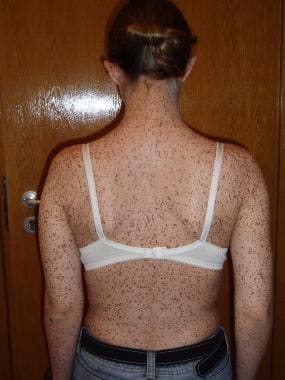
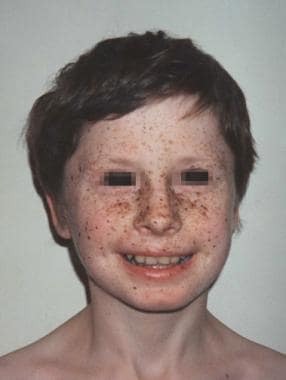
- Lentigines are small, dark brown, polygonal, irregularly shaped macules, usually 2-5 mm in diameter, but sometimes larger, even up to 1-1.5 cm.
- They are often present on the face, neck, and upper part of the trunk but also on the palms, soles, and the sclerae.
- Lentigines are the most prominent manifestation of the LEOPARD syndrome and are present in more than 90% of the patients; however, an absence of the feature does not exclude the diagnosis of the syndrome. Speculation about generalized lentiginosis always being a part of the spectrum of LEOPARD syndrome have been recently weakened by a study from Xing and al, who mapped familial generalized lentiginosis without systemic involvement to band 4q21.1-q22.3.
- On careful skin examination, other cutaneous abnormalities may be detected.
- Axillary freckling
- Café au lait spots
- Localized hypopigmentation
- Onychodystrophy
- Interdigital webs
- Hyperelastic skin
- Mental retardation, usually of mild degree, is observed in about 30% of the affected persons.
- About 25% of patients have sensorineural hearing loss.
- Seizures, nystagmus, or hyposmia have been documented in a few patients.
- One third of the patients demonstrate short stature (in 20% of the cases below third percentile), which seems to become evident soon after birth (most newborns are of normal birth weight).
- Despite frequent cardiac involvement, most patients are asymptomatic, and findings on routine physical examinations may be negative.
- In 2004, Yagubyan et al reported a patient with recurrent upper extremity aneurysms that required multiple operations. This patient also had multiple other peripheral aneurysms, thus far asymptomatic.
- About 35% of the patients demonstrate various cephalofacial findings. Ocular hypertelorism was the most frequently reported (25%). Other findings include the following:
- Mandibular prognathism
- Broad nasal root
- Dysmorphic skull
- Low-set ears
- Dental abnormalities
- High palate arch
- Epicanthal folds
- Ptosis
- Corneal tumors
- Developmental anomalies of the genitourinary system are described in 26% of patients, predominantly in men. Abnormalities of the external genitals, such as cryptorchidism or hypospadias, may be observed on physical examination.
- Different types of skeletal anomalies have been documented in affected patients, including chest deformity (pectus excavatum, pectus carinatum), kyphoscoliosis, winging of the scapulae, rib anomalies, syndactyly, delayed development or agenesis of permanent teeth, or supernumerary teeth.
- In 2004, Rudolph et al reported colobomas of the iris, the retina, and the choroid in 3 members of one family.
Causes
Familial cases suggest an autosomal dominant mode of inheritance with variable expressivity. Speculation exists on the more severe course of the disease in males, which may partially explain the slight preponderance of men in the large collected series of Voron et al in 1976.
Albright Syndrome
Carney Syndrome
Ephelides (Freckles)
Lentigo
Neurofibromatosis
Other Problems to be Considered
Noonan syndrome
Peutz-Jeghers syndrome
Nevi-atrial myxoma-myxoid neurofibromata-ephelides (NAME or LAMB) syndrome
Centrofacial lentiginosis
Lab Studies
- In some patients with endocrine abnormalities, low levels of follicle-stimulating hormone, luteinizing hormone, and thyrotropin and elevated levels of 17-hydroxy and 17-ketosteroids have been revealed.
Imaging Studies
- CT scanning or MRI of the head may reveal brain atrophy.
- Skeletal radiography is indicated for detection of skeletal malformations or for bone age assessment.
- Echocardiography should be done for visualization of structural heart abnormalities (eg, pulmonary valve stenosis, obstructive cardiomyopathy, myxomas).
- Assessment of the genitourinary system may require abdominal ultrasonography or urographic examination.
Other Tests
- Perform electrocardiography to exclude conduction abnormalities, which are reported in about one third of the patients. The most common electrocardiographic changes are left axis deviation, prolonged PR intervals, and right bundle branch block. Due to possible arrhythmia, ECG is especially mandatory before all planned surgical interventions.
- Due to possible arrhythmia, ECG is mandatory before all planned surgical interventions.
- EEG is recommended for patients with seizures.
- Sensorineural deafness may be detected by audiography or auditory evoked potentials.
Histologic Findings
Biopsy of a lentigo reveals an increased number of melanocytes per unit skin area and prominent rete ridges. Electron microscopic examination reveals large accumulations of melanosomes within the Langerhans cells and giant melanosomes. The latter were reported both in normal and pigmented skin in patients with the LEOPARD syndrome; they are also found in patients with neurofibromatosis and nevus spilus.
Medical Care
- Cryosurgery and laser treatment may be beneficial for isolated lentigines; however, because of the large number of lentigines it may be time consuming. For some patients, treatment with tretinoin cream and hydroquinone cream may be helpful.
- Therapeutic regimens include beta-adrenergic receptor or calcium channel blocking agents to reduce outflow tract obstruction and adrenergic responsiveness in patients with structural cardiac anomalies.
- Antiarrhythmic treatment may be required in cases with life-threatening ventricular ectopy.
Surgical Care
Surgical treatment may be necessary in cases with severe outflow tract obstruction or in patients with cryptorchidism, hypospadias, or severe skeletal deformity.
Consultations
- Genetic counseling should be offered to all patients with LEOPARD syndrome. Frequent presentation of forme fruste requires careful examination of all family members.
- Consult a cardiologist, endocrinologist, and orthopedist as dictated by history and physical examination findings.
Activity
Advise patients with outflow tract obstruction or significant cardiac dysrhythmias to avoid strenuous physical exercises.
The combination of tretinoin and hydroquinone can be used as a skin lightening agent.
Drug Category: Retinoids
Decrease cohesiveness of abnormal hyperproliferative keratinocytes and may reduce potential for malignant degeneration. Modulate keratinocyte differentiation. Have been shown to reduce risk of skin cancer formation in renal transplant patients. In this case, the combination with hydroquinone is good for topical use.
| Drug Name | Tretinoin (Avita, Retin-A) |
| Description | Keratolytic agent. Acts by increasing epidermal cell mitosis and turnover while suppressing keratin synthesis. May help lighten lentigines, particularly when used in combination with hydroquinone. |
| Adult Dose | Apply 0.1% cream qhs; hydroquinone cream may be applied afterwards |
| Pediatric Dose | Not established |
| Contraindications | Documented hypersensitivity |
| Interactions | Irritation increases with coadministration of benzoyl peroxide, salicylic acid, and resorcinol; avoid topical sulfur, resorcinol, salicylic acid, other keratolytics, abrasives, astringents, spices, and lime |
| Pregnancy | C - Safety for use during pregnancy has not been established.
|
| Precautions | Photosensitivity may occur; caution in eczema; do not apply to mucous membranes, mouth, and angles of nose, mouth or eyes (may cause excessive irritation); adverse effects include crusting, severe burning or redness, and swelling of skin |
Drug Category: Depigmenting agents
Blocks melanogenesis and works well in combination with tretinoin.
| Drug Name | Hydroquinone USP 4% |
| Description | Lightens hyperpigmented skin by inhibiting enzymatic oxidation of tyrosine and suppressing other melanocyte metabolic processes, thereby further inhibiting melanogenesis. Exposure to sun reverses effects and causes repigmentation. |
| Adult Dose | Apply to affected areas bid (may be applied after tretinoin application) |
| Pediatric Dose | <12 years: Not established >12 years: Administer as in adults |
| Contraindications | Documented hypersensitivity to drug or related products |
| Interactions | Concurrent use of hydrogen peroxide inactivates hydroquinone, which is labile in the presence of oxygen. |
| Pregnancy | C - Safety for use during pregnancy has not been established.
|
| Precautions | Adverse effects include erythema, stinging, irritation, sensitization, and contact dermatitis in sensitive individuals; application area should not exceed that of face, neck, hands, or arms. |
Further Inpatient Care
- No further inpatient care is needed except as indicated for complications of associated abnormalities.
Further Outpatient Care
- All patients with the LEOPARD syndrome should undergo periodic cardiac assessment with echocardiography and electrocardiographic examination because the heart conduction impairment tends to occur gradually but progressively.
Deterrence/Prevention
- Genetic counseling and examination of other family members is indicated.
Complications
- Complications may arise due to associated abnormalities.
Prognosis
- Prognosis is determined mainly by cardiac complications.
Patient Education
- Genetic counseling is recommended.
Medical/Legal Pitfalls
- Failure to perform thorough evaluation to identify any associated anomalies
- Failure to offer family evaluation and genetic counseling because the autosomal dominant mode of inheritance implies the need for these
- Failure to use care in using modalities to remove the lentigines
- Failure to recognize the syndrome
| Media file 1:
Multiple lentigines on the face of a child with LEOPARD syndrome. |
 | View Full Size Image | |
Media type: Photo
|
| Media file 2:
Lentigines on the sclerae in a child with LEOPARD syndrome. |
 | View Full Size Image | |
Media type: Photo
|
| Media file 3:
Area of disordered pigmentation on the trunk of a patient with LEOPARD syndrome. |
 | View Full Size Image | |
Media type: Photo
|
| Media file 4:
Onychodystrophy in a child with LEOPARD syndrome. |
 | View Full Size Image | |
Media type: Photo
|
| Media file 5:
Multiple, small lentigines evenly distributed over the trunk of an adult female with LEOPARD syndrome. |

 | View Full Size Image | |
Media type: Photo
|
- Ahlbom BE, Dahl N, Zetterqvist P, Anneren G. Noonan syndrome with cafe-au-lait spots and multiple lentigines syndrome are not linked to the neurofibromatosis type 1 locus. Clin Genet. Aug 1995;48(2):85-9. [Medline].
- Arnsmeier SL, Paller AS. Pigmentary anomalies in the multiple lentigines syndrome: Is it distinct from LEOPARD syndrome?. Pediatr Dermatol. Mar-Apr 1996;13(2):100-4. [Medline].
- Bonioli E, Di Stefano A, Costabel S, Bellini C. Partial agenesis of corpus callosum in LEOPARD syndrome. Int J Dermatol. Nov 1999;38(11):855-62. [Medline].
- Cetinkaya E, Günal N, Sönmez N, et al. LEOPARD syndrome and hypertrophic obstructive cardiomyopathy: a case report. Turk J Pediatr. Oct-Dec 2004;46(4):373-6. [Medline].
- Chan HH, Fung WK, Ying SY, Kono T. An in vivo trial comparing the use of different types of 532 nm Nd:YAG lasers in the treatment of facial lentigines in Oriental patients. Dermatol Surg. Aug 2000;26(8):743-9. [Medline].
- Choi WW, Yoo JY, Park KC, Kim KH. LEOPARD syndrome with a new association of congenital corneal tumor, choristoma. Pediatr Dermatol. Mar-Apr 2003;20(2):158-60. [Medline].
- Chong WS, Klanwarin W, Giam YC. Generalized lentiginosis in two children lacking systemic associations: case report and review of the literature. Pediatr Dermatol. Mar-Apr 2004;21(2):139-45. [Medline].
- Conti E, Dottorini T, Sarkozy A, et al. A novel PTPN11 mutation in LEOPARD syndrome. Hum Mutat. Jun 2003;21(6):654. [Medline].
- Coppin BD, Temple IK. Multiple lentigines syndrome (LEOPARD syndrome or progressive cardiomyopathic lentiginosis). J Med Genet. Jul 1997;34(7):582-6. [Medline].
- Dacey MJ, Kulp-Shorten CL, Callen JP. LEOPARD syndrome in a patient with morphea and acro-osteolysis. J Cutan Med Surg. Jul 1998;3(1):25-8. [Medline].
- Digilio MC, Conti E, Sarkozy A, et al. Grouping of multiple-lentigines/LEOPARD and Noonan syndromes on the PTPN11 gene. Am J Hum Genet. Aug 2002;71(2):389-94. [Medline].
- Digilio MC, Pacileo G, Sarkozy A, et al. Familial aggregation of genetically heterogeneous hypertrophic cardiomyopathy: a boy with LEOPARD syndrome due to PTPN11 mutation and his nonsyndromic father lacking PTPN11 mutations. Birth Defects Res A Clin Mol Teratol. Feb 2004;70(2):95-8. [Medline].
- Digilio MC, Sarkozy A, de Zorzi A, et al. LEOPARD syndrome: clinical diagnosis in the first year of life. Am J Med Genet A. Apr 1 2006;140(7):740-6. [Medline].
- Digilio MC, Capolino R, Marino B, et al. Congenital intrahepatic portosystemic venous shunt: an unusual feature in LEOPARD syndrome and in neurofibromatosis type 1. Am J Med Genet A. May 1 2005;134(4):457-8. [Medline].
- Froster UG, Glander HJ, Heinritz W. [Molecular genetic mutation analysis of the PTPN11 gene in the multiple lentigines (LEOPARD) syndrome]. Hautarzt. Dec 2003;54(12):1190-2. [Medline].
- Goyal SB, Aragam JR. Aortic root dilatation with redundancy of mitral and aortic leaflets associated with the LEOPARD syndrome. Int J Cardiol. Jun 7 2006;110(1):110-1. [Medline].
- Gupta P, Loiwal V, Rai R, et al. Leopard syndrome: a tropical rarity. J Dermatol. May 1998;25(5):341-3. [Medline].
- Hagspiel KD, Candinas RC, Hagspiel HJ, Amann FW. LEOPARD syndrome: cardiac imaging findings. AJR Am J Roentgenol. Mar 2005;184(3 Suppl):S21-4. [Medline].
- Hanna N, Montagner A, Lee WH, et al. Reduced phosphatase activity of SHP-2 in LEOPARD syndrome: consequences for PI3K binding on Gab1. FEBS Lett. May 1 2006;580(10):2477-82. [Medline].
- Ishigami T, Wakamatsu A, Kishida T, et al. [ECG changes during emergence from anesthesia in a patient with LEOPARD syndrome]. Masui. Oct 2003;52(10):1115-7. [Medline].
- Jozwiak S, Schwartz RA, Janniger CK. LEOPARD syndrome (cardiocutaneous lentiginosis syndrome). Cutis. Apr 1996;57(4):208-14. [Medline].
- Jozwiak S, Schwartz RA, Janniger CK. Familial occurrence of the LEOPARD syndrome. Int J Dermatol. Jan 1998;37(1):48-51. [Medline].
- Kalidas K, Shaw AC, Crosby AH, et al. Genetic heterogeneity in LEOPARD syndrome: two families with no mutations in PTPN11. J Hum Genet. 2005;50(1):21-5. [Medline].
- Keren B, Hadchouel A, Saba S, et al. PTPN11 mutations in patients with LEOPARD syndrome: a French multicentric experience. J Med Genet. Nov 2004;41(11):e117. [Medline].
- Kontaridis MI, Swanson KD, David FS, et al. PTPN11 (Shp2) mutations in LEOPARD syndrome have dominant negative, not activating, effects. J Biol Chem. Mar 10 2006;281(10):6785-92. [Medline].
- Kontoes PP, Vlachos SP, Marayiannis KV, et al. Intense pulsed light for the treatment of lentigines in LEOPARD syndrome. Br J Plast Surg. Sep 2003;56(6):607-10. [Medline].
- Legius E, Schrander-Stumpel C, Schollen E, et al. PTPN11 mutations in LEOPARD syndrome. J Med Genet. Aug 2002;39(8):571-4. [Medline].
- Merks JH, Caron HN, Hennekam RC. High incidence of malformation syndromes in a series of 1,073 children with cancer. Am J Med Genet A. Apr 15 2005;134(2):132-43. [Medline].
- Munshi A, Munshi AK. Leopard syndrome--report of a variant case. J Indian Soc Pedod Prev Dent. Mar 1999;17(1):5-8. [Medline].
- National Center for Biotechnology Information. Online Mendelian Inheritance in Man. Available at: http://www.ncbi.nlm.nih.gov/omim/. [Full Text].
- Ogata T, Yoshida R. PTPN11 mutations and genotype-phenotype correlations in Noonan and LEOPARD syndromes. Pediatr Endocrinol Rev. Jun 2005;2(4):669-74. [Medline].
- Ohkura T, Ohnishi Y, Kawada A, et al. Leopard syndrome associated with hyperelastic skin: analysis of collagen metabolism in cultured skin fibroblasts. Dermatology. 1999;198(4):385-7. [Medline].
- Pacheco TR, Oreskovich N, Fain P. Genetic heterogeneity in the multiple lentigines/LEOPARD/Noonan syndromes. Am J Med Genet A. Jun 15 2004;127(3):324-6. [Medline].
- Peter JR, Kemp JS. LEOPARD syndrome: death because of chronic respiratory insufficiency. Am J Med Genet. Nov 1990;37(3):340-1. [Medline].
- Petter G, Rytter M, Haustein UF. [Multiple lentigines (LEOPARD) syndrome. Case reports and review of the literature]. Hautarzt. Jun 2002;53(6):403-8. [Medline].
- Robain A, Perchet H, Fuhrman C. Flecainide-associated pneumonitis with acute respiratory failure in a patient with the LEOPARD syndrome. Acta Cardiol. Feb 2000;55(1):45-7. [Medline].
- Rudolph G, Haritoglou C, Kalpadakis P, et al. [LEOPARD syndrome with iris-retina-choroid coloboma. Discordant findings in monozygotic twins (MIM # 151 100)]. Ophthalmologe. Nov 2001;98(11):1101-3. [Medline].
- Sarkozy A, Obregon MG, Conti E, et al. A novel PTPN11 gene mutation bridges Noonan syndrome, multiple lentigines/LEOPARD syndrome and Noonan-like/multiple giant cell lesion syndrome. Eur J Hum Genet. Dec 2004;12(12):1069-72. [Medline].
- Sarkozy A, Conti E, Digilio MC, et al. Clinical and molecular analysis of 30 patients with multiple lentigines LEOPARD syndrome. J Med Genet. May 2004;41(5):e68. [Medline].
- Schepis C, Greco D, Siragusa M, et al. An intriguing case of LEOPARD syndrome. Pediatr Dermatol. Mar-Apr 1998;15(2):125-8. [Medline].
- Shamsadini S, Abazardi H, Shamsadini F. Leopard syndrome. Lancet. Oct 30 1999;354(9189):1530. [Medline].
- Shibusawa Y, Tamura A, Mochiki E, et al. c-kit Mutation in generalized lentigines associated with gastrointestinal stromal tumor. Dermatology. 2004;208(3):217-20. [Medline].
- Tartaglia M, Martinelli S, Stella L, et al. Diversity and Functional Consequences of Germline and Somatic PTPN11 Mutations in Human Disease. Am J Hum Genet. Feb 2006;78(2):279-90. [Medline].
- Tartaglia M, Gelb BD. Noonan syndrome and related disorders: genetics and pathogenesis. Annu Rev Genomics Hum Genet. 2005;6:45-68. [Medline].
- Ton''sheva LN, Sidorova LD. [The Leopard syndrome in a patient with sebocystomatosis]. Klin Med (Mosk). 2001;79(6):65-7. [Medline].
- Tong KL, Ding ZP, Chua T. Leopard syndrome. Singapore Med J. Jul 2001;42(7):328-31. [Medline].
- Torres J, Russo P, Tobias JD. Anaesthetic implications of LEOPARD syndrome. Paediatr Anaesth. Apr 2004;14(4):352-6. [Medline].
- Tullu MS, Muranjan MN, Kantharia VC, et al. Neurofibromatosis-Noonan syndrome or LEOPARD Syndrome? A clinical dilemma. J Postgrad Med. Apr-Jun 2000;46(2):98-100. [Medline].
- Ucar C, Calyskan U, Martini S, Heinritz W. Acute myelomonocytic leukemia in a boy with LEOPARD syndrome (PTPN11 gene mutation positive). J Pediatr Hematol Oncol. Mar 2006;28(3):123-5. [Medline].
- Voron DA, Hatfield HH, Kalkhoff RK. Multiple lentigines syndrome. Case report and review of the literature. Am J Med. Mar 1976;60(3):447-56. [Medline].
- Wu R, Legius E, Robberecht W, et al. Neurofibromatosis type I gene mutation in a patient with features of LEOPARD syndrome. Hum Mutat. 1996;8(1):51-6. [Medline].
- Xing Q, Chen X, Wang M, et al. A locus for familial generalized lentiginosis without systemic involvement maps to chromosome 4q21.1-q22.3. Hum Genet. Jul 2005;117(2-3):154-9. [Medline].
- Yagubyan M, Panneton JM, Lindor NM, et al. LEOPARD syndrome: a new polyaneurysm association and an update on the molecular genetics of the disease. J Vasc Surg. Apr 2004;39(4):897-900. [Medline].
- Yam AA, Faye M, Kane A, et al. Oro-dental and craniofacial anomalies in LEOPARD syndrome. Oral Dis. May 2001;7(3):200-2. [Medline].
- Yoshida R, Nagai T, Hasegawa T, et al. Two novel and one recurrent PTPN11 mutations in LEOPARD syndrome. Am J Med Genet A. Nov 1 2004;130(4):432-4. [Medline].
LEOPARD Syndrome excerpt Article Last Updated: Jul 20, 2006
|