Practice Essentials
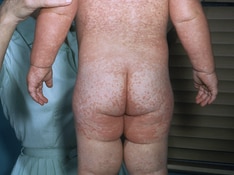
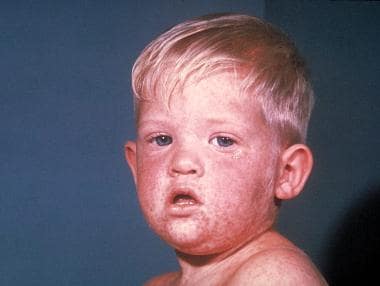
Measles, also known as rubeola, is one of the most contagious infectious diseases, with at least a 90% secondary infection rate in susceptible domestic contacts. Despite being considered primarily a childhood illness, measles can affect people of all ages. See the image below.
Although the elimination of endemic measles transmission in the US in 2000 was sustained through at least 2011, according to a CDC study, cases continue to be caused by virus brought into the country by travelers from abroad, with spread occurring largely among unvaccinated individuals. In 88% of the cases reported between 2000 and 2011, the virus originated from a country outside the US, and 2 out of every 3 individuals who developed measles were unvaccinated. Moreover, the director of the CDC noted that, in 2013, US measles cases increased threefold from the previous median, to 175 cases. [1, 2] Most of these cases were outbreaks in children whose parents had refused immunization.
This trend of increased incidence continued into 2014. From January 1 to May 23, 2014, 288 confirmed cases were reported to the CDC, a figure that exceeds the highest reported annual total number of cases (220 cases in 2011) since measles was declared eliminated in the United States in 2000. Of the 288 cases, 200 (69%) occurred in unvaccinated individuals and 58 (20%) in persons with unknown vaccination status. Nearly all of the 2014 cases reported thus far (280 [97%]) were associated with importations from at least 18 countries. Eighteen states and New York City reported measles infections during this period, and 15 outbreaks accounted for 79% of reported cases, including a large ongoing outbreak in Ohio primarily among unvaccinated Amish persons, with 138 cases reported. [3] Public health officials confirmed a total of 59 cases of measles in California residents since the end of December 2014. Of the confirmed cases, 42 have been linked to an initial exposure in December at Disneyland or Disney California Adventure Park in Anaheim, California. [4]
A study by Gastañaduy et al found that during the 2014 measles outbreak, the spread of measles was contained in an undervaccinated Amish community by the isolation of case patients, quarantine of susceptible individuals, and giving the MMR vaccine to more than 10,000 people. As a result, the spread of measles was limited to about 1% in an Amish community of 32,630. [5, 6]
In 2019, 1274 cases, the highest number of cases since 1992, were reported in the United States. Measles was reported in 31 states from January 1 to December 31, 2019. [7, 8]
Guidelines on measles from the American Academy of Pediatrics
The American Academy of Pediatrics released updated measles guidelines in response to the national outbreak of the disease. The guidelines feature changes in the evidence required for measles immunity, the use of immune globulin, vaccination for healthcare personnel, and the management of patients with HIV infections and other susceptibilities. [9, 10]
Any of the following constitutes evidence of immunity to measles:
-
Documentation of age-appropriate vaccination with a live measles virus–containing vaccine (one dose for preschool-aged children, two doses for children in kindergarten through 12th grade)
-
Laboratory evidence of immunity
-
Laboratory confirmation of disease
-
Birth before 1957
Recommendations for use of immune globulin are as follows:
-
Clinicians can administer immune globulin either intramuscularly or intravenously within 6 days of exposure to prevent or modify measles response in people who lack evidence of measles immunity.
-
The recommended dose is 0.50 mL/kg administered intramuscularly, with a maximum volume of 15 mL.
-
Groups who are at higher risk for complications from severe measles should receive intravenous application at a dose of 400 mg/kg.
Recommendations for people with HIV infections are as follows:
-
Measles immunization (in the form of the measles, mumps, and rubella vaccine) for everyone older than 12 mo who is infected by HIV, except those who have evidence of severe immunosuppression. Measles can be fatal in patients with HIV.
-
Immune globulin prophylaxis for HIV-infected children who are exposed to measles, depending on their immune status and measles vaccine history.
Recommendations for healthcare personnel are as follows:
-
Immunization programs for healthcare personnel, including students, who may be in contact with patients with measles.
-
Birth before 1957 is not a guarantee of measles immunity; facilities should consider vaccination of unimmunized healthcare personnel who lack laboratory evidence of immunity who were born before 1957.
Recommendations for management of susceptible individuals are as follows:
-
Clinicians can best manage immunodeficient and immunosuppressed patients exposed to measles if they have previous knowledge of the patients' immune status.
-
Children should receive measles vaccination prior to treatment with biological response modifiers, such as tumor necrosis factor antagonists.
-
Susceptible patients with immunodeficiencies should receive immune globulin after measles exposure.
-
Warning against giving live-virus measles vaccines to immunocompromised patients with disorders associated with increased severity of viral infections (except people with HIV who do not have evidence of severe immunosuppression).
-
Recommendation not to give immunization for at least a month after a patient has finished a high-dose course of corticosteroids, such as prednisone.
Signs and symptoms
Onset of measles ranges from 7-14 days (average, 10-12 days) after exposure to the virus. The first sign of measles is usually a high fever (often >104o F [40o C]) that typically lasts 4-7 days. The prodromal phase is also marked by malaise; anorexia; and the classic triad of conjunctivitis, cough, and coryza (the “3 Cs”). Other possible prodromal manifestations include photophobia, periorbital edema, and myalgias.
Enanthem
-
Koplik spots—bluish-gray specks or “grains of sand” on a red base—develop on the buccal mucosa opposite the second molars
-
Generally appear 1-2 days before the rash and last 3-5 days
-
Pathognomonic for measles, but not always present
Rash
-
On average, the rash develops about 14 days after exposure
-
Mild pruritus may also occur
-
Blanching, erythematous macules and papules begin on the face at the hairline, on the sides of the neck, and behind the ears
-
Within 48 hours, the lesions coalesce into patches and plaques that spread cephalocaudally to the trunk and extremities, including the palms and soles, while beginning to regress cephalocaudally, starting from the head and neck
-
Lesion density is greatest above the shoulders, where macular lesions may coalesce
-
The eruption may also be petechial or ecchymotic in nature
-
Patients appear most ill during the first or second day of the rash
-
The exanthem lasts for 5-7 days before fading into coppery-brown hyperpigmented patches, which then desquamate
-
Immunocompromised patients may not develop a rash
Clinical course
-
Uncomplicated measles, from late prodrome to resolution of fever and rash, lasts 7-10 days
-
Cough may be the final symptom to appear
Modified measles
-
Occurs in individuals who have received serum immunoglobulin after exposure to the measles virus
-
The incubation period may be as long as 21 days
-
Similar but milder symptoms and signs may occur
Atypical measles
-
Occurs in individuals who were vaccinated with the original killed-virus measles vaccine between 1963 and 1967 and who have incomplete immunity
-
A mild or subclinical prodrome of fever, headache, abdominal pain, and myalgias precedes a rash that begins on the hands and feet and spreads centripetally
-
The eruption is accentuated in the skin folds and may be macular, vesicular, petechial, or urticarial
See Clinical Presentation for more detail.
Diagnosis
Although the diagnosis of measles is usually determined from the classic clinical picture, laboratory identification and confirmation of the diagnosis are necessary for public health and outbreak control. Laboratory confirmation is achieved by means of the following:
-
Serologic testing for measles-specific IgM or IgG titers
-
Isolation of the virus
-
Reverse-transcriptase polymerase chain reaction (RT-PCR) evaluation
Measles-specific IgM titers
-
Obtain blood on the third day of the rash or on any subsequent day up to 1 month after onset
-
The measles serum IgM titer remains positive 30-60 days after the illness in most individuals but may become undetectable in some subjects at 4 weeks after rash onset
-
False-positive results can occur in patients with rheumatologic diseases, parvovirus B19 infection, or infectious mononucleosis
Measles-specific IgG titers
-
More than a 4-fold rise in IgG antibodies between acute and convalescent sera confirms measles
-
Acute specimens should be drawn on the seventh day after rash onset
-
Convalescent specimens should be drawn 10-14 days after that drawn for acute serum
-
The acute and convalescent sera should be tested simultaneously as paired sera
Viral culture
-
Throat swabs and nasal swabs can be sent on viral transport medium or a viral culturette swab
-
Urine specimens can be sent in a sterile container
-
Viral genotyping in a reference laboratory may determine whether an isolate is endemic or imported
-
In immunocompromised patients, isolation of the virus or identification of measles antigen by immunofluorescence may be the only feasible method of confirming the diagnosis
Polymerase chain reaction
-
RT-PCR, if available, can rapidly confirm the diagnosis of measles [11]
-
Blood, throat, nasopharyngeal, or urine specimens can be used
-
Samples should be collected at the first contact with a suspected case of measles
Case reporting
Immediately reporting any suspected case of measles to a local or state health department is imperative. The US CDC clinical case definition for reporting purposes requires only the following:
-
Generalized rash lasting 3 days or longer
-
Temperature of 101.0°F (38.3°C) or higher
-
Cough, coryza, or conjunctivitis
For reporting purposes for the CDC, cases are classified as follows:
-
Suspected: Any febrile illness accompanied by rash
-
Probable: A case that meets the clinical case definition, has noncontributory or no serologic or virologic testing, and is not epidemiologically linked to a confirmed case
-
Confirmed: A case that is laboratory confirmed or that meets the clinical case definition and is epidemiologically linked to a confirmed case; a laboratory-confirmed case need not meet the clinical case definition
See Workup for more detail.
Management
Treatment of measles is essentially supportive care, as follows:
-
Maintenance of good hydration and replacement of fluids lost through diarrhea or emesis
-
IV rehydration may be necessary if dehydration is severe
-
Vitamin A supplementation should be considered
Postexposure prophylaxis should be considered in unvaccinated contacts; timely tracing of contacts should be a priority. Patients should receive regular follow-up care with a primary care physician for surveillance of complications arising from the infection.
Vitamin A supplementation
The World Health Organization recommends vitamin A supplementation for all children diagnosed with measles, regardless of their country of residence, based on their age, [12] as follows:
-
Infants younger than 6 months: 50,000 IU/day PO for 2 doses
-
Age 6-11 months: 100,000 IU/day PO for 2 doses
-
Older than 1 year: 200,000 IU/day PO for 2 doses
-
Children with clinical signs of vitamin A deficiency: The first 2 doses as appropriate for age, then a third age-specific dose given 2-4 weeks later
See Treatment and Medication for more detail.

Background
Measles, also known as rubeola, is one of the most contagious infectious diseases, with at least a 90% secondary infection rate in susceptible domestic contacts. It can affect people of all ages, despite being considered primarily a childhood illness. Measles is marked by prodromal fever, cough, coryza, conjunctivitis, and pathognomonic enanthem (ie, Koplik spots), followed by an erythematous maculopapular rash on the third to seventh day. Infection confers life-long immunity.
A generalized immunosuppression that follows acute measles frequently predisposes patients to bacterial otitis media and bronchopneumonia. In approximately 0.1% of cases, measles causes acute encephalitis. Subacute sclerosing panencephalitis (SSPE) is a rare chronic degenerative disease that occurs several years after measles infection.
After an effective measles vaccine was introduced in 1963, the incidence of measles decreased significantly. Nevertheless, measles remains a common disease in certain regions and continues to account for nearly 50% of the 1.6 million deaths caused each year by vaccine-preventable childhood diseases. The incidence of measles in the United States and worldwide is increasing, with outbreaks being reported particularly in populations with low vaccination rates. [13]
Maternal antibodies play a significant role in protection against infection in infants younger than 1 year and may interfere with live-attenuated measles vaccination. A single dose of measles vaccine administered to a child older than 12 months induces protective immunity in 95% of recipients. Because measles virus is highly contagious, a 5% susceptible population is sufficient to sustain periodic outbreaks in otherwise highly vaccinated populations.
A second dose of vaccine, now recommended for all school-aged children in the United States, [14] induces immunity in about 95% of the 5% who do not respond to the first dose. Slight genotypic variation in circulating strains has not affected the protective efficacy of live-attenuated measles vaccines.
Unsubstantiated claims that suggest an association between the measles vaccine and autism have resulted in reduced vaccine use and contributed to a recent resurgence of measles in countries where immunization rates have fallen to below the level needed to maintain herd immunity. [15, 16]
Considering that for industrialized countries such as the United States, endemic transmission of measles may be reestablished if measles immunity falls to less than 93-95%, efforts to ensure high immunization rates among people in both developed and developing countries must be sustained.
Supportive care is normally all that is required for patients with measles. Vitamin A supplementation during acute measles significantly reduces risks of morbidity and mortality.
Pathophysiology
In temperate areas, the peak incidence of infection occurs during late winter and spring. Infection is transmitted via respiratory droplets, which can remain active and contagious, either airborne or on surfaces, for up to 2 hours. Initial infection and viral replication occur locally in tracheal and bronchial epithelial cells.
After 2-4 days, measles virus infects local lymphatic tissues, perhaps carried by pulmonary macrophages. Following the amplification of measles virus in regional lymph nodes, a predominantly cell-associated viremia disseminates the virus to various organs prior to the appearance of rash.
Measles virus infection causes a generalized immunosuppression marked by decreases in delayed-type hypersensitivity, interleukin (IL)-12 production, and antigen-specific lymphoproliferative responses that persist for weeks to months after the acute infection. Immunosuppression may predispose individuals to secondary opportunistic infections, [17] particularly bronchopneumonia, a major cause of measles-related mortality among younger children.
In individuals with deficiencies in cellular immunity, measles virus causes a progressive and often fatal giant cell pneumonia.
In immunocompetent individuals, wild-type measles virus infection induces an effective immune response, which clears the virus and results in lifelong immunity. [18]
Etiology
The cause of measles is the measles virus, a single-stranded, negative-sense enveloped RNA virus of the genus Morbillivirus within the family Paramyxoviridae. Humans are the natural hosts of the virus; no animal reservoirs are known to exist. This highly contagious virus is spread by coughing and sneezing via close personal contact or direct contact with secretions.
Risk factors for measles virus infection include the following:
-
Children with immunodeficiency due to HIV or AIDS, leukemia, alkylating agents, or corticosteroid therapy, regardless of immunization status
-
Travel to areas where measles is endemic or contact with travelers to endemic areas
-
Infants who lose passive antibody before the age of routine immunization
Risk factors for severe measles and its complications include the following:
-
Underlying immunodeficiency
-
Pregnancy
-
Vitamin A deficiency
Epidemiology
United States statistics
The practice of administering 2 doses of live-attenuated measles vaccine to children to prevent school outbreaks of measles was implemented when the vaccine was first licensed in 1963. The immunization program resulted in a decrease of more than 99% in reported incidence.
From 1989 to 1991, a major resurgence occurred, affecting primarily unvaccinated preschoolers. This measles resurgence resulted in 55,000 cases and 130 deaths [19] and prompted the recommendation that a second dose of measles vaccine be given to preschoolers in a mass vaccination campaign that led to the effective elimination in the United States of endemic transmission of the measles virus. [20]
By 1993, vaccination programs had interrupted the transmission of indigenous measles virus in the United States; since then, most reported cases of measles in the United States have been linked to international travel. [21] By 1997-1999, the incidence of measles had been reduced to a historic low (< 0.5 cases per million persons). From 1997 to 2004, the reported incidence was as low as 37-116 cases per year. From November 2002 on, measles was not considered an endemic disease in the United States.
From 2000 through 2007, an average of 63 cases were reported annually to the US Centers for Disease Control and Prevention (CDC). In 2004, 34 cases were reported; after that all-time low, however, the annual incidence began to increase, with most cases linked either directly or indirectly to international travel. Incomplete vaccination rates facilitate the spread once the virus is imported to the United States.
In 2005, 66 cases of measles were reported to the CDC. [22] Of these, 34 were linked with a single outbreak in Indiana associated with the return of an unvaccinated 17-year-old American traveling in Romania. In 2006, a total of 49 confirmed cases were reported in the United States.
From January to June 2008, 131 cases of measles were reported to the CDC. [23] Although 90% of those 131 cases were associated with importation of the virus to the United States from overseas, 91% of those affected were unvaccinated or had unknown or undocumented vaccination status. At least 47% of the 131 measles infections were in school-aged children whose parents chose not to have them vaccinated. [23]
In the period from January 1 to May 20, 2011, a total of 118 cases were reported to the CDC; this represents the highest reported number of measles cases for the same period since 1996. [24] Of the 118 cases, 105 (89%) were associated with importation; the source of the remaining 13 cases could not be ascertained. In all, 105 (89%) of the 118 patients were unvaccinated; 24 (20%) were persons 12 months to 19 years of age whose parents claimed a religious or personal exemption.
Approximately half of the 118 cases—58, or 49%—were accounted for by 9 outbreaks. The largest of these outbreaks involved 21 persons in Minnesota, in a setting where parental concerns about the safety of measles, mumps, and rubella (MMR) vaccine caused many children to go unvaccinated. [25] As a result of this outbreak, many persons were exposed, and at least 7 infants too young to receive MMR vaccine were infected.
Although the elimination of endemic measles transmission in the US in 2000 was sustained through at least 2011, according to a CDC study, cases continue to be caused by virus brought into the country by travelers from abroad, with spread occurring largely among unvaccinated individuals. In 88% of the cases reported between 2000 and 2011, the virus originated from a country outside the US, and 2 out of every 3 individuals who developed measles were unvaccinated. Moreover, the director of the CDC noted that, in 2013, US measles cases increased threefold from the previous median, to 175 cases. [1, 2] Most of these cases were outbreaks in children whose parents had refused immunization.
This trend of increased incidence has continued into 2014. From January 1 to May 23, 2014, 288 confirmed cases were reported to the CDC, a figure that exceeds the highest reported annual total number of cases (220 cases in 2011) since measles was declared eliminated in the United States in 2000. Of the 288 cases, 200 (69%) occurred in unvaccinated individuals and 58 (20%) in persons with unknown vaccination status. Nearly all of the 2014 cases reported thus far (280 [97%]) were associated with importations from at least 18 countries. Eighteen states and New York City reported measles infections during this period, and 15 outbreaks accounted for 79% of reported cases, including a large ongoing outbreak in Ohio primarily among unvaccinated Amish persons, with 138 cases reported thus far. [3]
A research letter by Clemmons et al reported 1789 cases of measles in the US from 2001 to 2015, of which, 69.5% (1243 cases) were from unvaccinated individuals. The study also reported that incidence per million population increased from 0.28 in 2001 to 0.56 in 2015. [26]
Despite the highest recorded immunization rates in history, young children who are not appropriately vaccinated may experience more than a 60-fold increase in risk of disease due to exposure to imported measles cases from countries that have not yet eliminated the disease.
International statistics
In developing countries, measles affects 30 million children a year and causes 1 million deaths. Measles causes 15,000-60,000 cases of blindness per year.
In 1998, the cases of measles per 100,000 total population reported to the World Health Organization (WHO) was 1.6 in the Americas, 8.2 in Europe, 11.1 in the Eastern Mediterranean region, 4.2 in South East Asia, 5.0 in the Western Pacific region, and 61.7 in Africa. In 2006, only 187 confirmed cases were reported in the Western Hemisphere (mainly in Venezuela, Mexico, and the United States). [27]
Between 2000 and 2008, the number of worldwide measles cases reported to the WHO and the United Nations Children’s Fund (UNICEF) declined by 67% (from 852,937 to 278,358). During the same 8-year period, global measles mortality dropped by 78%. However, it is believed that global measles incidence and mortality remain underreported, with many countries, particularly those with the highest disease burden, lacking complete, reliable surveillance data. [28]
Since 2008, France has been experiencing an outbreak of measles, which has not yet begun to slacken. [29] Over the same period, outbreaks have also been occurring in the 46 countries of the WHO African Region. [30] Worldwide, most reported cases of measles continue to be from Africa. [31]
Following a worldwide decline in measles vaccination coverage during the COVID-19 pandemic, measles-related deaths rose by 43% in 2022, compared with 2021. The number of total reported cases increased by 18% during the same period, accounting for about 9 million cases and 136,000 deaths globally, mostly among children. [32]
Age-related demographics
Although measles is historically a disease of childhood, infection can occur in unvaccinated or partially vaccinated individuals of any age or in those with compromised immunity.
Unvaccinated young children are at the highest risk. Age-specific attack rates may be highest in susceptible infants younger than 12 months, school-aged children, or young adults, depending on local immunization practices and incidence of the disease. Complications such as otitis media, bronchopneumonia, laryngotracheobronchitis (ie, croup), and diarrhea are more common in young children.
Of the 66 cases of measles reported in the United States in 2005, 7 (10.6%) involved infants, 4 (6.1%) involved children aged 1-4 years, 33 (50%) involved persons aged 5-19 years, 7 (10.6%) involved adults aged 20-34 years, and 15 (22.7%) involved adults older than 35 years. [22]
Among the 118 US patients reported to have measles between January 1 and May 20, 2011, age ranged from 3 months to 68 years. [24] More than half were younger than 20 years: 18 (15%) were younger than 12 months, 24 (20%) were 1-4 years old, 23 (19%) were 5-19 years old, and 53 (45%) were 20 years of age or older.
In heavily populated, underdeveloped countries, measles is most common in children younger than 2 years.
Sex- and race-related demographics
Unvaccinated males and females are equally susceptible to infection by the measles virus. Excess mortality following acute measles has been observed among females at all ages, but it is most marked in adolescents and young adults. Excessive non–measles-related mortality has also been observed among female recipients of high-titer measles vaccines in Senegal, Guinea Bissau, and Haiti. [33]
Measles affects people of all races.
Prognosis
The prognosis for measles is generally good, with infection only occasionally being fatal. The CDC reports the childhood mortality rate from measles infection in the United States to be 0.1-0.2%. However, many complications and sequelae may develop, and measles is a major cause of childhood blindness in developing countries.
Morbidity and mortality
Globally, measles remains one of the leading causes of death in young children. According to the CDC, measles caused an estimated 197,000 deaths worldwide in 2007. [27] An estimated 85% of these deaths occurred in Africa and Southeast Asia. From 2000-2007, deaths worldwide fell by 74% (to 197,000 from an estimated 750,000), thanks to the partnership of several global organizations.
Case-fatality rates are higher among children younger than 5 years. The highest fatality rates are among infants aged 4-12 months and in children who are immunocompromised because of human immunodeficiency virus (HIV) infection or other causes.
Complications of measles are more likely to occur in persons younger than 5 years or older than 20 years, and morbidity and mortality are increased in persons with immune deficiency disorders, malnutrition, vitamin A deficiency, and inadequate vaccination.
Croup, encephalitis, and pneumonia are the most common causes of death associated with measles. Measles encephalitis, a rare but serious complication, has a 10% mortality.
Complications
Most complications of measles occur because the measles virus suppresses the host’s immune responses, resulting in a reactivation of latent infections or superinfection by a bacterial pathogen. Consequently, pneumonia, whether due to the measles virus itself, to tuberculosis, to or another bacterial etiology, is the most frequent complication. Pleural effusion, hilar lymphadenopathy, hepatosplenomegaly, hyperesthesia, and paresthesia may also be noted.
Complications of measles are more likely to occur in persons younger than 5 years or older than 20 years, and complication rates are increased in persons with immune deficiency disorders, malnutrition, vitamin A deficiency, and inadequate vaccination. Immunocompromised children and adults are at increased risk for severe infections and superinfections.
Common infectious complications include otitis media, interstitial pneumonitis, [34] bronchopneumonia, laryngotracheobronchitis (ie, croup), exacerbation of tuberculosis, transient loss of hypersensitivity reaction to tuberculin skin test, encephalomyelitis, diarrhea, sinusitis, stomatitis, subclinical hepatitis, lymphadenitis, and keratitis, which can lead to blindness. In fact, measles remains a common cause of blindness in many developing countries.
Rare complications include hemorrhagic measles, purpura fulminans, hepatitis, disseminated intravascular coagulation (DIC), subacute sclerosing panencephalitis (SSPE), thrombocytopenia, appendicitis, ileocolitis, pericarditis, myocarditis, acute pancreatitis, [35] and hypocalcemia. [36] Transient hepatitis may occur during an acute infection.
Approximately 1 of every 1000 patients develops acute encephalitis, which often results in permanent brain damage and is fatal in about 10% of patients. In children with lymphoid malignant diseases, delayed-acute measles encephalitis may develop 1-6 months after the acute infection and is generally fatal.
An even rarer complication is SSPE, a degenerative CNS disease that can result from a persistent measles infection. SSPE is characterized by the onset of behavioral and intellectual deterioration and seizures years after an acute infection (the mean incubation period for SSPE is approximately 10.8 years).
The complications of measles in the pregnant mother include pneumonitis, hepatitis, subacute sclerosing panencephalitis, premature labor, spontaneous abortion, and preterm birth of the fetus. Perinatal transmission rates are low.
-
Koplik spots in measles. Photograph courtesy of World Health Organization.
-
Enanthem of measles (Koplik spots).
-
Measles conjunctivitis.
-
Face of boy with measles.
-
Morbilliform rash.